MURDOCK, Neb. (AP) — They aren't toss-up races. Not even close.
But Democrats are dreaming of pulling off upsets in what might be called “reach” House districts, where Republicans usually win and likely will again — but where races could tighten if a rare political wave gains strength in November.
The party in power traditionally suffers losses during midterm elections. Democrats managed to avoid a predicted 2022 “red wave,” but they saw Republicans flip both chambers when President Donald Trump was reelected last cycle.
Now, with an unpopular war in Iran and lingering concerns about inflation, Democrats are hoping that this year could be a replay of 2018, when a backlash against Trump changed the balance of power in Congress.
“House Democrats are expanding the battlefield deep into Trump terrain,” said Washington Rep. Suzan DelBene, chair of the Democratic Congressional Campaign Committee.
National Republican Congressional Committee spokesman Mike Marinella countered that “national Democrats can keep throwing darts at the map and calling wherever they land a battleground, but nobody is buying it."
Here are some long-shot races, where stronger Democratic performances might signal an especially good election nationally for the party.
While all eyes are on the open seat in Nebraska's hotly contested "blue dot” 2nd Congressional District in Omaha, another race in the nearby, but more rural, more conservative, 1st District might be heating up.
The seat hasn't gone blue since President Lyndon B. Johnson topped the ticket in 1964, but the Democratic Congressional Campaign Committee added the race to its list of those “in play," meaning national party support.
Hoping to break the losing streak is Chris Backemeyer, a former senior State Department official who said he left Washington after the Elon Musk-ledDepartment of Government Efficiency “came in and just wanted me to fire a lot of people."
Born and raised in the college town of Lincoln, the bluest part of an otherwise Republican district, Backemeyer quit his job and embarked on a cross-country road trip with his wife and three children, before eventually attending a town hall last summer hosted by Republican Rep. Mike Flood.
The line to get into the event stretched for blocks, Backemeyer recalled, and the atmosphere turned tense as audience members pressed Flood on cuts to Medicaid and reductions in federal veterans benefits. Backemeyer said he remembers thinking Nebraskans “deserve better.”
Flood was first elected in 2022, and won by 20-plus points two years ago. A former state legislator and owner of a broadcast communications company, he has continued to hold town halls with constituents — despite many of his House Republicans refraining from doing so.
As he campaigns in conservative areas, Backemeyer said “I've never been run out of town anywhere." But he also knows that making it to Congress won't be easy.
“I've had to convince just Democrats here that I can win," he said.
Rep. Andy Barr’s seat in Kentucky’s 6th District is open as he runs to succeed retiring Sen. Mitch McConnell. Barr is one of 36 Republican House members not seeking reelection this cycle, compared to 23 Democrats.
Former federal prosecutor and Navy veteran Zach Dembo is the Democratic nominee against Republican Ralph Alvarado, a physician and ex-state senator endorsed by Trump in the primary.
The central Kentucky district has remained solidly red since Barr defeated incumbent Democratic Rep. Ben Chandler in 2012, and the National Republican Congressional Committee said it now has the advantage in voting registrations.
But Dembo’s party sees hope in the fact that the district easily backed Democratic Gov. Andy Beshear during an off-year gubernatorial contest in 2023.
During that race, its largest county, Fayette — which includes Lexington — voted Democratic by more than 40 percentage points. A year later, however, the district easily reelected Barr as Trump carried Kentucky.
In the 2nd District of northern Nevada's high desert, Republican Rep. Mark Amodei is retiring after 15 years in Congress. But his chosen successor, rancher and former state Sen. James Settelmeyer, didn't win their party's nomination to succeed him.
Trump endorsed small business owner and retired Air Force Lt. Col. David Flippo, who won the primary despite Amodei calling the president's choice “a mistake.”
Flippo faces Teresa Benitez-Thompson, a social worker, former majority leader of the Nevada legislature and onetime Miss America contestant who left her seat in 2024 due to term limits.
The district, which includes Reno and the state capital of Carson City, has never elected a Democrat. Trump improved his vote share in all three of his presidential runs from 2016 to 2024, and his party holds a sizable, districtwide voter registration advantage.
Benitez-Thompson is arguing that she can push back on federal overreach. Flippo says he would solidify the district's place in Trump's “Make America Great Again” movement.
Rep. Nancy Mace is vacating her seat in South Carolina's 1st District after finishing a distant fifth in the state’s Republican primary for governor. She has a history of on-and-off feuding with Trump, and he opposed her campaign after she pushed to release files related to disgraced financier Jeffrey Epstein.
Now Republicans have nominated Jenny Costa Honeycutt, an attorney and Charleston County councilwoman, to run against Democrat Nancy Lacore, a retired Navy vice admiral who was fired by Defense Secretary Pete Hegseth during a larger purge at the Pentagon last year and later won a tough primary fight.
Trump easily carried the district in 2024, but having no incumbent could change the dynamics. Democrat Joe Cunningham flipped the seat during Trump's first term, though Mace won it back for Republicans in 2020 and redistricting has likely made the seat more red since then.
Texas' 35th district was once safe blue territory stretching from San Antonio to Austin. But its boundaries were significantly redrawn by the state's Republican-controlled Legislature.
The new district encompasses an electorate that is majority Hispanic and backed Trump by double digits in 2024. But Democrat Johnny Garcia, former sheriff of Bexar County, which includes San Antonio, has tried to woo disillusioned former Trump voters by campaigning as a “law-and-order" candidate who also opposes the president's sweeping tariffs.
Garcia is facing Republican Carlos De La Cruz, brother of Republican Rep. Monica De La Cruz, who could potentially have her own, even tighter race for reelection in another part of the state, South Texas' District 15.
A retired Air Force veteran in a district with a heavy Air Force presence, Carlos de la Cruz was endorsed by Trump in a crowded primary. The field he bested included Republican state Rep. John Lujan, who helped pass the new district's boundaries.
Republican House Speaker Mike Johnson recently campaigned in the district, bringing national party presence that might yet prove necessary if Garcia can keep things closer than expected.
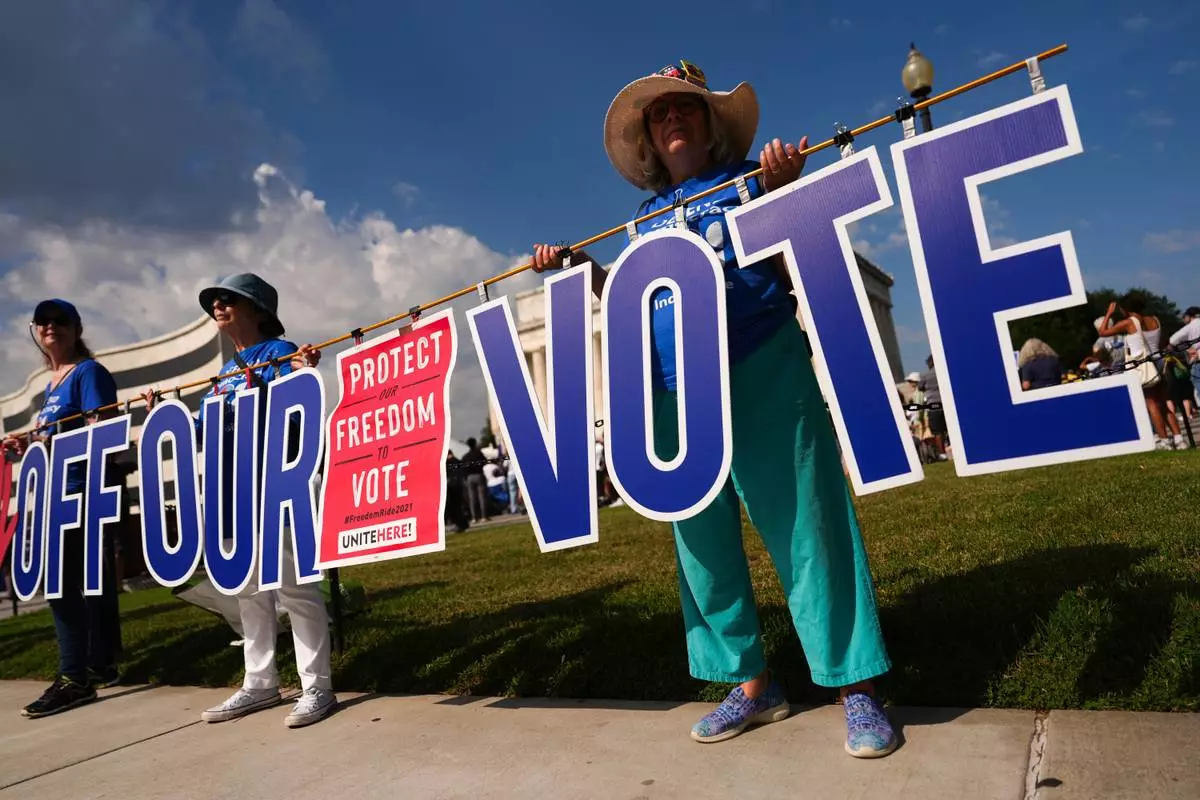
Demonstrators holds a sign during the March on Washington, Friday, Aug. 28, 2026, near the Lincoln Memorial in Washington. (AP Photo/Julia Demaree Nikhinson)

Democratic congressional candidate Chris Backemeyer poses in front of a campaign banner after an event in Murdock, Nebraska, on Sunday, Aug. 16, 2026. (AP Photo/Will Weissert)
KIRYAT SHMONA, Israel (AP) — Kiryat Shmona has long been a bastion of support for Prime Minister Benjamin Netanyahu’s Likud party. But that loyalty is no longer ironclad.
Once a bustling commercial center, Israel's northernmost city was temporarily evacuated three years ago after being battered by rockets from nearby Lebanon, and it still feels half-empty even though the attacks have mostly subsided. Although the town remains staunchly conservative, there are rumblings of displeasure with Netanyahu’s handling of the latest war against the militant group Hezbollah, and that could bode poorly for him in Israel's election Tuesday.
Vowing to stop Hezbollah's attacks, Netanyahu led a bombing campaign in Lebanon and invaded the country twice since 2023. More than 4,000 Lebanese have been killed, and Israeli troops have occupied a swath of southern Lebanon, leveling multiple towns and displacing an estimated 1 million people.
Still, Hezbollah remains active. Some in Kiryat Shmona say Israel should have been even tougher; others say they no longer trust that Netanyahu cares about them.
Eti Ben Shabat, 64, says in previous elections she had always followed her family in voting for Likud, almost without thinking. But in recent years, she said, something snapped. She pointed in part to Netanyahu’s broken promises to bring security to the north and dismantle Hezbollah.
“I don’t want the lies to continue,” she said.
Netanyahu is unlikely to lose Kiryat Shmona entirely. But even a small dip in its support — and that of other traditional strongholds — could spell trouble for him.
It could tip a very tight election to the man aiming to replace him, Gadi Eisenkot. Or it could strengthen far-right parties, which would likely back Netanyahu to remain prime minister but would then have even greater power in a ruling coalition.
Kiryat Shmona has always supported right-wing parties, particularly Likud. In the last elections held in 2021 and 2022, around 50% of voters there chose Likud, compared to a quarter of voters nationwide, according to the Central Elections Committee.
“Kiryat Shmona, the way the city is socioeconomically and religion-wise, it is made for the right and specifically Likud,” said Sami Malul, 72, a retired Likud city councilor who served as the town’s acting mayor in 2008.
But the town is reeling from the war. The government evacuated Kiryat Shmona and dozens of other towns and villages along the Lebanese border for more than a year – from the time Hezbollah began firing on Israel after Hamas’ Oct. 7, 2023, attack on southern Israel until a ceasefire with Hezbollah was reached in late 2024.
Netanyahu claimed to have subdued Hezbollah. So trust in him shattered among some in Kiryat Shmona when Hezbollah missiles again started hitting in March after Israel and the U.S. launched their war on Iran.
Israel’s subsequent occupation of southern Lebanon has reduced but not stopped Hezbollah fire. Efforts by the Lebanese army to remove Hezbollah from southern Lebanon have made little progress.
Kiryat Shmona claims that nearly 80% of its 22,000 residents have returned, but locals say the real figure is closer to 50%. Streets feel empty and abandoned. On the main commercial drags, several shops remain shuttered. Others are open but devoid of customers.
Malul insists the government handled the war and the evacuation well, prioritizing residents’ safety. He argued Kiryat Shmona has faced attacks since its founding and Netanyahu isn't to blame for the current situation.
Many others feel the same.
“We really love Bibi, and we can’t choose anyone else, but he should see the needs of his people,” said Maimon Amsalem, using Netanyahu’s nickname. “Keeping our security is the most important thing, we don’t want anything else.”
Nissan Zeevi, a third-generation resident of northern Israel who lives in a town adjacent to Kiryat Shmona, has voted for Likud as long as he can remember. But this year he is running for a seat in parliament with the Beyachad opposition party, furious over what he calls Netanyahu’s “abandonment of the north.”
During the most recent war with Hezbollah, Zeevi founded Lobby 1701, an activist group advocating for better security in the north. He wants the Israeli military to increase its attacks against Hezbollah and maintain its buffer zone in southern Lebanon until the Lebanese government identifies Hezbollah as a terror organization.
“Residents in the north have been in a war for three years that hasn’t ended,” said Zeevi. “You can see the people’s great frustration and great disappointment in Netanyahu.”
“Netanyahu still has his base here, who will go with him through fire and water. But people have much more political awareness now,” said Zeevi. “After 20 years, he needs to make way for new leadership.”
Around town, there’s little evidence that elections are just days away, and little outward excitement for Likud or Netanyahu. A few scattered campaign posters for the smaller right-wing parties flutter at intersections or are glued onto mobile bomb shelters. Few residents wanted to speak about politics, citing a general feeling of hopelessness and frustration.
No candidates have offered a concrete plan for the conflict with Hezbollah, beyond offering vague promises of “strong defense.”
In northern Israel as a whole, support for Netanyahu dropped from around 29% just before the last election in 2022 to around 17% in a poll conducted earlier this month for Agam Labs at Hebrew University.
Nimrod Nir, the director of Agam Labs, said most Likud voters frustrated with Netanyahu will likely support hardline parties like Otzma Yehudit (Jewish Power) and the Religious Zionist Party, which advocate tough military action against Israel's enemies.
Waiting outside a downtown hairdresser in Kiryat Shmona, Ben Shabat talked about her decision to support Eisenkot, a former military chief who ordered disproportionate force in response to Hezbollah attacks when he was a general during a 2006 war.
Ben Shabat said she trusts Eisenkot as a more honest leader than Netanyahu, who she feels made little effort to connect with residents in the north and sent soldiers to fight while his own son was in a luxury apartment in Miami. She also pointed to his ongoing corruption trial.
Netanyahu made a brief campaign stop in the town on Tuesday. He visited a high school and university, events that were closed to the public, but did not walk around downtown to mingle with residents, as other candidates have done.
Her decision to vote for Eisenkot wasn't easy in a place where Likud support is a matter of identity more than ideology. The town is overwhelmingly made up of Mizrahi Jews, who arrived from Arabic-speaking countries in the Middle East and North Africa in the 1950s.
Mizrahi Jews often identify with the right and especially Likud, having faced discrimination by the European-descended elites that traditionally dominate Israeli government, military and business institutions.
“Kiryat Shmona is like a small family, we’re always helping each other, it’s one of the things I love about it,” Ben Shabat said. But that close-knit support also comes with social pressure to vote a certain way.
At a recent meetup for Eisenkot supporters, the room was packed, but people did not want photos taken of the audience, worrying what their family or neighbors would think, Ben Shabat said.
“It’s a small place, so people aren’t speaking about it openly,” she said. “But inside, people really want a change.”

People walk near a bomb shelter and elections campaign banners in Kiryat Shmona, Israel's largest northern city near Lebanon's border, ahead of the country's general, Tuesday, Oct. 13, 2026. (AP Photo/Ariel Schalit)
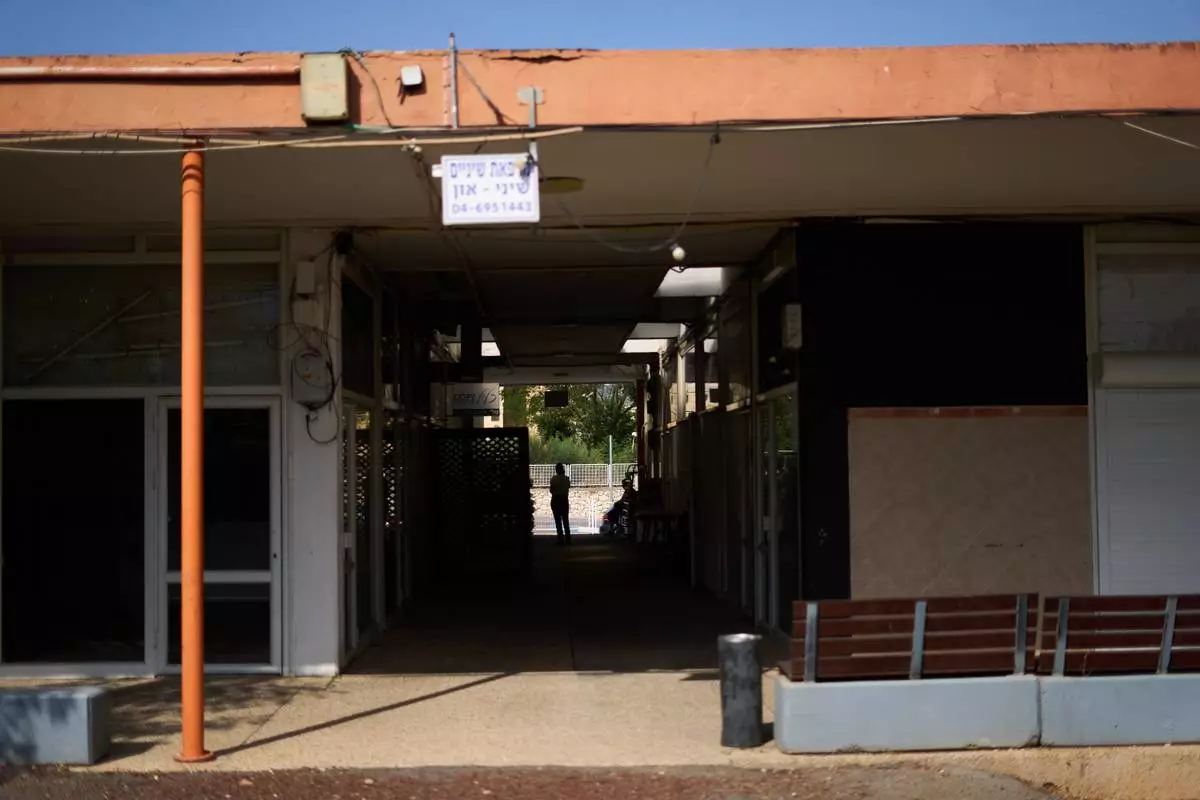
A woman talks on her phone beside shuttered shops in an alley in Kiryat Shmona, Israel's largest northern city, near Lebanon's border, ahead of the country's general election, Tuesday, Oct. 13, 2026. (AP Photo/Ariel Schalit)
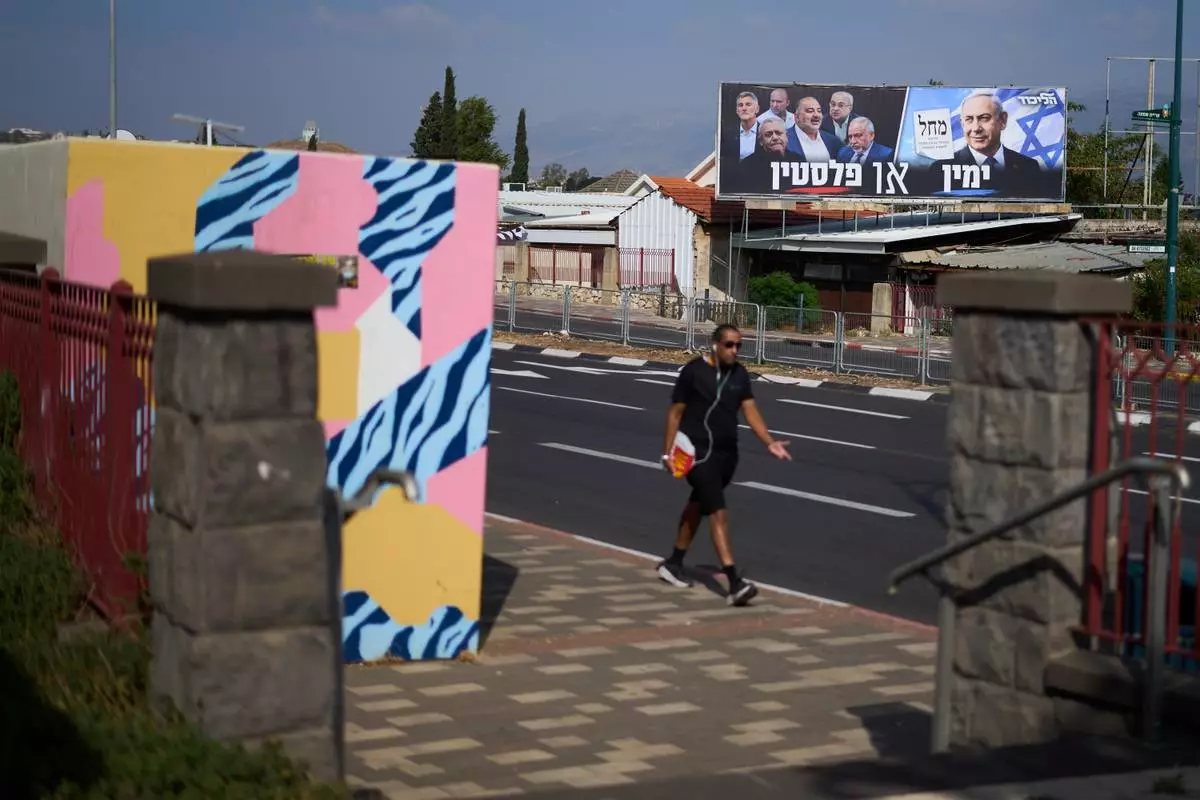
An election campaign billboard featuring Israeli Prime Minister Benjamin Netanyahu, leader of the Likud party, and other politicians hangs in Kiryat Shmona, Israel's largest northern city, near Lebanon's border, ahead of the country's general election, Tuesday, Oct. 13, 2026. The Hebrew writing reads, "Right or Palestine." (AP Photo/Ariel Schalit)
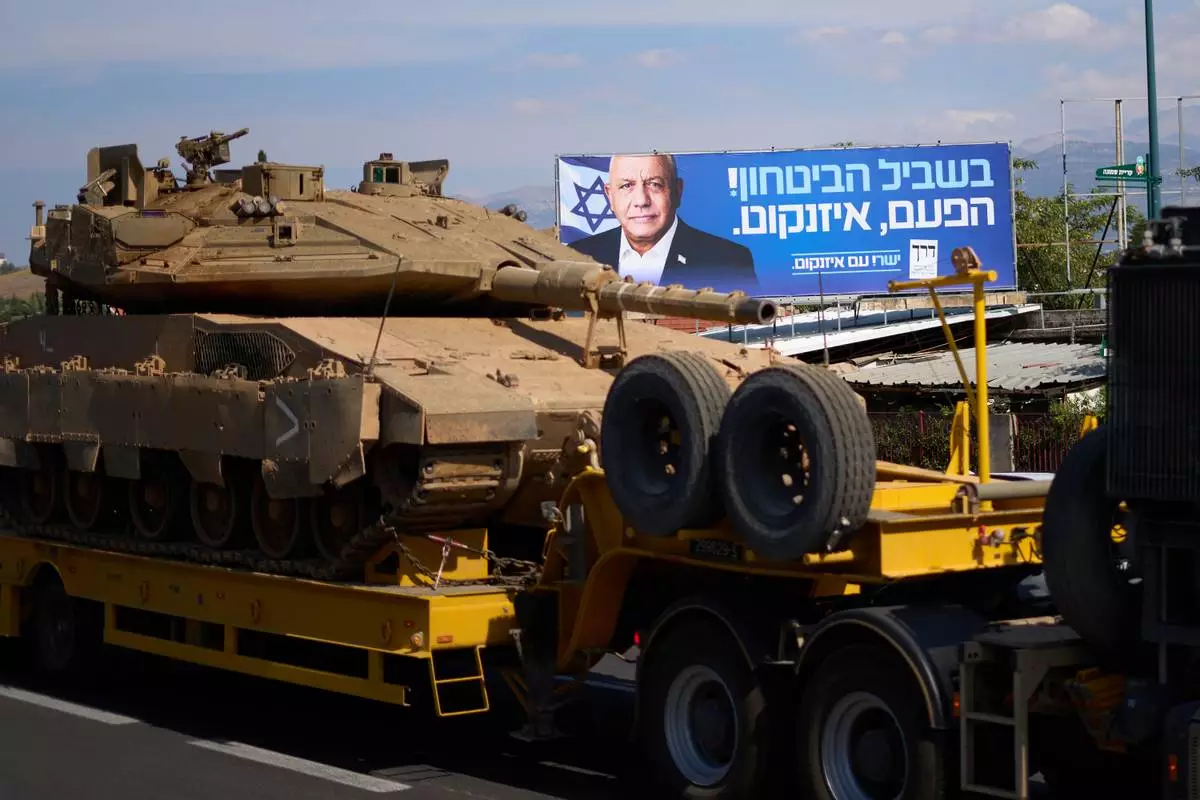
A tank mounted on a military truck passes an election campaign poster featuring Gadi Eisenkot, leader of the centrist Yashar ("Straight") party, ahead of Israel's general election in Kiryat Shmona, near the border with Lebanon in northern Israel, Tuesday, Oct. 20, 2026. (AP Photo/Ariel Schalit)
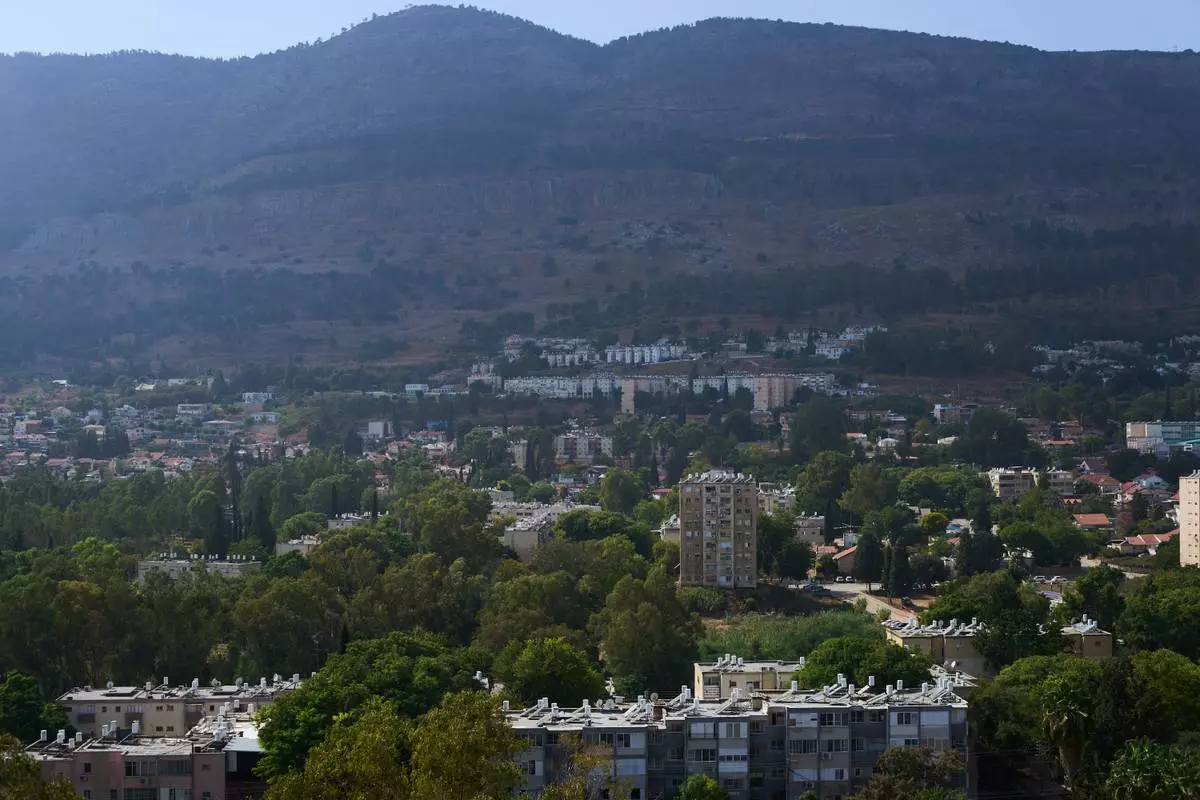
A view of Kiryat Shmona, Israel's largest northern city, is seen Tuesday, Oct. 13, 2026, with the border with Lebanon in the background. (AP Photo/Ariel Schalit)