NEW YORK (AP) — Federal regulators are opening an investigation into whether Tesla's new steering-wheel-free taxis comply with safety rules a day after the company began offering rides in the vehicles.
The National Highway Traffic Safety Administration said it was looking into whether Tesla was in full compliance with federal rules in deploying so-called Cybercabs in Austin, Texas, given that the two-seater cars lack steering wheels, mirrors or brake pedals typically required of all vehicles.
The head of the company, Elon Musk, kicked off his Cybercab service in Austin on Thursday with fanfare, sending dozens of the futuristic taxis into the city streets and holding a launch event for invitees.
Tesla stock was down more than 5% to $357.38 in early trading Friday on news of the probe, reversing many of the gains a day earlier.
Tesla did not respond immediately to a request for comment.
Before the launch, Tesla had said it had relied on a self-certification procedure to make sure the Cybercabs were in compliance, but the agency apparently is unsure if the taxis do indeed meet standards. In its filing, the agency said it will now conduct an audit to “examine the process and technical data” that Tesla used in the certification.
The Austin service Thursday kicked off what Musk says will be a national rollout of a cheap, driverless taxi service that he promises to transform the way people travel.
Musk plans to integrate Cybercabs, which lack manual controls so passengers could take over in an emergency, into the company's existing cab service that up to now uses just normal Tesla vehicle. That robotaxi network has been operating in Austin for more than a year, but has also begun offering rides in five other Texas and Florida cities.
The company is facing several federal investigation into the safety of its self-driving software.
One probe is examining the software’s role in several Tesla crashes in fog, sun glare and other low-visibility conditions, including one in which a pedestrian was killed. Another is investigating dozens of incidents in which Teslas using partial self-driving software ran red lights or drove on the wrong side of the road, sometimes crashing into other vehicles and causing injuries. A third is examining why Tesla apparently violated regulatory requirements by failing to report crashes promptly.

A Tesla Cybercab is displayed in downtown Austin, Texas, Thursday, Sept. 3, 2026. (AP Photo/Eric Gay)

A Tesla Cybercab moves through downtown Austin, Texas, Thursday, Sept. 3, 2026. (AP Photo/Eric Gay)
Denmark and four other European Union countries agreed Friday on a model for “return hubs” in non-EU nations and hope to begin sending migrants to the facilities as early as 2027, an official said Friday.
The announcement, made after a one-day meeting in Copenhagen, is the latest development in an effort by EU states to send people whose asylum requests have been rejected to third countries outside the bloc.
“We are moving forward toward what is actually a fundamental transformation of the common European migration and asylum system," said Morten Bødskov, Denmark's minister of immigration and integration.
He briefed reporters alongside counterparts from Germany, the Netherlands, Austria and Greece. The five countries have been negotiating with governments mainly in Africa over potential sites, pioneering the initiative for the whole of the EU.
Human rights groups have criticized plans to deport migrants to centers or prisons in third countries, arguing that European nations cannot guarantee their rights will be respected there.
Bødskov rejected the idea that “return hubs” were a euphemism for detention and deportation centers and said the International Organization for Migration and the UN Refugee agency would monitor the centers.
“We are not talking about camps, we are talking about opportunities, for a new chance for irregular migrants who cannot return to their own country today and who have no legal grounds to be in our countries," Bødskov said.
The UNHCR told The Associated Press that it “has not been approached with details of such a proposal,” and therefore “cannot comment on the specific arrangements being discussed or on what any potential role for UNHCR might entail.”
Although the ministers did not specify which third countries were being considered, Bødskov said they expect to reach their first deal by early 2027.
He acknowledged that the concept of “return hubs” was mocked only a few years ago and deemed incompatible with EU and international law.
EU laws, however, have changed due to public and political pressure for tougher measures against irregular migration.
European lawmakers voted in June to allow member states to set up centers outside the EU on their own or in small coalitions, and send rejected asylum seekers there instead of to their home countries.
“This is something new and it’s groundbreaking," said Bart van den Brink, the Netherlands' minister of asylum and migration.
In early August, a spokesperson for the Rwandan government said it "was natural” for her government to negotiate with European countries and others to potentially host asylum seekers who are not allowed to live elsewhere.
Speaking to Royal FM Kigali, Rwandan government spokesperson Yolande Makolo cited an emergency transit mechanism established in Gashora in 2018 for people evacuated from Libya, who could stay there until they were resettled in third countries.
Makolo said one of the ideas discussed was to offer a “safe place” where people who have nowhere else to go could get medical care, training and rest while their asylum applications were processed, until they could go back home if safe or get resettled to yet another country.
“We want to be part of a solution to a big global problem," Makolo said.
It remained unclear what countries in negotiations with EU nations would gain in return for taking Europe's rejected migrants.
Migrant rights groups have criticized European efforts to set up migrant centers abroad where it may be difficult to monitor and enforce human rights.
In an emailed statement, Council of Europe Commissioner for Human Rights, Michael O’Flaherty, said “vague assurances of compliance with human rights law are not enough."
“States need to commit to the guardrails necessary to prevent setting up human rights black holes,” he said.
The European ministers in Copenhagen emphasized the new hubs would abide by European and international law.
Van den Brink, the Dutch immigration minister, said technical talks and missions to potential partner countries would be used “to gain more insight into the human rights situation and the living conditions of the refugees." “Because we want to do this in a European way, in line with our values and international law and human rights at its core.”
Brussels-based rights group PICUM condemned the meeting in Copenhagen.
Ciobanu reported from Warsaw, Poland, and Brito reported from Barcelona, Spain. Philipp Jenne in Vienna and Sam McNeil in Brussels contributed to this report.
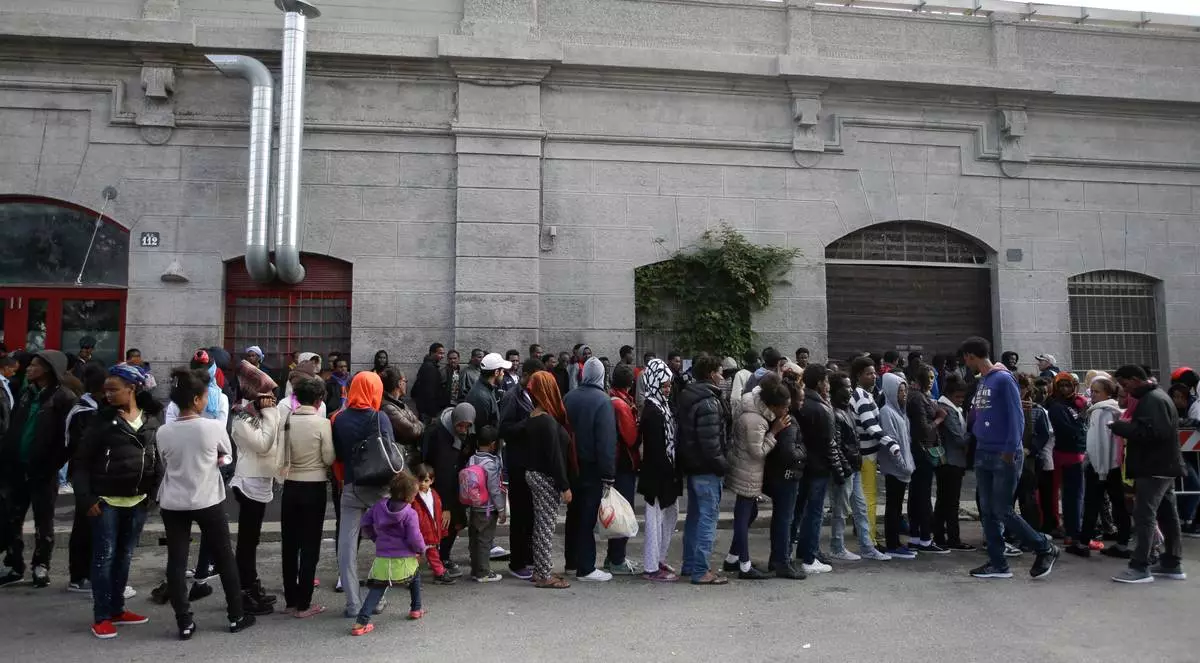
FILE - Migrants queue to enter a refectory in Milan, Italy, on Oct. 21, 2016. (AP Photo/Luca Bruno, File)