Skip to Content Facebook Feature Image

Robotics, AI take center stage as IFA 2026 opens in Berlin

HotTV

HotTV

HotTV

Robotics, AI take center stage as IFA 2026 opens in Berlin

2026-09-05 15:23 Last Updated At:09-06 14:44

IFA Berlin 2026, one of the world's largest trade fairs for consumer electronics and home appliances, opened Friday, with robotics and artificial intelligence (AI) taking center stage.

According to the organizers, this year's event has attracted more than 1,900 brands from around the world. Visitors can explore a wide range of cutting-edge technologies and innovations during the five-day event, from robots and AI to smart homes and flying cars.

Inside the exhibition halls, AI is increasingly moving beyond screens into real-life applications. Smaller and more energy-efficient AI models are rapidly integrated into smart phones, vehicles, home appliances and other everyday consumer products.

Leif Lindner, CEO of IFA Berlin, said companies now need to show clearly what AI can actually bring to users.

"I believe there is an increasing need for companies to explain what AI can actually bring to consumers. That means AI itself isn't what should be front and center, rather, you explain the product and what the innovation is. An innovation isn't defined primarily by highlighting certain features. Instead, the product has to be intuitive and easy to use," said Lindner.

At this year's IFA, Chinese companies have continued their strong presence, with brands, including TCL, Hisense, Haier, DJI and Xiaomi, showcasing new products and technologies that are drawing significant attention from media and visitors.

At Chinese home appliance giant Haier's exhibition booth, a smart refrigerator is demonstrating an entire process including food identification, inventory management and reminders, while laundry and garment-care devices use computer vision and algorithms to assess clothing conditions and automatically select appropriate programs.

"I think everybody in this fair will talk about artificial intelligence, AI. It's a theme which is massively important. We're also starting to talk more about robotics, so the physical and the intelligence coming together. It's about sensing, it's about cameras, it's about intelligence, it's about technologies," said Neil Tunstall, CEO of Haier Europe.

With the show now underway, more AI-, robotics- and smart-device-focused launches of products are expected over the coming days to highlight how AI is reshaping the next generation of consumer electronics.

Robotics, AI take center stage as IFA 2026 opens in Berlin

Robotics, AI take center stage as IFA 2026 opens in Berlin

New Zealand's ruling National-led coalition has secured a parliamentary majority in the general election, preliminary results showed early Sunday, putting Prime Minister Christopher Luxon on course to retain power for a second term.

The Election Commission's tally of all voting places has resulted in 11 "overhang" seats, increasing to 131 the total number of seats in parliament, which normally has 120.

Among the seats, the National Party, ACT New Zealand and New Zealand First collectively secured 67, giving the three-party coalition a narrow majority to continue governing, while the opposition bloc of the Labor Party, the Green Party and the Maori Party garnered 57 in total.

The contest between the National and the Labor, led by former prime minister Chris Hipkins, remained exceptionally close, with each securing over 29 percent, according to preliminary figures.

Addressing supporters in Auckland, Luxon said the election was "too close to call," with the final outcome hinging on special votes to be counted. He acknowledged that negotiations and compromise would be needed to form the next government.

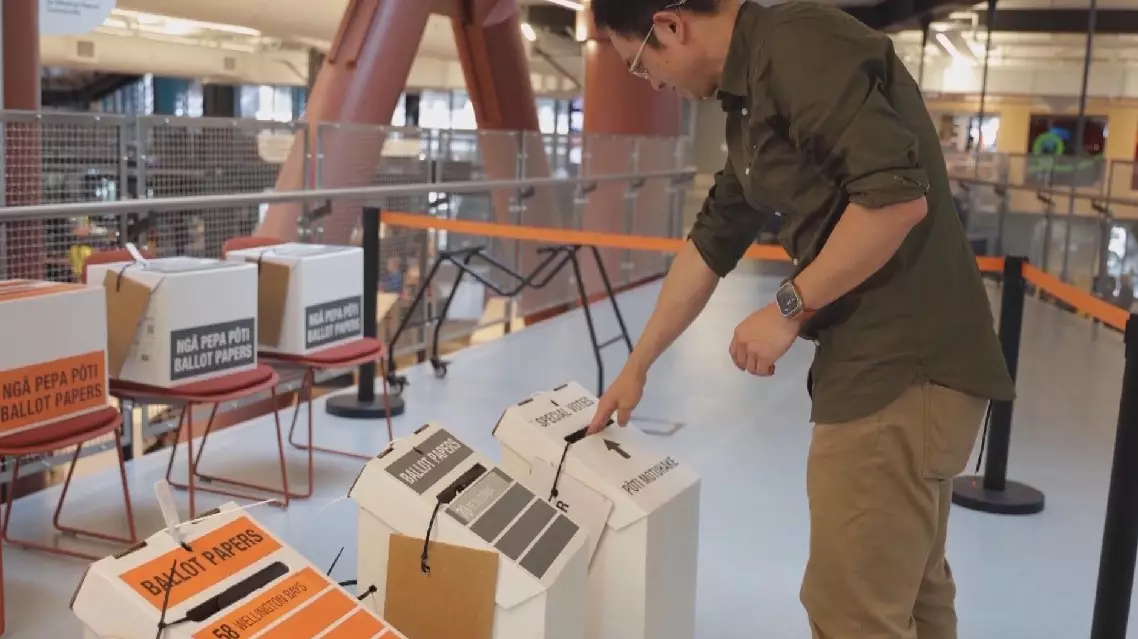
The outcome could still change when 700,000 special votes are counted days later. These include ballots cast by overseas voters and people voting outside their electorates, and are not included in the preliminary results, according to the Electoral Commission, which is scheduled to release the final official results, including special votes, on Nov. 27.

The Green Party has won a record 16 seats in parliament. The centrist Opportunity Party has also made a parliamentary breakthrough, projected to win seven seats, preliminary results showed.

The country has nearly 3.8 million provisionally enrolled voters for the 2026 general election, representing 93.6 percent of the estimated eligible population, below the final enrolment rates of 94.7 percent in 2023 and 94.1 percent in 2020, the commission said.

New Zealand uses the mixed-member proportional voting system to elect its parliament. Under this system, voters cast two ballots, one for a political party and another for their local electorate candidate. The government is usually formed by two or more parliamentary political parties.

New Zealand's National-led coalition wins majority parliamentary seats: preliminary results

New Zealand's National-led coalition wins majority parliamentary seats: preliminary results

Recommended Articles