Skip to Content Facebook Feature Image

Chinese vice premier meets Putin on relations, co-chairs bilateral events

China

Chinese vice premier meets Putin on relations, co-chairs bilateral events
China

China

Chinese vice premier meets Putin on relations, co-chairs bilateral events

2026-09-05 21:20 Last Updated At:22:37

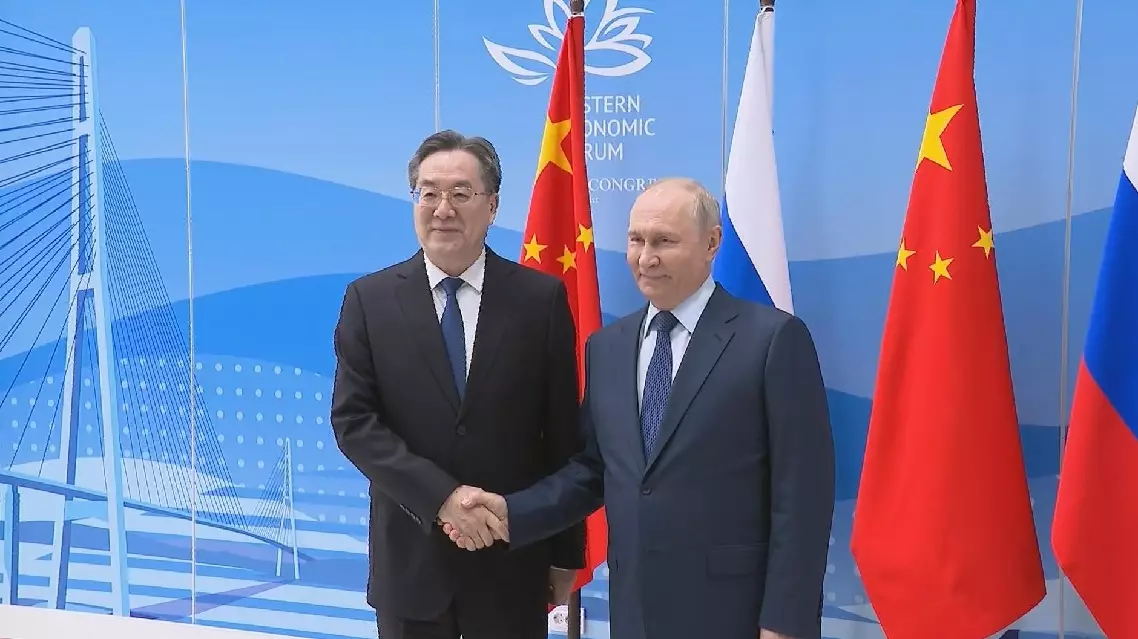
Visiting Chinese Vice Premier Ding Xuexiang met with Russian President Vladimir Putin, and co-chaired with Russian leaders a series of China-Russia bilateral meetings in Russia's far eastern city of Vladivostok from Wednesday to Friday.

Ding, also a member of the Standing Committee of the Political Bureau of the Communist Party of China Central Committee, co-chaired the 13th meeting of the China-Russia Investment Cooperation Committee with Russian First Deputy Prime Minister Denis Manturov, and the 23rd meeting of the China-Russia Energy Cooperation Committee with Russian Deputy Prime Minister Alexander Novak. He also attended the opening ceremony of the 8th China-Russia Energy Business Forum.

During his meeting with Putin, Ding conveyed Chinese President Xi Jinping's cordial greetings to the Russian president.

Ding said China is ready to work with Russia to implement the important consensus reached by the two heads of state, deepen the integration of interests of the two countries with concrete measures, and continuously consolidate the foundation for higher-quality development of China-Russia relations.

Putin asked Ding to convey his sincere greetings to Xi.

Noting that Russia-China relations have reached an unprecedented level, with positive progress made in cooperation across various fields, Putin said Russia stands ready to strengthen strategic coordination and cooperation with China to bring bilateral relations to an even higher level.

When co-chairing bilateral meetings on investment and energy, Ding urged efforts from both sides to step up and expand practical cooperation in the relevant fields for mutually beneficial and win-win results.

Ding said it is essential to strengthen planning and policy guidance, facilitate the implementation and effective operation of key projects, and broaden and deepen cooperation.

He also called for efforts from both sides to continue consolidating the achievements of existing energy cooperation, explore new areas and new directions for energy cooperation and jointly promote reform of the global energy governance system.

The Russian side spoke highly of the level of bilateral ties and the achievements of bilateral cooperation. They expressed the readiness to work with China to implement the important consensus reached by the two heads of state, strengthen strategic alignment and project collaboration, and deliver benefits to the two countries and the two peoples through high-quality cooperation.

At the opening ceremony of the 8th China-Russia Energy Business Forum, Ding read out Xi's congratulatory message to the forum and delivered a speech.

He said that in the energy cooperation between China and Russia, guidance by the heads of state is its greatest advantage, mutual benefit and win-win results serve as the fundamental impetus, and meeting challenges together is a prominent feature.

Ding urged efforts from both sides to have a deep understanding and carry forward these valuable experiences, and work together to promote steady and long-term development of China-Russia energy cooperation.

Igor Sechin, executive secretary of the Russian presidential commission for strategic development of fuel and the energy sector and environmental security, and chief of Russian oil company Rosneft, read out Putin's congratulatory message to the forum.
Chinese vice premier meets Putin on relations, co-chairs bilateral events
Chinese vice premier meets Putin on relations, co-chairs bilateral events
As the world grapples with multiplying crises and a dangerous decline in international trust, a senior Uzbek lawmaker has called for greater unity and multilateral cooperation to tackle shared crises.

Sodiq Safoyev, first deputy chairman of the Senate of the Oliy Majlis (national parliament) of Uzbekistan, said the world is navigating a complex era of "polycrisis" marked by wars, pandemics, and growing division, and that the response should not be to create new dividing lines, but to unite people and act collectively.

"Today we're living in a difficult time worldwide. Even some academicians defined the contemporary world as in a time of polycrisis or simultaneous occurrence of several catastrophic events, indeed, wars, pandemia, fragmentation of the world. And I think that it's a time not to create new division lines, but to unite the people and act together, vis-a-vis global challenges. I think that such an idea, proposed by his Excellency, Chairman [President] Xi Jinping, is very important, because it brings very clear idea that today we need to build cooperation and to think about the next generation's destiny, to save the earth from the challenges which we have," said Safoyev.

Safoyev also pushed back against the notion that deglobalization has taken hold, saying that international trade, information flows, and migration remain unstoppable. However, he warned that rising interconnectedness has been accompanied by a dangerous decline in mutual trust and understanding.

"Some people think that the process of deglobalization has started. I don't think so. I don't think that it's possible to stop international trade, flow of information, migration of people who want to study abroad, who want to work abroad. Globalization is not stopping and that's why interconnectedness of the nations only increases. But at the same time, simultaneously, we're absorbing diminishing of trust and understanding. It's a very dangerous combination. We connected, but we don't understand each other," said Safoyev.

Acknowledging that international organizations fail to meet public expectation in resolving conflicts, Safoyev said that regional mechanisms such as the Shanghai Cooperation Organisation (SCO) and cooperation between China and Central Asian countries offer models for effective cooperation.

"And I think that international organizations today are not matching expectations of the people in the regard with preventing conflicts, preventing the problems and resolving them. And it's the most challenging issues of the contemporary world. And I think that's why the experience of Shanghai organizations [the Shanghai Cooperation Organization] and cooperation between China and Central Asian countries is very important to demonstrate that it's possible," said Safoyev.

He also said that Central Asia serves as a prime example of overcoming fragmentation and uniting, as the region has transformed from one plagued by border disputes, suspicion, and resource conflicts a decade ago into a cohesive, cooperating bloc.

"From the more positive side, I'd like to note that the situation in Central Asia is something which might give us some more optimism. Twenty years ago, even 10 years ago, Central Asia was divided, divided by suspicion, divided by unresolved issues like unresolved borders, many conflicts of interest in the regard with the using the water resources of the transnational water resources etc. Today, in a relatively short time, period of time, Central Asia became completely different, more and more consolidating, uniting, having joint approach to the regional problems. And that's why Central Asia started to lure more attention worldwide. We're seeing that [there are] more interests of the global actors with the Central Asia, and I think that it demonstrates to the whole world that it's possible today now to overcome fragmentation and to unite. And that's why we, as usual, have both some concerns. But at the same time, we must be optimists in looking ahead," said Safoyev.

He also said that wisdom of humanity and visionary leadership inspire optimism that building future of common shared destiny is possible.

Senior Uzbek lawmaker calls for regional unity, cooperation amid global "polycrisis"

Senior Uzbek lawmaker calls for regional unity, cooperation amid global "polycrisis"

Recommended Articles