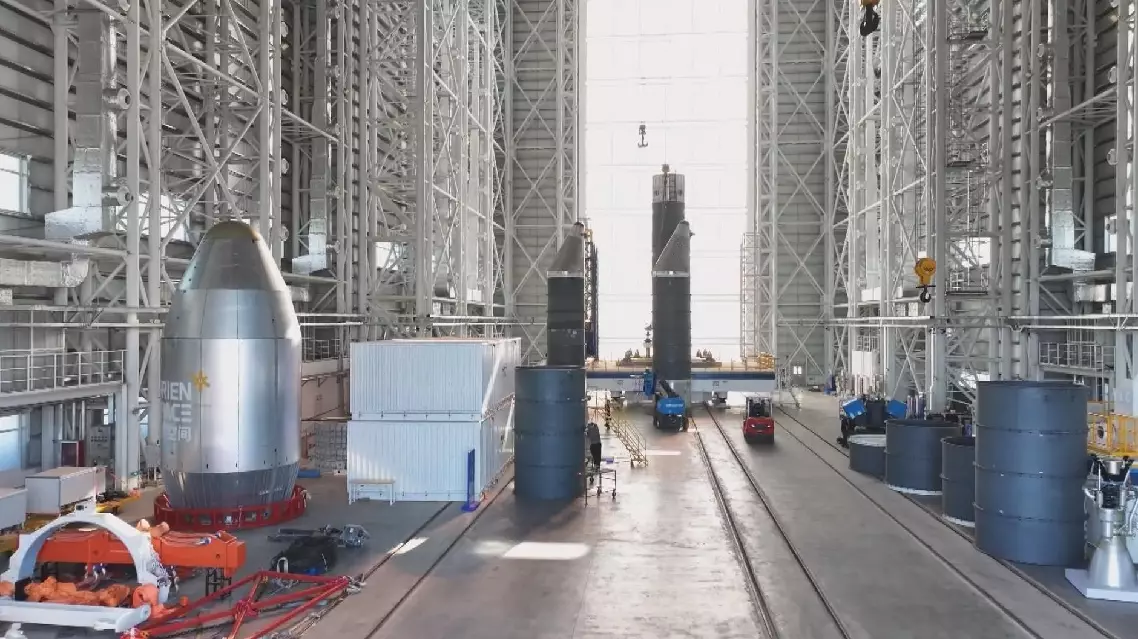
China's fast-growing commercial space sector is fueling a nationwide competition for talent, with companies racing to hire engineers in core fields.
With a rapidly growing number of commercial rockets launched, demand for experts in liquid-propellant rockets and reusable rocket development is growing explosively, according to industry recruitment data and company officials.
"In the first half of this year, more than 100 employees have already joined the company. The onboarding rate has doubled compared with that in the same period last year. The professional backgrounds of the recruited talents are mainly concentrated in aviation, structural manufacturing, and other aerospace-related mechanics specialties. At present, liquid-propellant reusable rocket talent is relatively scarce across the entire industry," said Feng Chunyang, human resources manager at Dongfang Space Technology, a Beijing-based commercial space firm.
In east China's Jiangsu province, local aerospace companies also intensified recruitment efforts.
"Our company has also offered nearly 200 positions. The most prominent gap is in research and development talent for liquid-propellant reusable rockets, and the annual salary for some individual key talents can reach the million-yuan (about 149,000 U.S. dollars) level," said Zhang Chengcong, deputy general manager of Deep Blue Aerospace.
The sector's expansion is creating new openings for graduates and researchers in related fields.
An engineer holding a Tsinghua University PhD in optical engineering who recently joined Chang Guang Satellite Technology in Changchun, Jilin Province shared his experience.
"First, because my major matches the position. More importantly, I think this is one of the industries that best combines my dreams and ambitions with down-to-earth contributions: satellites capture data in space, and at the same time these data can directly serve agriculture, environmental protection, and urban planning, truly landing to solve real problems," said Zhao Yun, the engineer.
According to recruitment platform Zhaopin.com, commercial aerospace job postings rose 21.2 percent year on year from January to July 2026, with average monthly salaries near 20,000 yuan (about 2,980 U.S. dollars). Jobs tied to liquid-propellant reusable rockets jumped 75.6 percent over the same period.
China's commercial space sector intensifies race for engineering talent

As the world grapples with multiplying crises and a dangerous decline in international trust, a senior Uzbek lawmaker has called for greater unity and multilateral cooperation to tackle shared crises.
Sodiq Safoyev, first deputy chairman of the Senate of the Oliy Majlis (national parliament) of Uzbekistan, said the world is navigating a complex era of "polycrisis" marked by wars, pandemics, and growing division, and that the response should not be to create new dividing lines, but to unite people and act collectively.
"Today we're living in a difficult time worldwide. Even some academicians defined the contemporary world as in a time of polycrisis or simultaneous occurrence of several catastrophic events, indeed, wars, pandemia, fragmentation of the world. And I think that it's a time not to create new division lines, but to unite the people and act together, vis-a-vis global challenges. I think that such an idea, proposed by his Excellency, Chairman [President] Xi Jinping, is very important, because it brings very clear idea that today we need to build cooperation and to think about the next generation's destiny, to save the earth from the challenges which we have," said Safoyev.
Safoyev also pushed back against the notion that deglobalization has taken hold, saying that international trade, information flows, and migration remain unstoppable. However, he warned that rising interconnectedness has been accompanied by a dangerous decline in mutual trust and understanding.
"Some people think that the process of deglobalization has started. I don't think so. I don't think that it's possible to stop international trade, flow of information, migration of people who want to study abroad, who want to work abroad. Globalization is not stopping and that's why interconnectedness of the nations only increases. But at the same time, simultaneously, we're absorbing diminishing of trust and understanding. It's a very dangerous combination. We connected, but we don't understand each other," said Safoyev.
Acknowledging that international organizations fail to meet public expectation in resolving conflicts, Safoyev said that regional mechanisms such as the Shanghai Cooperation Organisation (SCO) and cooperation between China and Central Asian countries offer models for effective cooperation.
"And I think that international organizations today are not matching expectations of the people in the regard with preventing conflicts, preventing the problems and resolving them. And it's the most challenging issues of the contemporary world. And I think that's why the experience of Shanghai organizations [the Shanghai Cooperation Organization] and cooperation between China and Central Asian countries is very important to demonstrate that it's possible," said Safoyev.
He also said that Central Asia serves as a prime example of overcoming fragmentation and uniting, as the region has transformed from one plagued by border disputes, suspicion, and resource conflicts a decade ago into a cohesive, cooperating bloc.
"From the more positive side, I'd like to note that the situation in Central Asia is something which might give us some more optimism. Twenty years ago, even 10 years ago, Central Asia was divided, divided by suspicion, divided by unresolved issues like unresolved borders, many conflicts of interest in the regard with the using the water resources of the transnational water resources etc. Today, in a relatively short time, period of time, Central Asia became completely different, more and more consolidating, uniting, having joint approach to the regional problems. And that's why Central Asia started to lure more attention worldwide. We're seeing that [there are] more interests of the global actors with the Central Asia, and I think that it demonstrates to the whole world that it's possible today now to overcome fragmentation and to unite. And that's why we, as usual, have both some concerns. But at the same time, we must be optimists in looking ahead," said Safoyev.
He also said that wisdom of humanity and visionary leadership inspire optimism that building future of common shared destiny is possible.
Senior Uzbek lawmaker calls for regional unity, cooperation amid global "polycrisis"