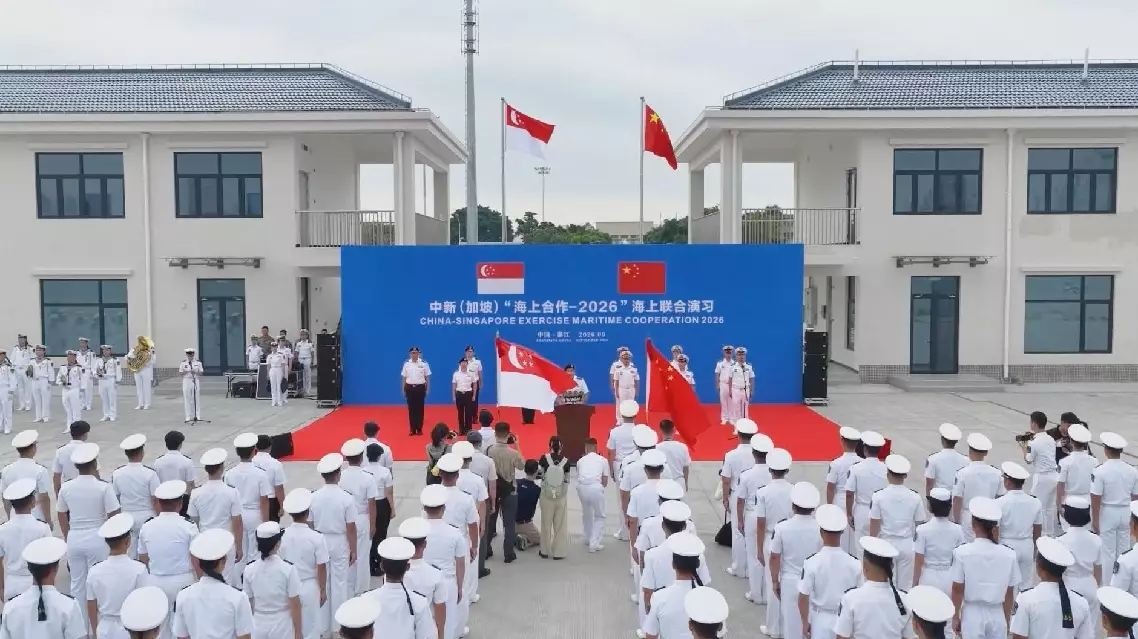
A joint maritime exercise between China and Singapore started Saturday in south China's Guangdong Province, marking the fifth such cooperation held by the two countries.
The opening ceremony was held at a naval port in Zhanjiang. Two warships participate in the exercise -- the Chinese guided-missile frigate Dali and Singapore's frigate RSS Steadfast.
The exercise aims to deepen mutual trust, strengthen practical cooperation, and enhance their ability to jointly safeguard regional peace and stability, according to China's Ministry of National Defense earlier this week.
According to the ministry, the exercise is conducted in two phases, covering in-port exchanges and at-sea drills. The two sides will exchange expertise on diving operations, submarine search and rescue, and underwater medicine, and conduct drills in communications, replenishment-at-sea, joint maritime strikes, and joint search and rescue.
China and Singapore held their first bilateral maritime exercise in 2015. Such joint exercises have become a regular part of military exchanges between the two countries in recent years. In May 2025, the Chinese Navy dispatched a guided-missile frigate and a mine countermeasure vessel to Singapore for a joint exercise.
In addition to regular joint maritime exercises with Singapore, China also carries out routine joint drills and training with neighboring countries including Thailand and Cambodia.
China, Singapore launch joint maritime exercise
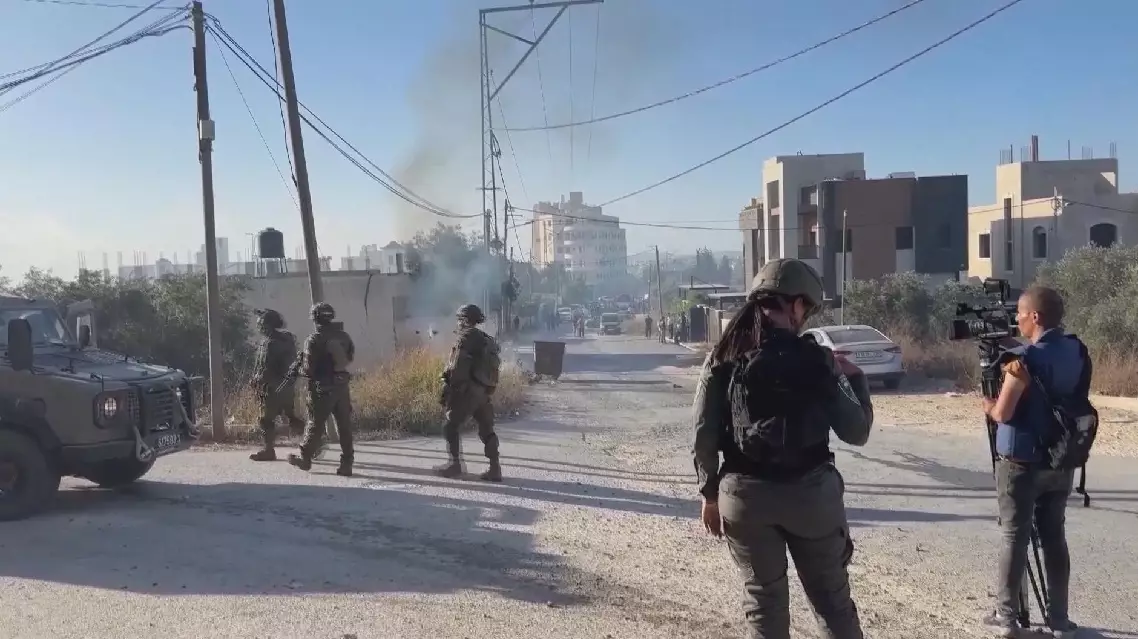
Israeli military operations have affected hundreds of Palestinian families, with more than 2,000 civilians directly impacted in Hebron region in the West Bank, the official Palestinian News and Information Agency (WAFA) reported Sunday.
WAFA said the Israeli military has continued its operations and maintained a blockade in the Hebron region since Friday, resulting in the forced demolition and destruction of numerous Palestinian civilian and commercial facilities, as well as significant property damage.
The report said that on Sunday, the Israel Defense Forces (IDF) forcibly demolished a residential building in western Hebron, used heavy machinery to destroy several commercial facilities and leveled thousands of square meters of surrounding agricultural land.
In addition, the IDF intensively installed various military roadblocks and closed iron gates, cutting off main roads and severely disrupting local supply chains and the movement of people, it said.
On the same day, Israeli Jewish settlers also leveled land belonging to Palestinian civilians in southern Hebron and set up tents in preparation for establishing an outpost for a Jewish settlement, according to WAFA.
It said the Hebron regional government announced on Sunday that several local cities would establish joint emergency operations centers operating 24 hours a day, mobilizing all available municipal resources to assist residents affected by the Israeli military operations. Local authorities are currently expediting the drafting of a legal document to be formally submitted to the International Criminal Court.
According to WAFA, incidents of the Israeli military destroying Palestinian civilian property and attacks by Israeli Jewish settlers also occurred in other parts of the West Bank.
The Israeli army used heavy machinery to level large swaths of land and forcibly uprooted dozens of olive trees in the midst of the harvest season in a Palestinian village west of Ramallah to build a road unilaterally planned by Israel leading to a nearby Jewish settlement, it said.
In a Palestinian village near Nablus, Israeli Jewish settlers attacked and detained several Palestinian farmers harvesting olives, forcibly transferring them to a nearby Jewish settlement, according to the news outlet.
Israeli military operations impact over 2,000 people in West Bank's Hebron