Three studies explore the relationship between tumor microenvironment, genomic alterations, and treatment response in non-small cell lung cancer using AI-based analysis
SEOUL, South Korea, Sept. 8, 2026 /PRNewswire/ -- Lunit (KRX:328130), a leading provider of AI for cancer diagnostics and precision oncology, today announced the presentation of three studies at the 2026 World Conference on Lung Cancer (WCLC 2026), to be held in Seoul, South Korea, from September 12 to 15.
Across the three studies, Lunit researchers and collaborators leveraged AI-based analysis to investigate the tumor microenvironment (TME) in non-small cell lung cancer (NSCLC), exploring its relationship with genomic characteristics and treatment response.
In the first study, researchers used Lunit SCOPE IO to analyze 494 hematoxylin and eosin (H&E)-stained whole-slide images from EGFR-mutant NSCLC cases, identifying distinct TME characteristics across mutation subtypes. Exon 19 deletion (Ex19del) tumors showed significantly lower intratumoral tumor-infiltrating lymphocyte (TIL) density, while L858R tumors showed relative enrichment of both TIL and macrophage infiltration, and exon 20 insertion (Ex20ins) tumors demonstrated higher endothelial cell density.
The findings suggest that differences in treatment outcomes across EGFR mutation subtypes may involve not only kinase kinetics but also subtype-specific characteristics of the TME.
In another study, conducted in collaboration with Paola Nisticò, M.D., of the Regina Elena National Cancer Institute in Rome, Italy researchers combined Lunit SCOPE IO with spatial transcriptomics and high-plex spatial proteomics to analyze 32 NSCLC patients treated with neoadjuvant chemo-immunotherapy. The study was conducted through the Lunit Research Program for SITC Members, which provides eligible Society for Immunotherapy of Cancer (SITC) members with research access to Lunit SCOPE IO for AI-powered tumor microenvironment analysis in cancer immunotherapy research. Tumors from patients who achieved pathological complete response (pCR) showed a highly inflamed and spatially organized microenvironment with prominent tertiary lymphoid structures (TLS), while non-pCR tumors were characterized by immune exclusion and activated fibroblast-rich stroma.
The findings highlight distinct spatial and immunological features associated with pathological response and support further investigation of spatially resolved biomarkers.
The third study evaluated an H&E-based AI model for predicting TP53 mutation status in lung adenocarcinoma. Validated in an independent cohort of 462 cases, the model achieved an area under the receiver operating characteristic curve (AUROC) of 0.759, with 82% sensitivity and 63% specificity. TME analysis further showed that TP53-mutant tumors were more frequently immune-inflamed, while TP53-wild-type tumors were characterized by immune exclusion and higher stromal fibroblast and endothelial cell densities.
The findings highlight the potential of H&E-based AI as a screening tool to enrich for patients with TP53 mutations who may be eligible for emerging clinical trials targeting specific TP53 variants.
"These studies demonstrate the expanding potential of AI-based analysis to generate deeper insights into lung cancer biology, from genomic characteristics and the tumor microenvironment to features associated with treatment response," said Brandon Suh, CEO of Lunit. "By broadening the range of insights that can be derived from routinely available pathology images, we aim to advance AI-powered biomarker discovery and patient stratification, ultimately contributing to more personalized treatment strategies for patients with cancer."
Lunit's presentations at WCLC 2026 include:
- [Poster #P3.156] AI-Powered Tumor Microenvironment Analysis Across EGFR-Mutation Subtypes in Non-Small Cell Lung Cancer, September 15, 9:30 AM KST, Exhibits and Posters, Hall C, 3F
- [Poster #P2.126] Spatial Multi-Omics and AI-Driven Digital Pathology to Identify Determinants of Pathological Response to Neoadjuvant Chemo-IO in NSCLC, September 14, 10:30 AM KST, Exhibits and Posters, Hall C, 3F
- [Poster #P2.134] Development of an H&E-Based Genotype Predictor and Tumor Microenvironment Analysis of TP53-Mutated Lung Adenocarcinoma, September 14, 10:30 AM KST, Exhibits and Posters, Hall C, 3F
###
About Lunit
Founded in 2013, Lunit (KRX: 328130) is a global leader on a mission to conquer cancer through AI. Our clinically validated solutions span medical imaging, breast health, and biomarker analysis—empowering earlier detection, smarter treatment decisions, and more precise outcomes across the cancer care continuum.
Lunit offers a comprehensive suite spanning from risk prediction and early detection to precision oncology. Our FDA-cleared Lunit INSIGHT Breast Suite and breast health solutions support cancer screening in thousands of medical institutions worldwide, while the Lunit SCOPE platform is used in research partnership with global pharma and laboratory leaders for biomarker research, and companion diagnostic development.
Trusted by over 10,000 sites in more than 65 countries, Lunit combines deep medical expertise with continuously evolving datasets to deliver measurable impact—for patients, clinicians, and researchers alike. Headquartered in Seoul with global offices, Lunit is driving the worldwide fight against cancer. Learn more at lunit.io.
** This press release is distributed by PR Newswire through automated distribution system, for which the client assumes full responsibility. **
Lunit Unveils New AI-Powered Tumor Microenvironment Insights in Lung Cancer at WCLC 2026
SINGAPORE, Sept. 9, 2026 /PRNewswire/ -- Social media work is increasingly mobile-first. From publishing short-form video to managing content across TikTok, Instagram, YouTube, and other platforms, many everyday workflows still depend on native mobile apps.
For agencies, brands, and content teams managing multiple clients, campaigns, or regional operations, that creates a practical challenge: as mobile workloads grow, so does the number of Android environments a team needs to manage.
Traditionally, adding more mobile capacity meant adding more physical devices. Cloud phone technology offers a different approach by turning Android environments into remotely accessible, software-managed infrastructure.
The Hidden Cost of Managing More Physical Phones
Physical smartphones work well when a team only needs a few devices. At a larger scale, however, the work around those devices can become a burden of its own.
Teams need to purchase and replace hardware, keep devices charged, manage operating system and app updates, maintain network settings, provide remote access, and keep track of which device belongs to which client or project.
Large collections of physical smartphones are sometimes loosely described as a "phone farm," but for legitimate social media teams, the more practical issue is often much simpler: every additional device adds another piece of hardware that needs to be stored, maintained, accessed, and organized.
The challenge is not the smartphone itself. It is the operational complexity that comes with managing physical hardware as mobile workloads grow.
Turning Android Devices Into Cloud-Managed Infrastructure
A cloud phone changes that model.
Instead of tying an Android environment to a physical phone sitting on a desk, a cloud phone runs remotely and can be accessed through a computer. Teams can create mobile environments when they need them, organize them by project, and manage them from a central workspace.
In this model, the Android environment becomes a software-managed resource rather than a piece of hardware that must always be physically available.
That distinction matters for distributed teams. A device no longer has to be passed from one employee to another or remain plugged in at a particular office. Team members can access the mobile environment remotely while keeping project resources organized in one place.
The shift is less about replacing smartphones entirely and more about giving businesses another way to manage mobile capacity.
How GeeLark Makes Cloud Phones Easier to Manage
GeeLark brings cloud phones into a centralized workspace designed for mobile-first social media operations.
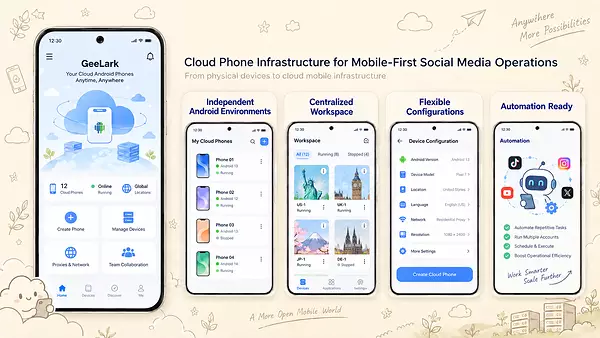
Each GeeLark cloud phone operates as a separate Android environment with its own storage, app data, login sessions, and network configuration. This allows teams to keep different projects and mobile workflows organized without relying on a growing collection of physical devices.
Teams can also configure cloud phone environments based on project requirements, including Android versions, device models, language, location, and network or proxy settings.
For an agency managing different brands or regional campaigns, for example, cloud phone profiles can be grouped and organized by client or project. Access can be managed across team members, while the environments themselves remain available remotely through the same workspace.
This centralized approach makes it easier to answer basic operational questions that become harder as a team grows: Which environment belongs to which project? Who needs access to it? What configuration does it use? And how can the team manage more mobile workflows without adding the same amount of physical hardware?
From Remote Access to Automated Mobile Workflows
Moving Android environments to the cloud reduces hardware-management work. The next efficiency gain comes from reducing repetitive actions inside those environments.
GeeLark combines cloud phones with automation tools for mobile workflows. Teams can use ready-made automation templates for common tasks, build custom in-app workflows with RPA, or use APIs to connect cloud phones and automation tasks with their own internal systems.
For content teams, this can mean preparing content in advance, assigning workflows to different cloud phone environments, scheduling repetitive publishing tasks, and reviewing execution results without manually operating every device one by one.
For teams with more specialized processes, RPA provides a way to turn repeated Android app actions into reusable workflows. Technical teams can go further by using APIs to connect cloud phone operations with existing content systems, scheduling tools, scripts, or internal dashboards.
The result is a more flexible approach to mobile operations: instead of scaling workloads by continually adding physical devices and manual steps, teams can manage Android environments and repeatable workflows through software.
For agencies, brands, and other teams whose social media work depends heavily on mobile apps, cloud phones provide a practical way to reduce device-management overhead while keeping mobile workflows accessible, organized, and easier to scale.
About GeeLark
GeeLark provides cloud phone and automation tools for teams managing mobile-first social media workflows. Its platform combines cloud-based Android environments, team management, automation templates, RPA, and API capabilities in a single workspace.
Learn more about GeeLark and its cloud phone platform at GeeLark.com.
** This press release is distributed by PR Newswire through automated distribution system, for which the client assumes full responsibility. **
GeeLark Advances Cloud Phone Infrastructure for Scalable Social Media Operations