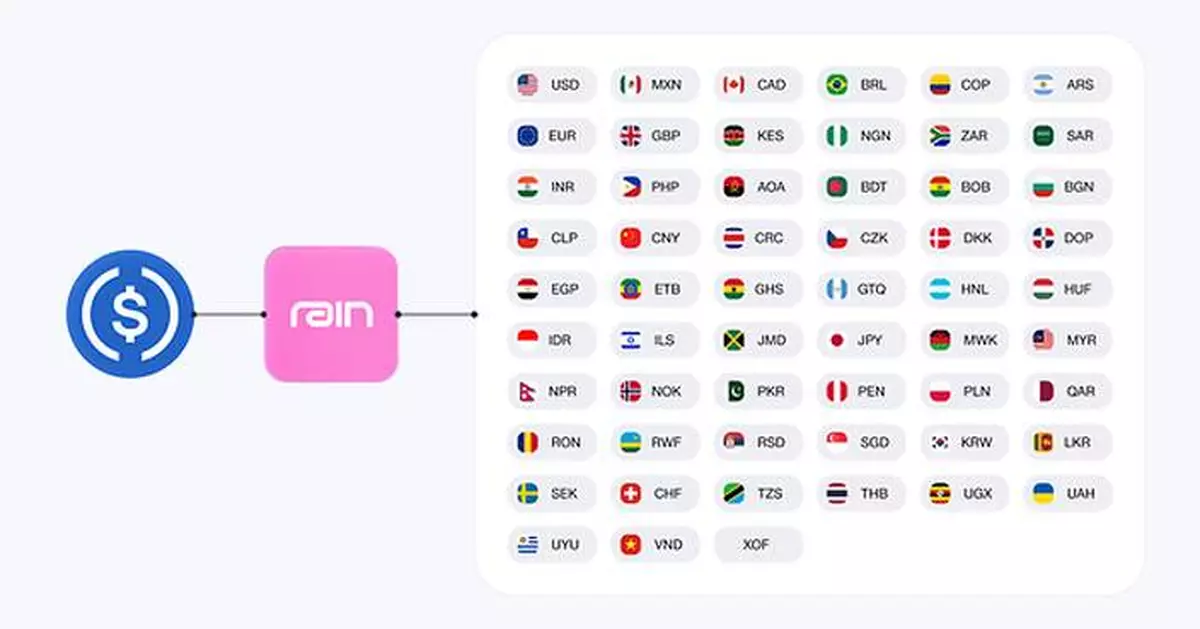
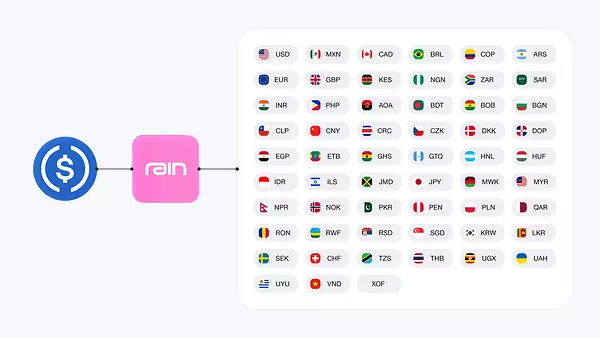
Payouts build on Rain's existing money movement technology, which enables partners to offer virtual accounts, onramps, and offramps and give users even more ways to spend stablecoins
Key facts
- Rain's expanded global payouts capability broadens its money movement technology.
- Rain's partners can now support payouts to more than 80 countries in 50 currencies from stablecoins, with expansion to 95 countries and more than 60 currencies by the end of the year.
- Global payouts support business-to-business (B2B), business-to-consumer (B2C), consumer-to-consumer (C2C), and consumer-to-business (C2B) transactions, whether a partner is sending funds to their own account or to someone else's.
- Global payouts are available now for select beta partners, with broader availability expected by the end of the year.
NEW YORK, Sept. 8, 2026 /PRNewswire/ -- Rain, the enterprise-grade infrastructure for stablecoin payments, announced today an expansion of its global money movement technology platform, enabling partners to send payouts to more than 80 countries in 50 currencies, and plans to reach 95 countries and more than 60 currencies by the end of the year. The expanded capability gives Rain's partners one way to pay others in the currency they actually use, from a single stablecoin balance. It supports business-to-business (B2B), business-to-consumer (B2C), consumer-to-consumer (C2C), and consumer-to-business (C2B) payouts, whether a partner is sending funds to their own account or to someone else's.
Rain's global payouts capability closes the last-mile gap for stablecoins by connecting onchain infrastructure with legacy rails. Partners fund payouts directly from the stablecoin balances they already hold, and Rain orchestrates the conversion of stablecoins to local currency through licensed partners.
Stablecoin cards were Rain's original answer to making stablecoins spendable in the real world. The purchase is authorized like any other card transaction at the point of sale, but behind the scenes, Rain settles with the card networks in stablecoins, while the merchant gets paid in fiat. But card transactions represent just one way users want to use their stablecoins. A business in Bogotá still needs to pay a supplier in Lisbon. A contractor in Buenos Aires still needs pesos to pay their landlord for rent.
An expansion across pay-ins and payouts
Virtual accounts already let partners move money between fiat and stablecoins, covering both pay-ins and payouts. Rain's global payouts extend the payout side of that stack to local currencies and local rails in more than 80 countries.
Together, the two capabilities mean a partner can bring pesos onchain through a virtual account in Mexico, hold them as stablecoins, and separately initiate a payout to a vendor in Argentina. Once the payout is initiated, a licensed partner would deliver Argentine pesos to the recipient's bank account.
"Partners don't want to stitch together several vendors every time they need to pay someone in a new country," said Charles Yoo-Naut, CTO and co-founder of Rain. "They want one platform that powers the whole flow of funds, from stablecoins to local currency, wherever that money needs to land. Rain's global payouts product is the next step in building that platform."
Built for how partners actually move money
Rain built global payouts around the flows its partners already need it for:
- Neobanks can offer money movement and payments services to their own consumer or business customers, without building and maintaining local banking relationships in every market themselves.
- Marketplaces can pay a global base of sellers and drivers in their local currencies from a single stablecoin balance instead of prefunding an account in every country they operate in.
- Contractor platforms can distribute payments to freelancers across borders, regardless of where they live.
- Businesses can pay suppliers abroad from their onchain balance without requiring that vendor to accept stablecoins.
Settlement time depends on the rail and the destination. Many corridors settle in real time, others take up to two business days.
Rolling out now
Global payouts is live today with a select group of beta partners, and will roll out more broadly across Rain's partner base over the coming months. Interested partners can work with their Account Manager to join the beta program and interested prospects can contact Partnerships at sales@rain.xyz.
Frequently Asked Questions
Question: What are global payouts?
Answer: Global payouts are the latest capability in Rain's global money movement product suite. It lets partners send money to recipients in more than 80 countries and 50 currencies, landing as local currency in the recipient's own bank account, with plans to reach 95 countries and more than 60 currencies by the end of the year. The capability covers business-to-business (B2B), business-to-consumer (B2C), consumer-to-consumer (C2C), and consumer-to-business (C2B) payouts, whether a partner is sending funds to their own account or to someone else's. Global payouts is live today with a select group of Rain partners and will expand to new partners over the coming months.
Question: What kinds of payments does Rain global payouts support?
Answer: Rain supports business-to-business, business-to-consumer, consumer-to-consumer, and consumer-to-business payouts. Common use cases include marketplace seller payouts, contractor payments, consumer payments, and supplier or vendor payments.
Question: Does Rain offer more than stablecoin cards?
Answer: Yes. Rain enables card issuing, rewards, embedded wallets, virtual accounts, and on/offramps via one platform. Expanding global payout capabilities means partners get the convenience of a single stack, with the flexibility and modularity to use only the pieces they need underneath it.
Question: What are Rain's money movement capabilities?
Answer: Rain provides a full suite of money movement technology, enabling partners to access global payouts, onramps and offramps, and virtual accounts in several currencies. Virtual accounts already support both pay-ins and payouts, moving money between fiat and stablecoins in multiple currencies. Global payouts expands the payout side of that stack specifically, extending Rain's reach to local-currency payouts across more than 80 countries through local payment rails.
Question: Who are global payouts built for?
Answer: Partners with a global base of recipients to pay: marketplaces paying sellers and drivers, contractor platforms hiring across borders, businesses paying suppliers and vendors abroad, and neobanks offering money movement services to their own consumer or business customers.
About Rain
Rain is the global stablecoin payments platform for enterprises, neobanks, platforms, developers, and AI agents. Our technology allows partners to move, store, and use stablecoins instantly and compliantly through global payment cards, rewards, on/offramps, stablecoin and fiat wallets, and cross-border rails. As both a Visa and Mastercard Principal Member, Rain issues cards that work at more than 175 million merchant locations in over 200 countries and territories. Built natively for stablecoins and trusted by more than 100 organizations worldwide, Rain delivers secure, scalable infrastructure that makes money move freely and instantly around the world. Learn more at https://www.rain.xyz/.
Media Contact:
Joseph Gallo
Communications Director, Rain
joseph@rain.xyz
** This press release is distributed by PR Newswire through automated distribution system, for which the client assumes full responsibility. **
Rain Expands Global Payouts to More than 80 Countries in 50 Currencies