Russian President Vladimir Putin and U.S. President Donald Trump on Tuesday held a telephone conversation that was "constructive and very frank," Kremlin aide Yury Ushakov said.
Ushakov said the call lasted exactly one hour, adding that during the conversation, Putin stressed that Russia has no hostile intentions toward European countries.
"Against the backdrop of speculation alleging that Russia holds hostile intentions toward European states, it was emphasized that we do not harbor any aggressive plans against Europe whatsoever. The circulated myths about a Russian threat serve as a cover for European nations to ramp up support for Ukraine and increase their own military spending," Ushakov said.
Ushakov said Trump, for his part, stressed the need to end the Ukraine conflict, a move that would immediately open broad and promising prospects for the full restoration of Russia-U.S. relations.
The two sides agreed to continue efforts to resolve humanitarian issues, including the exchange of detained and convicted individuals.
When asked for further details, Ushakov said the conversation was strictly confidential.

Putin, Trump discuss Ukraine over phone
Foreign ministers from 12 countries moved on Tuesday to tighten restrictions on trade with Israeli settlements in the occupied West Bank, as mounting settlement expansion and violence fuel growing concerns over the viability of a two-state solution.
Foreign ministers from Canada, Denmark, Finland, France, Iceland, Ireland, Norway, Poland, Portugal, Spain, Sweden and Britain said in a joint statement that they intended to introduce tighter restrictions on businesses or entities that operate in, or support, settlements, which are illegal under international law.
The ministers said the situation in the West Bank was "rapidly deteriorating" amid what they described as unprecedented levels of settler violence and settlement expansion.
Among the 12 countries, Britain, France and Canada said they would bring forward national measures to ban trade in goods produced in settlements, while welcoming steps already taken by Ireland, Spain, the Netherlands, Norway and Belgium.
Britain on Tuesday announced some of the most detailed measures so far. Speaking in the House of Commons, British Foreign Secretary Ed Miliband said Britain would introduce a ban on imports of goods from Israeli settlements in the West Bank.
He said that Britain would also establish a new sanctions regime targeting specific companies and individuals providing construction, infrastructure, financing or real estate services that contribute to settlement expansion. Advertising in Britain for property in Israeli settlements would also be prohibited.
The Palestinian Presidency on Tuesday welcomed Britain's decision, while calling for additional and binding international action to halt Israeli settlement expansion, stop settlers' crimes, and hold those responsible accountable.
French Foreign Minister Jean-Noel Barrot said on X that France would "end trade" with Israeli settlements in the occupied Palestinian territories, adding that France could not, through its trade, support a situation that threatened Israelis, Palestinians and regional stability. He also urged the European Union to adopt the same approach.
Some European countries have already been moving in a similar direction.
Spain has already prohibited imports of goods produced in settlements and related commercial advertising. Belgium has decided to introduce an import ban after approving draft rules in July under which permits for goods originating from Israeli settlements would be refused. Ireland has approved draft legislation to ban imports of goods produced in settlement.
The Netherlands has adopted a national ban on the import, purchase and sale of goods from settlements, which will take effect on Sept. 22, while Norway has put proposed legislation banning imports from and exports to settlements out for public consultation.
The EU has also stepped up sanctions against extremist Israeli settlers. On May 28, it sanctioned four entities and three individuals over serious human rights abuses against Palestinians in the West Bank. The measures include asset freezes, funding bans and travel restrictions. The bloc, however, has yet to impose an EU-wide ban on trade with Israeli settlements.
The latest push for tougher measures followed Israel issuing a tender in August for 1,234 housing units in the E1 settlement project in the West Bank.
According to the tender published online by Israel's Ministry of Construction and Housing, the project is part of a broader plan to build 3,401 housing units in the E1 area east of Jerusalem.
The 12 foreign ministers said the E1 decision was among the developments undermining prospects for a Palestinian state and called on the Israeli government to immediately halt settlement expansion and ensure accountability for settler violence.
Israeli President Isaac Herzog criticized the planned British move on Tuesday, calling the sanctions a "grave miscalculation."
The 12 ministers also reiterated their condemnation of the Hamas attack on Israel on Oct. 7, 2023, and recognized Israel's legitimate security interests.
They reaffirmed support for a two-state solution under which Israel and a sovereign, democratic and viable Palestinian state would live side by side in peace and security within internationally recognized borders.
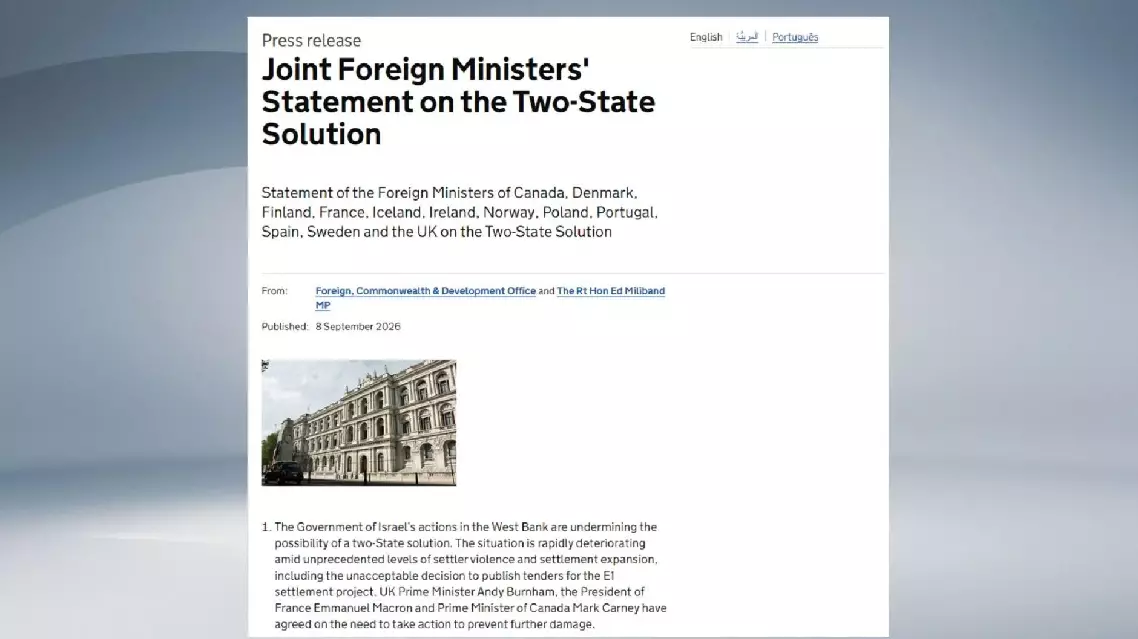
Twelve countries move toward tighter trade curbs on Israeli settlements