SAO PAULO (AP) — Brazilian Supreme Court Justice Flávio Dino restored two senior police officials to their posts on Wednesday, overruling a decision by a rival judge and deepening a major crisis at the country's top court.
Dino, a former justice minister who was appointed by President Luiz Inácio Lula da Silva to the top court, reversed a decision made Tuesday by fellow Supreme Court Justice Andre Mendonca to remove the federal police' director-general Andrei Rodrigues and the force's intelligence director, Leandro Almada, for allegedly leading illegal investigations against him.
Dino contended that Mendonca, who was picked by former President Jair Bolsonaro, cannot use his disagreements with the force to remove the two police officers “for his own cause, aiming stop investigations and police work.”
Lula allies have accused Mendonca of stalling federal police investigations that hit opposition presidential candidate Sen. Flávio Bolsonaro, while speeding up others that impact the president’s inner circle. Mendonca has denied such claims of bias.
Dino added his decision should only be reviewed by the full court, currently formed of 10 justices.
Mendonca chairs two sensitive investigations as Lula prepares to face Sen. Bolsonaro in his reelection bid in October's national elections. One investigation centers on the collapse of Banco Master, which has ensnared several politicians, and the other looks at alleged frauds in Brazil’s pension system.
The first has hit mostly figures of the country’s opposition, while the latter has raised questions of wrongdoing by one of Lula’s sons.
Mendonca has also been embroiled in a public spat with fellow justice Alexandre de Moraes, who last year sentenced Jair Bolsonaro to 27 years in prison.
Mendonca recently unsealed federal police documents that showed that Banco Master owner Daniel Vorcaro frequently sought de Moraes’ legal advice before his arrest.
De Moraes previously denied wrongdoing in the case, but he has faced pressure to resign since investigations showed his wife provided legal services to Banco Master as part of a 130 million reais ($25 million) contract. De Moraes is yet to make public comments about the case.
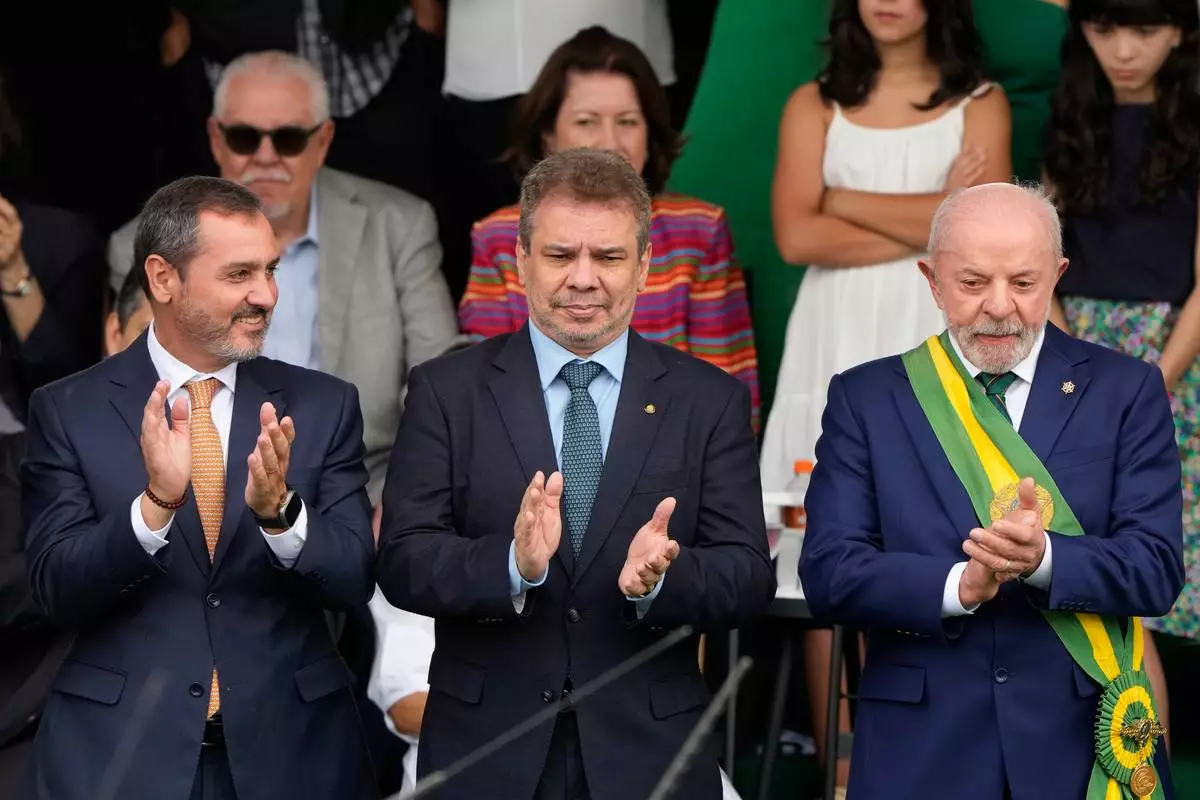
Federal Police Director-General Andrei Rodrigues, left, applauds with Brazilian President Luiz Inacio Lula da Silva, right, and Justice Minister Wellington Cesar during Independence Day celebrations in Brasilia, Brazil, Monday, Sept. 7, 2026. (AP Photo/Eraldo Peres)
VIENNA (AP) — The board of the U.N. nuclear watchdog on Wednesday adopted a resolution ending its investigation into past secret nuclear activities in Syria that revealed a reactor configured to produce fissile material for possible use in nuclear weapons.
Under ousted former President Bashar Assad, Syria was believed to have operated an extensive undeclared nuclear program that included a reactor built by North Korea in eastern Deir el-Zour province.
The 35-member board of governors of the Vienna-based International Atomic Energy Agency adopted the resolution unanimously, according to diplomats who spoke on condition of anonymity to describe the outcome of the closed-door vote.
Delegates could be heard applauding inside the board room as the resolution was adopted, ending the investigation after almost two decades.
The resolution was put forward by Egypt, Jordan, Morocco and Saudi Arabia.
In June 2011, the IAEA Board of Governors found Syria in non-compliance with its nonproliferation obligations for secretly constructing a nuclear reactor in Deir el-Zour and reported the matter to the U.N. Security Council and the U.N. General Assembly to consider sanctions.
Under the Nuclear Non-Proliferation Treaty and the safeguards agreement Syria has with the U.N. nuclear watchdog, Syria is legally bound to declare all nuclear material and activities to the agency and allow IAEA inspectors to verify that none of it is being diverted from peaceful uses.
Following Assad’s ouster in December 2024, the new authorities in Damascus agreed to give IAEA inspectors access to suspected former nuclear sites.
Wednesday’s draft resolution, which was seen by The Associated Press, therefore decided to “terminate” the provisions of the 2011 resolution, ending the IAEA investigation into Syria’s non-compliance.
The draft resolution, however, underlined that Syria “remains bound” by its obligations under the Nonproliferation Treaty and the safeguards agreement and encourages Syria “to continue its cooperation with the Agency, including the excavation work” at the site of the nuclear reactor.
It also requested the head of the IAEA, Rafael Grossi, to continue updating the board on the “outcomes of ongoing activities” in Syria.
The site in Deir el-Zour only became public knowledge after Israel launched airstrikes in 2007 that destroyed the facility. Syria later leveled the site and never responded fully to the IAEA’s questions about it.
The draft resolution welcomed “the transparency and cooperation” of Syria’s new authorities and commended them “for the actions taken in resolving its non-compliance.”
During a visit to Syria in August, Grossi and a team of senior inspectors observed the ongoing excavation work of the Deir el-Zour reactor.
They also inspected additional locations, including sites for fuel fabrication and fuel storage and for planned reprocessing activities.
The IAEA chief and a team of senior agency officials also inspected a previously undeclared site in Syria where they witnessed the unearthing of 73 tonnes of natural uranium metal, of which 55 tonnes were in the form of fuel rods.
All of this material has been placed under IAEA surveillance measures.
The Associated Press receives financial support from multiple private foundations. AP is solely responsible for all content. Find AP’s standards for working with philanthropies, a list of supporters and funded coverage areas at AP.org.

FILE - The International Atomic Energy Agency (IAEA) flag flies during a special session of an IAEA Board of Governors meeting in Vienna, Austria, March 2, 2026. (AP Photo/Heinz-Peter Bader, File)