CAPE CANAVERAL, Fla. (AP) — The two NASA astronauts who led the Artemis II moonshot earlier this year are stepping away from spaceflight.
NASA announced Wednesday that Artemis II commander Reid Wiseman and pilot Victor Glover will no longer serve as active astronauts but will continue to support the moon exploration program as emeritus astronauts.
Glover has taken a leadership job at his alma mater, California Polytechnic State University, while Wiseman’s future plans weren't disclosed. They flew around the moon in April with two other astronauts, setting a new distance record for humanity.
Artemis II’s Jeremy Hansen retired from the Canadian Space Agency in July. That leaves Christina Koch as the only crew member still on the active astronaut rolls.
As emeritus astronauts, Wiseman and Glover will donate their time to train and mentor NASA workers and share their knowledge for future moon missions. It's a new approach to taking advantage of expertise, according to the space agency.
"Together, they took on one of the most challenging missions in human spaceflight and helped return America to the lunar environment," NASA Administrator Jared Isaacman said in a statement. "I’m grateful they will continue sharing what they learned."
Cal Poly said Glover will help shape long-term strategies and inspire students to study science and engineering. His new job in San Luis Obispo took effect Sept. 1, the same day he retired from the Navy.
In an interview with The Associated Press, Glover stressed “this is not a leaving ... for me, this is opening the aperture, not closing it down.”
"I want to keep talking about how faith and science work together in my life," Glover said. “That’s not NASA’s mission, but I can still help NASA from the sidelines.”
Instead of waiting to command a moon-landing mission, Glover said he decided to put spaceflight behind in order to focus his efforts on young people and spend more time with his wife and four daughters. Three of his daughters are currently enrolled at Cal Poly. The oldest has already graduated from there.
Wiseman's status change will take effect this month. Chosen by NASA as an astronaut in 2009, the retired Navy captain spent more than five months aboard the International Space Station in 2014, later becoming the space agency's chief astronaut.
After graduating from Cal Poly in 1999, Glover became a Navy test pilot before NASA picked him to be an astronaut in 2013. He served as pilot on SpaceX's second crew flight for NASA, a nearly six-month mission to the space station in 2020 and 2021.
Glover's eloquence stood out while flying to and from the moon.
Earth is an oasis in “a whole bunch of nothing, this thing we call the universe” where humanity exists as one, he observed from space. “This is an opportunity for us to remember where we are, who we are, and that we are the same thing and that we’ve got to get through this together.”
Wiseman also tugged at heartstrings as he and his crew asked for permission to name one of the moon's craters after his late wife Carroll, who died of cancer in 2020.
Last month, the Artemis II crew received the Congressional Space Medal of Honor from President Donald Trump during a ceremony at NASA's Johnson Space Center in Houston.
The Associated Press’ health and science coverage receives financial support from the AP Fund for Journalism and private foundations. AP is solely responsible for all content. Find AP’s standards for working with philanthropies, a list of supporters and funded coverage areas at AP.org.
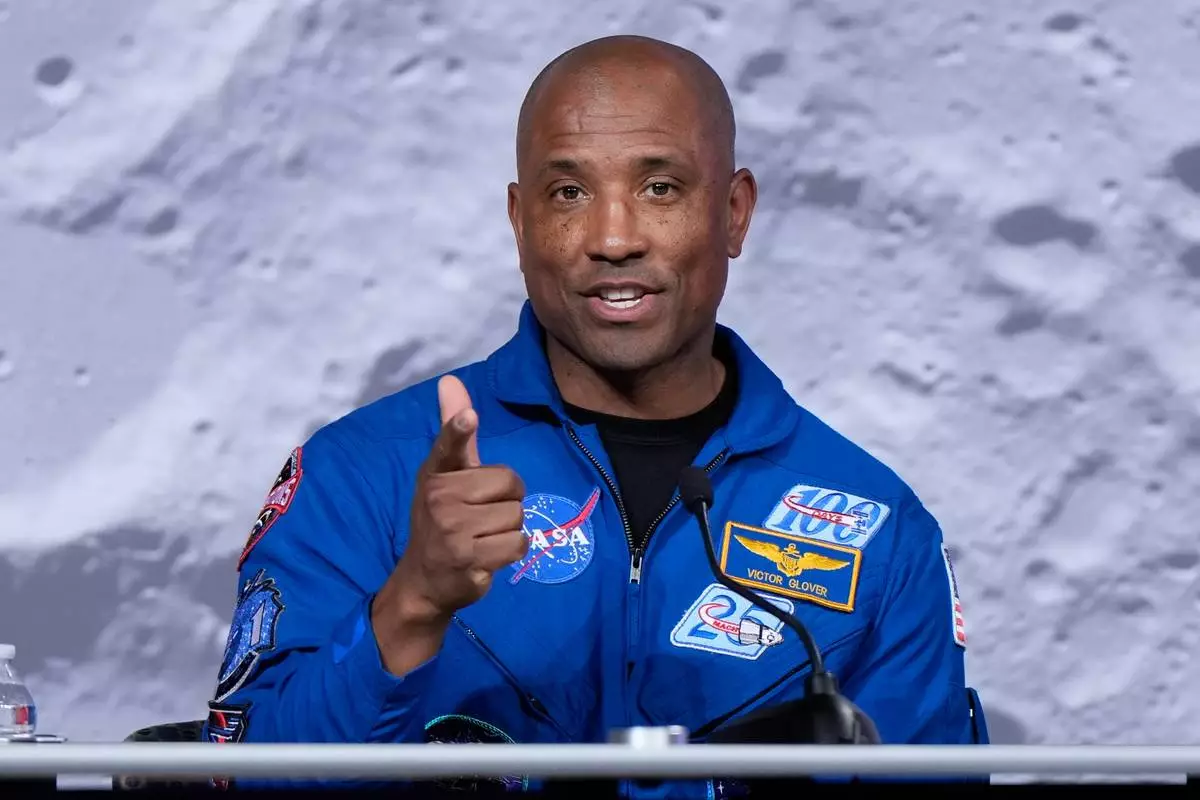
FILE - NASA astronaut Victor Glover, a member of the NASA's Artemis II crew, speaks during a news conference on April 16, 2026, in Houston. (AP Photo/Ashley Landis, file)

FILE - Artemis II Pilot Victor Glover, left, and Commander Reid Wiseman, right, participate in a Congressional Space Medal of Honor ceremony at NASA's Johnson Space Center, Aug. 28, 2026, in Houston. (AP Photo/Karen Warren, file)
MIAMI (AP) — Temporary legal protections for about 200,000 immigrants from El Salvador was in limbo Wednesday as a deadline neared for the Trump administration to decide if they should end, as it has done for hundreds of thousands from Venezuela, Haiti and other countries.
The Temporary Protected Status designation expires Wednesday but the statute does not give a specific time for when that happens. If the Department of Homeland Security takes no action, protections are automatically extended for six months. This rare reprieve happened in May, when the protections were automatically extended to about 11,000 Lebanese, allowing them to stay and work in the U.S. for another 180 days.
About 200,000 people from El Salvador have lived in the U.S. since 2001 under TPS, which allows people already in the country to remain with work permits for renewable periods of up to 18 months, if the secretary of homeland security determines conditions are unsafe for return. They are eligible for work permits.
During President Donald Trump’s second term, Homeland Security has ended TPS for more than 1 million people from 14 countries, including El Salvador, Venezuela, Haiti, Honduras, Nicaragua, Afghanistan and Syria. Only about 103,000 from three countries remain protected with termination dates in October for Ukraine and Sudan, and November for Lebanon.
The Trump administration obtained a major victory when the Supreme Court ruled in June that Homeland Security acted within its authority by ending TPS for about 350,000 Haitians and 6,000 Syrians. The impact of the decision extends far beyond Haitians and Syrians, potentially affecting nearly 1.3 million people from 17 countries on TPS.
DHS did not immediately respond to a request for information from The Associated Press.
Tom Homan, Trump’s “border czar" who has advocated for ending TPS, said Tuesday that the decision rests with the Homeland Security Secretary Markwayne Mullin.
“If it expires, it’s up to the secretary,” Homan said when asked about TPS. “Temporary protected status means temporary. Let’s face it, El Salvador is a much safer country than it’s ever been now with a new president up there."
TPS was created by Congress in 1990 to prevent deportations to countries suffering from natural disasters or civil strife.
It was granted to El Salvador following two devastating 2001 earthquakes that left hundreds of thousands of people homeless. Just before leaving office, President Joe Biden extended TPS for El Salvador for 18 months to Sept. 9, 2026.
The vast majority of Salvadoran TPS holders have children born in the U.S. Many have lost their jobs and fear being detained, separated from their American family members, and deported to a country they barely know.
El Salvador, once one of the most violent places in the world, has become one of the safest countries in the Americas since Salvadoran President Nayib Bukele ordered mass arrests in 2022. In April 2025, the State Department upgraded El Salvador’s travel advisory to its highest level, citing a drop in violent crimes and murders.
Bukele has been an ally of Trump’s policy of mass deportations and was one of the first countries to receive deportees and held them at a mega prison in El Salvador also known as CECOT.
Human rights groups and advocates have denounced mass and arbitrary arrests, torture, and disappearances in the Central American nation’s prison system.
Trump received Bukele at the White House in April of 2025 and invited him to participate in a military coalition to fight against drug trafficking and organized crime. Less than a year later, in July of 2026, Trump and Bukele met again in Washington, the Salvadoran president has not publicly stated whether he requested an extension of TPS from the Trump administration.
In 2019, during the first Trump administration, Bukele asked Trump to extend TPS. It remained because there were lawsuits.
Salvadorans in the U.S. sent $9.9 billion in remittances to El Salvador last year, representing 24% of country’s gross domestic product, according to El Salvador’s central bank.

FILE - President Donald Trump greets El Salvador's President Nayib Bukele, left, at the Shield of the Americas Summit, March 7, 2026, at Trump National Doral Miami in Doral, Fla. (AP Photo/Mark Schiefelbein, File)