A senior Nepali meteorologist has hailed China's Fengyun weather satellites for their high-resolution, real-time data that helped guide the response to the devastating mudslide that hit the China-Nepal border.
The mudslide and flash floods, triggered by an ice-rock avalanche on the Nepalese side on Aug 26, tore through Nepal's Bhote Koshi river in a matter of minutes. The disaster has so far killed at least 1,374 people in Nepal, with thousands more still missing, according to local authorities.
Bibhuti Pokharel, a senior divisional meteorologist at the Nepal Meteorological Department, explained how data supplied by Chinese satellites kept rescue personnel on the ground updated on developing cloud formations, rainfall, flash floods, landslides, and destructive winds in the aftermath last month's disaster.
Pokharel said the satellites give the Nepali side the detail it needs to follow individual weather systems as they form.
"That's very helpful because we are getting from Fengyun satellites, we are getting information about what's actually happening, meteorological information about clouds, precipitation, wind and the system itself. And apart from that, they also have very fine resolution -- one-kilometer resolution -- which is very helpful for us," she said.
Within hours of the disaster, Chinese meteorological authorities activated a cross-border monitoring mechanism that coordinated the response on both sides of the border and issued early warnings for further geological hazards.
Pokharel said the effective disaster response had made the case for closer coordination between the two sides.
"After this incident happened, there seems very much [to be a] necessity for this kind of coordination. It started from just small measures, but I think it worked very nicely," said the meteorologist.
She added that greater trans-boundary data-sharing is the best way to strengthen early-warning systems particularly as global warming has exacerbated the impact of extreme weather events on vulnerable regions like Nepal.
Pokharel said Nepal has to stand ready and prepared to deal with more such disasters.
"We have seen that we are in a vulnerable situation which may be beyond our imagination. And this may be one of the cases, but there may be another also, so we have to move forward," she said.
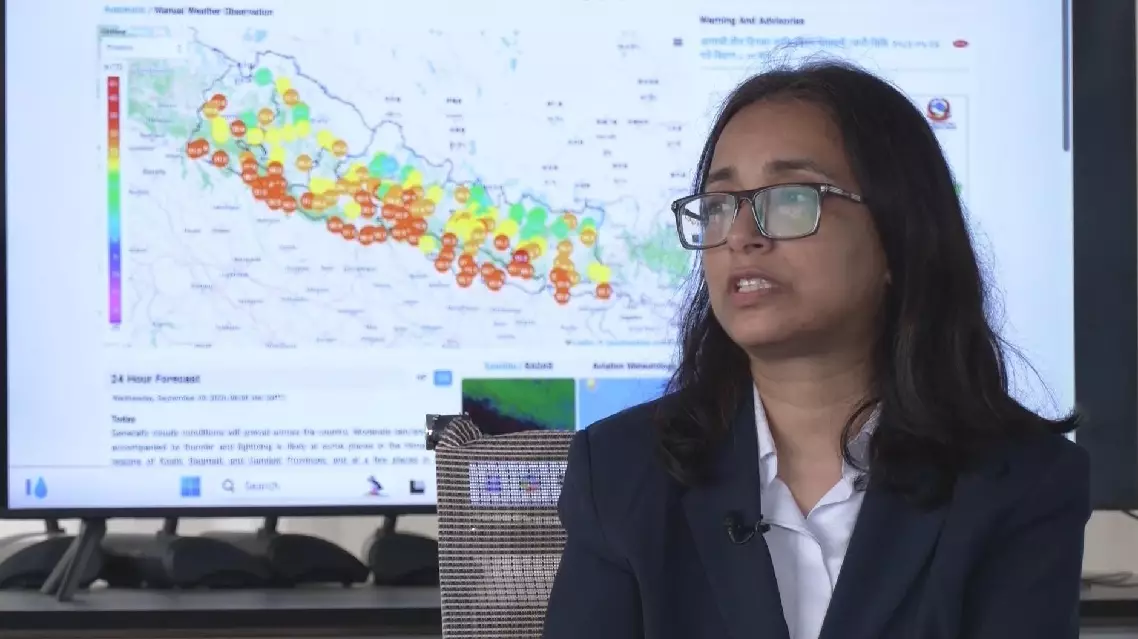
Nepali meteorologist hails Chinese satellite data in border mudslide rescue