The 33rd Asia-Pacific Economic Cooperation (APEC) Economic Leaders' Meeting marked a new peak in Asia-Pacific economic cooperation.
Chinese President Xi Jinping attended the 33rd APEC Economic Leaders' Meeting and other events in Shenzhen, south China's Guangdong Province, earlier this week. It was the first time in 12 years that China had hosted the top event of the region's highest-level, most extensive and most influential economic cooperation mechanism.
On Thursday, Xi chaired the 33rd APEC Economic Leaders' Meeting and delivered an address, in which he called for further efforts to build an Asia-Pacific community and write a new chapter of the "Asia-Pacific miracle."
"The launch of APEC more than 30 years ago started a remarkable journey toward building an Asia-Pacific community. Over three decades and more, our region has witnessed progress with each passing day, and created the Asia-Pacific miracle of rapid economic growth," he said during the meeting.
Xi highlighted the importance of openness and integration, calling for efforts to uphold open regionalism, steadily advance economic integration, and champion free and open trade and investment, while developing a cooperation pattern that is open and integrated rather than exclusive or fragmented.
"In the face of new opportunities and challenges, we must adapt to the new realities, take new strides, and open up new prospects for Asia-Pacific cooperation. Together, we must strive to build an Asia-Pacific community characterized by solidarity and mutual assistance, openness and integration, enterprise and innovation, as well as inclusive development," Xi said.
In his closing remarks, Xi called for strengthening confidence to translate the consensus on building an Asia-Pacific community into concrete action, and to turn the vision into reality.
He stressed the need to focus on development as the broadest common ground for cooperation and deliver more tangible benefits through Asia-Pacific cooperation.
"Shenzhen is known as the City of the Roc (named after a legendary bird of great size and strength). I hope that with our joint efforts, Asia-Pacific cooperation will spread its wings like the roc, and fly high and far to a bright future," Xi said.
Leaders and representatives of APEC member economies shared their views at the meeting on building an Asia-Pacific community to prosper together.
They spoke highly of the achievements of China's APEC host year and expressed their readiness to step up cooperation to advance APEC's development.
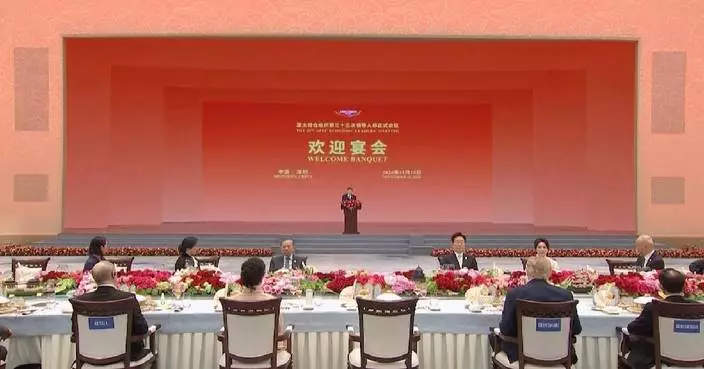
On Wednesday evening, Xi and his wife, Peng Liyuan, hosted a banquet to welcome guests attending the 33rd APEC Economic Leaders' Meeting.
"I once said that to see over a few thousand years of China, go to Xi'an; to see 500 years of China, go to Beijing; to see 100 years of China, go to Shanghai. Tonight, let me add this: To see 50 years of China, come to Shenzhen," he said.
"Now, I would like to propose a toast. Let's raise our glasses: to the shared prosperity of the Asia-Pacific; to the great success of the APEC Economic Leaders' Meeting; and to the health of all distinguished guests and your families. Cheers!" said Xi.
Earlier on Wednesday, Xi attended the opening ceremony of the APEC CEO Summit 2026 and delivered a keynote speech.
"You are more than welcome to continue to get actively involved in China's reform and opening up and modernization drive, and share in the opportunities created by Chinese modernization. Let us join hands to meet challenges facing development through opening up, generate momentum for growth through innovation, and pursue prosperity for all through cooperation. Let us work together to build an Asia-Pacific community and deliver a bright future for our region," Xi said in his speech.
The same day, the Shenzhen initiative of the Asia-Pacific Economic Cooperation (APEC) CEO Summit 2026 was released, calling for deepening an open regional economy, driving inclusive growth through technological innovation, strengthening regional connectivity, and working together to achieve shared prosperity.
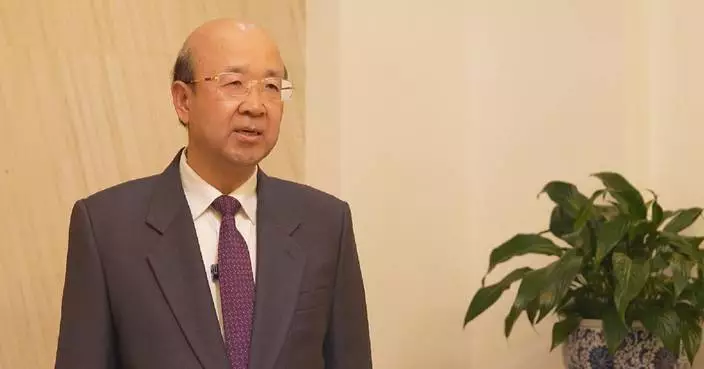
"What we witnessed at the APEC meetings was arguably the most successful and milestone-setting gatherings in APEC's history. The CEO summit produced the Shenzhen Initiative, and the economic leaders' meeting adopted the Shenzhen Outlook, marking a rich set of outcomes. Most notably, this marked the first time in history that the Asia-Pacific community has been translated from a vision into action," said Gao Fei, president of the China Foreign Affairs University in Beijing.
"During APEC 2013, President Xi Jinping creatively put forward the vision of an Asia-Pacific community with a shared future. That vision has since been steadily broadened and has gained ever-deeper resonance, especially today when APEC economies have a more profound appreciation regarding a shared future. Some of the key concepts in Xi's thought on diplomacy have also injected greater momentum into subsequent APEC cooperation," said Su Xiaohui, director of the Department for Developing Countries Studies at the China Institute of International Studies.
On Thursday, Xi chaired a historic summit in Shenzhen with Russian President Vladimir Putin and U.S. President Donald Trump, marking the first-ever face-to-face meeting between the Chinese, Russian and U.S. heads of state. Both leaders arrived in the city the day earlier for the 33rd APEC Economic Leaders' Meeting.
"Humanity, living in the same global village, is a community with a shared future where we all stand to benefit or lose together. In this global village, major countries shoulder special responsibilities. Positive interaction between major countries is not optional, but a must," Xi said. Both Putin and Trump welcomed China's solution.
"I would like to thank the Chinese side and President Xi for organizing today's meeting between the leaders of Russia, China, and the United States. I firmly believe that if Russia, China, and the United States -- along with the people of our three nations -- can engage in constructive, partnership-based cooperation founded on mutual respect, equality, and a balance of interests, we can make a significant contribution to strengthening global security and stability," Putin said.
"I want to congratulate President Xi on hosting a very successful APEC summit -- it was very successful, tremendous. I'm delighted that this trip has also given us the opportunity for this first-ever trilateral meeting between the leaders of the United States, Russia and China. So today in that sense -- and I think in lots of other ways -- we are really making history. We have a special responsibility to maintain open, respectful and productive dialogue on issues impacting not just our people, but the entire planet," Trump said.
Following the summit, the three countries released the China-Russia-U.S. Heads of State Declaration toward Peace, outlining their common understandings on issues including the UN reform, energy security, the jurisdiction of the International Criminal Court and nuclear risk reduction.
Ahead of the summit, Xi met separately with Trump and Putin.
"2026 is a big year for China-U.S. relations. The two heads of state have interacted several times and completed mutual visits within half a year. China-Russia relations, meanwhile, have remained at a high level. Given all this, in this round of communication and the trilateral summit, the role China played cannot be overlooked," Su said.
"What is really happening behind the once-in-a-century changes unfolding in our world? In essence, the traditional international system and order are being reshaped. Everyone is confronting the challenges that this change in international relations brings. So how should we respond? How should major countries respond? The fact that these three countries can sit down effectively together, with peace and major-country strategic stability as the central themes, offers a measure of certainty and stable expectations to a changing world. That matters to us all," Gao said.
From Tuesday to Friday, Xi also met separately with leaders of 12 other APEC economies, namely Canada, Papua New Guinea (PNG), Vietnam, Mexico, Peru, Chile, the Republic of Korea (ROK), Indonesia, Australia, Singapore, Thailand and Malaysia.
On Thursday morning, Peng Liyuan and spouses of leaders of other APEC economies visited a cultural exhibition in Shenzhen.
Chinese Foreign Minister Wang Yi said Thursday in Shenzhen that the 33rd APEC Economic Leaders' Meeting was the most important diplomatic event China hosted this year.
The meeting produced the ambitious, practical and comprehensive APEC Leaders' Shenzhen Outlook, which is the most significant outcome of the APEC "China Year" and a new milestone in APEC cooperation, said Wang, who is also a member of the Political Bureau of the Communist Party of China Central Committee.
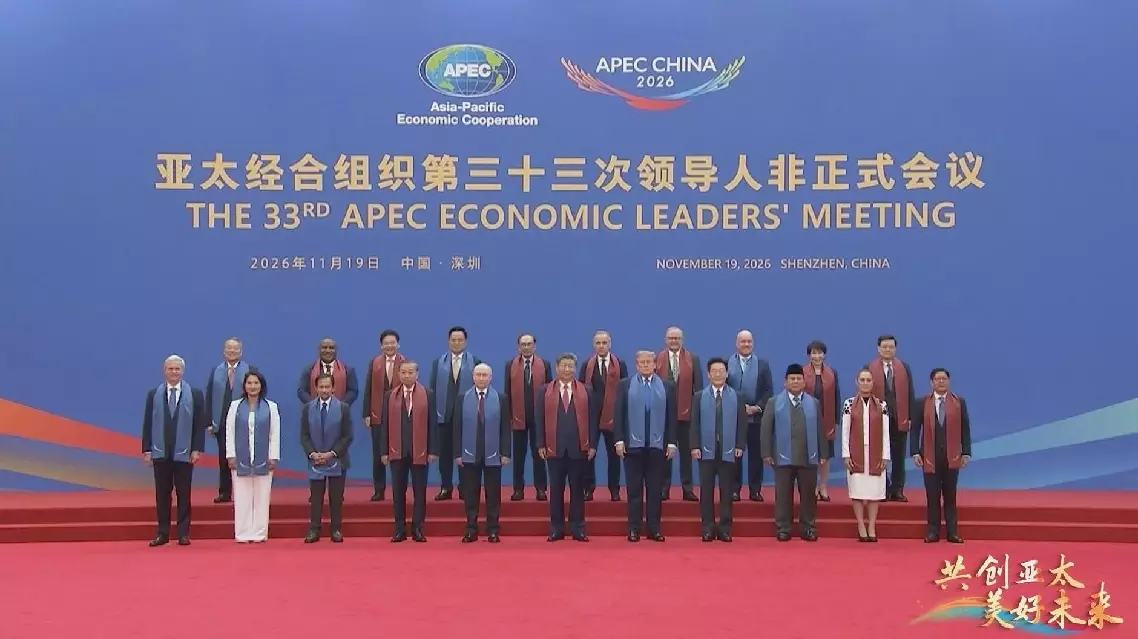
APEC Shenzhen meeting marks new peak in Asia-Pacific economic cooperation
APEC Shenzhen meeting marks new peak in Asia-Pacific economic cooperation