DEN BOSCH, Netherlands (AP) — Lottie Woad and Charley Hull are the power pairing of the European team.
They couldn't provide a spark at the Solheim Cup on Day 1.
Click to Gallery
Nelly Korda of the United States, left, and Lauren Coughlin bump fists on the sixth green during the Solheim Cup in Den Bosch, Netherlands, Friday, Sept. 11, 2026. (AP Photo/Alastair Grant)
Lottie Woad of Europe of Europe reacts after her tee shot on the third hole during the Solheim Cup at the Bernardus Golf course in Den Bosch, Netherlands, Friday, Sept. 11, 2026. (AP Photo/Alastair Grant)
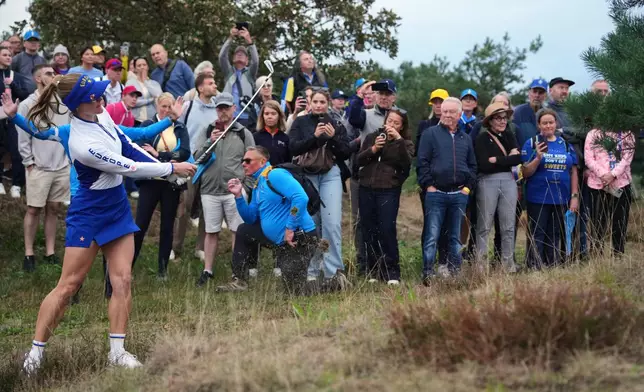
Charley Hull of Europe plays from rough on the third hole during the Solheim Cup at the Bernardus Golf course in Den Bosch, Netherlands, Friday, Sept. 11, 2026. (AP Photo/Alastair Grant)
Charley Hull of Europe watches her approach shot into the second green during the Solheim Cup at the Bernardus Golf course in Den Bosch, Netherlands, Friday, Sept. 11, 2026. (AP Photo/Alastair Grant)
Captain Anna Nordqvist put them together twice Friday, sending them out first in the morning and the afternoon in the hope they would give Team Europe early momentum in each session.
They managed only a half point in their two matches combined as Day 1 ended with the teams tied at 4-4.
World No. 1 Nelly Korda and Allisen Corpuz beat Hull and Woad 4 and 3 in morning foursomes. In the afternoon, Woad, the world No. 7, and No. 8 Hull were 3-up after 11 holes against Yealimi Noh and Angel Yin before the Americans rallied to tie the match.
Still, Hull was upbeat after the afternoon contest.
“Yeah, I like matches like that. They’re really interesting. It was good fun. There was a lot of birdies,” Hull said.
All four players were battling the elements in an afternoon that saw a mixture of sunshine and showers pass over Bernardus Golf in the southern Netherlands.
“There was some tricky holes out there, some long iron shots middle of the round because it started raining and the wind got up a little bit, and then now the sun’s come out,” Hull said.
Yin had been a big question mark for the Americans after missing two months with severe stomach issues and only returning for the final event before the Solheim Cup — where she shot 81-76 to miss the cut.
But she and Noh never quit against the Europeans.
“The front, Angel really kept it together with three birdies. My putter was kind of cold and she was keeping us in the game,” Noh said. “We made mistakes but on different holes, and just had a really good rhythm out there.”
Woad said it was a good contest, but American grit earned a half point.
“We had the lead for most of it,” she said. "But they kept on fighting back.”
See AP’s full golf coverage here

Nelly Korda of the United States, left, and Lauren Coughlin bump fists on the sixth green during the Solheim Cup in Den Bosch, Netherlands, Friday, Sept. 11, 2026. (AP Photo/Alastair Grant)

Lottie Woad of Europe of Europe reacts after her tee shot on the third hole during the Solheim Cup at the Bernardus Golf course in Den Bosch, Netherlands, Friday, Sept. 11, 2026. (AP Photo/Alastair Grant)
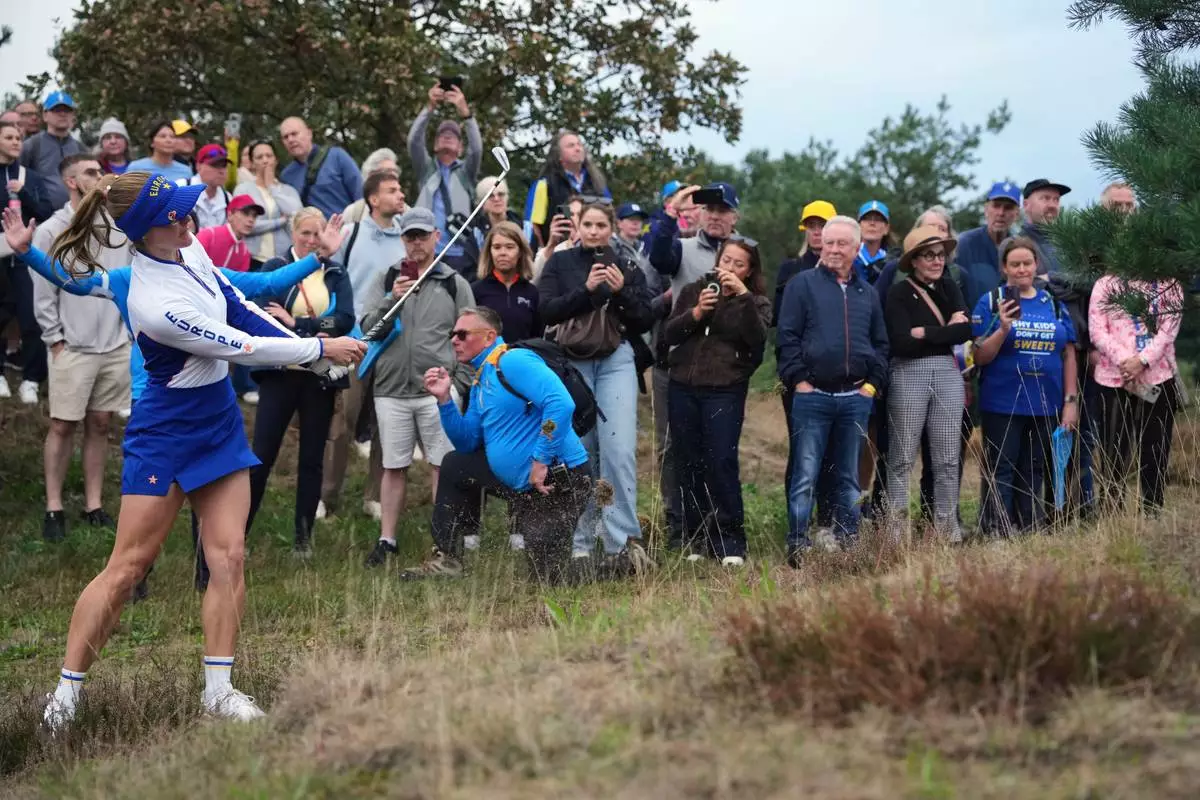
Charley Hull of Europe plays from rough on the third hole during the Solheim Cup at the Bernardus Golf course in Den Bosch, Netherlands, Friday, Sept. 11, 2026. (AP Photo/Alastair Grant)

Charley Hull of Europe watches her approach shot into the second green during the Solheim Cup at the Bernardus Golf course in Den Bosch, Netherlands, Friday, Sept. 11, 2026. (AP Photo/Alastair Grant)
KOZATSKE, Ukraine (AP) — A white towel on her gate and a white rag in her hand were Ukrainian Nataliia Diadiuk’s only ways to tell Russian drone operators she is a civilian. When a brief ceasefire kicked in on Oct. 27, she had a moment of respite.
The 53-year-old is one of a handful of residents left in Kozatske, a riverside village located in the kill zone of Ukraine’s Kherson region less than 2 kilometers (1.2 miles) from a Russian-controlled area.
“I really want silence,” Diadiuk said, fighting back tears as she stood on an empty street lined with abandoned houses. “And I want to see the people who left, all of them. People left for both sides."
Diadiuk’s life has been reduced to basic survival: rainwater to drink, firewood gathered around town for heat, a radio she tries to tune in to for news, and the remnants of humanitarian aid that had not reached her in two years until the brief ceasefire that ended Sunday night just days after it began. Going out means dodging every kind of weapon, including mines scattered everywhere. The neighbors she mentions are more often the dead than the few still living nearby.
A team from The Associated Press gained rare access to a so-called red zone to see firsthand what life in the kill zone looks like, a visit made possible only because of a brief, localized ceasefire tied to the humanitarian aid mission in the Russian-occupied city of Oleshky.
Oleshky has drawn the world’s attention, but civilians are trapped in many more places on both sides of the front line. During the mission, Ukrainian regional officials, police, the Ukrainian Red Cross Society and volunteers, with the facilitation of civil-military cooperation specialists, used the rare window of time to reach people on their side of the river, some of them cut off for nearly two years.
In all, 180 people were evacuated from riverside communities and the city of Kherson, including 23 children, the regional administration said. About 140,000 people remain in the Ukrainian-held part of the Kherson region.
Before the war, the whole region, now nearly 70% under Russian control, had about 1 million residents. The riverside is designated a red zone, the highest level of military danger. With the ceasefire over, residents will again face drones, artillery, glide bombs and airdropped mines. Still, many refuse to leave. Some cannot afford to start over, and others will not abandon the places where they grew up.
On the road to Diadiuk’s village, burned-out cars sit abandoned where they were hit, alongside wrecked ground robots that Ukrainians try sending down roads too dangerous for people. A relic of peacetime still stands on that road: “Thank you for keeping the roadside clean.”
In the village, many houses are reduced to burned walls. Glide bombs have left craters, and the tail fins of shells stick out of the asphalt like flowers. Mines dropped from drones lie everywhere, some petal-shaped, others improvised and wrapped in foil or plastic, so every step must be taken with care. Thick vegetation swallows the ruins of empty houses.
What Diadiuk finds hardest to bear is the howling of the dogs left behind in the houses, surviving much as she is. “Even for the sake of these, I can’t leave them,” she says, pointing to two thin dogs that never stray far from her. But she shares what little food she has with other dogs as well.
Isolated and forced to fight for survival every day, she has lost track of time. “I turn on my phone only to see what day it is,” she says. She charges it with solar panels.
Diadiuk collects rainwater, strains it through gauze, treats it with chlorine and boils it. “The water here is more or less all right,” she says. “There are a lot of dead lying in the houses, so it’s good water only in a manner of speaking.”
The village’s ordeal began in the first days of Russia’s full-scale invasion, when it was occupied. After Ukrainian forces liberated it, Kozatske gradually came under siege by drones as the war turned increasingly technological.
“Before, I’d just open the door and walk out,” said Oleksii Shavokin, 54, who lives a little farther down the street. “Now I open it a crack, stick my ear out and listen to the sky."
His house burned down in early 2023 after a mortar attack, he said, but he patched it up and stays on there. He lives off old humanitarian aid and eggs from the hens he still keeps. “I ration my food so it lasts. I’m used to it,” he said. “Now I eat once a day, in the evening, and that’s quite enough.” He has lost 30 kilograms (66 pounds) from a weight of close to 100 kilograms (220 pounds).
Many of the people he knew were killed by strikes, and others left. He decided to stay.
“I value life, but where’s the guarantee a car won’t hit me somewhere else?” Shavokin said. “Wherever it’s written for you, that’s where you’ll lose your life, or go on living. And still, I hope this all ends soon.”
Many residents who stay do not know where they would go and fear they would be left to fend for themselves, said Oleh Tarabaka, head of the Nova Kakhovka city military administration. He was part of the team that tried to persuade Diadiuk and Shavokin to leave.
But it is difficult, he said. Many have lived there their whole lives and fear that once they leave, they will have nothing to live on. Not everyone has someone to go to. Some have no relatives.
“If there hadn’t been a period of quiet, we simply wouldn’t have gotten people out,” Tarabaka said. “We wouldn’t have been able to drive in here.”
What residents are living through goes beyond survival, Tarabaka said, adding that perhaps no word has yet been invented to describe it.
Some, however, can be persuaded to leave. That was the case for Yevhen and his mother, Antonina, who declined to give their last names for security reasons.
One of the military officials turned to Yevhen. “Just make the right decision, the decision of a man and a son,” a Ukrainian soldier from the 42nd brigade who was part of the evacuation group told him.
Eventually, they agreed.
All the way through her bombed-out town, Antonina wailed and wept, not wanting to leave. Her cries echoed through the empty streets.
The temporary truce allowed the Red Cross to evacuate far more people than usual from Kherson city. Normally, every route and every stage must be planned around the constant threat of drones and other weapons.
“Right now, some streets and places in Kherson are a kill zone too. It’s simply impossible to slip through there. The risk is very, very high,” said Mykola Taranenko, commander of the Ukrainian Red Cross Society’s rapid response team in the Kherson region.
His team usually evacuates about 10 people a week, but during the ceasefire week, it took out 32.
Among those evacuated were Volodymyr and Kateryna Yakuba, both 77, who divorced more than 20 years ago but left the city together. Their daughter arranged the evacuation, and they are going to stay with her in Odesa.
“We need to get out before the cold sets in,” Kateryna said, adding about the ceasefire: “I don’t know how we would have gotten out otherwise.”
“It’s scary to leave home,” her voice trembled. "You don’t know if you’ll come back, or if there will be anything to come back to.”
Associated Press journalists Vasilisa Stepanenko and Evgeniy Maloletka contributed to this report.
Follow the AP’s coverage of the war in Ukraine at https://apnews.com/hub/russia-ukraine
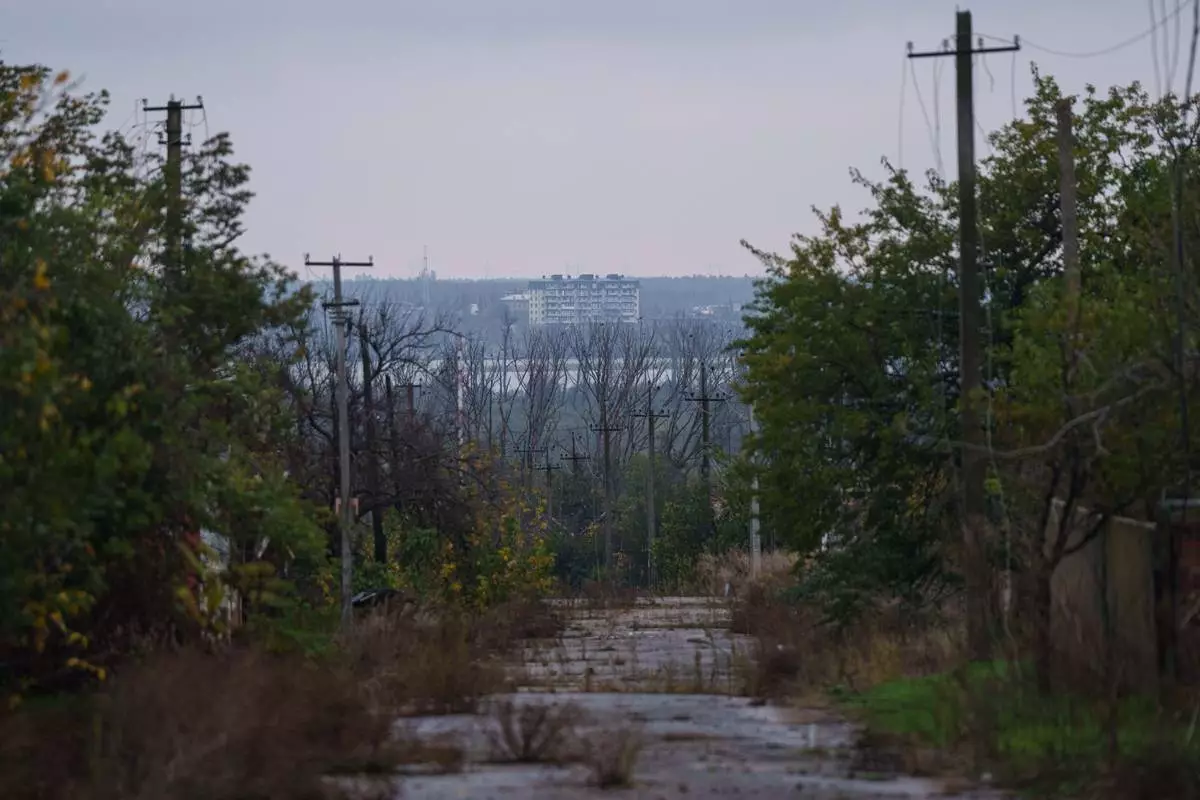
A residential building in Russian-occupied Nova Kakhovka is seen across the Dnipro River from the village of Kozatske during a localized ceasefire linked to a humanitarian aid mission to Oleshky in the Kherson region of Ukraine, Saturday, Oct. 31, 2026. (AP Photo/Evgeniy Maloletka)
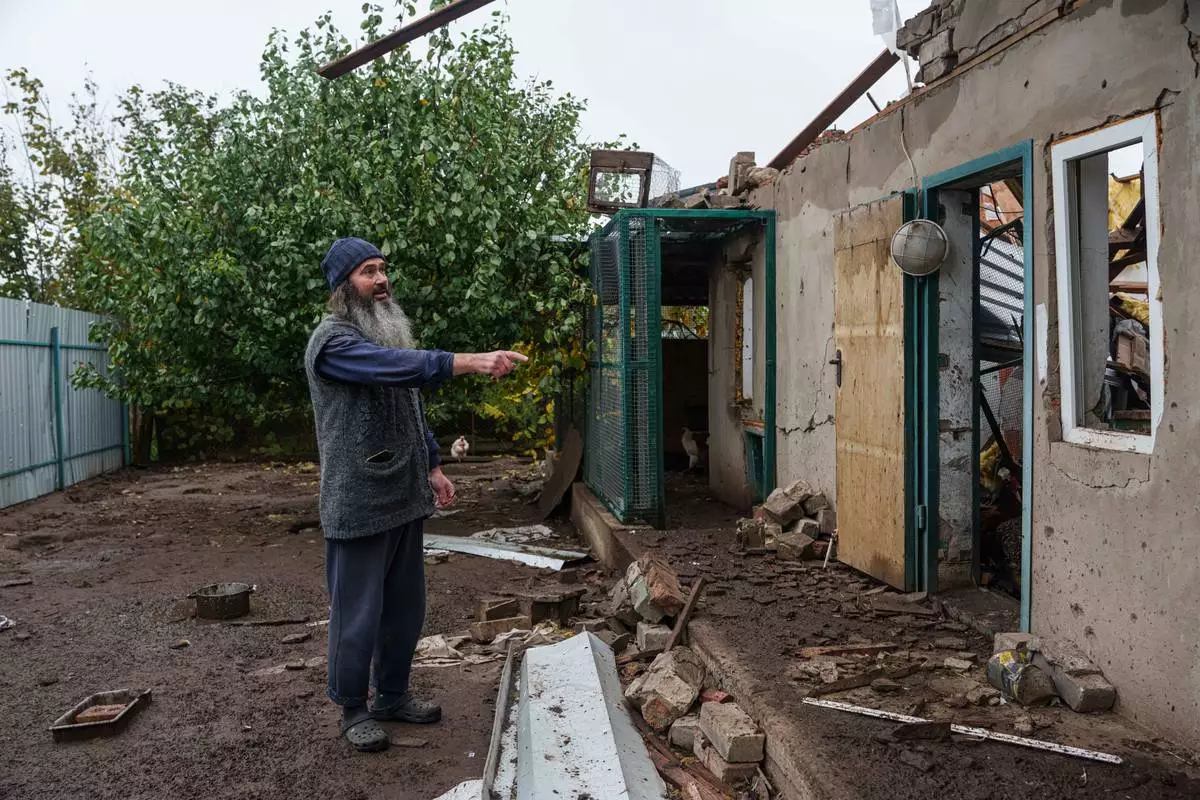
Oleksii Shavokin, 54, a local resident, stands in front of his house destroyed by Russian shelling during a localized ceasefire linked to a humanitarian aid mission to Oleshky, in the village of Kozatske, Kherson region, Ukraine, Saturday, Oct. 31, 2026. (AP Photo/Evgeniy Maloletka)
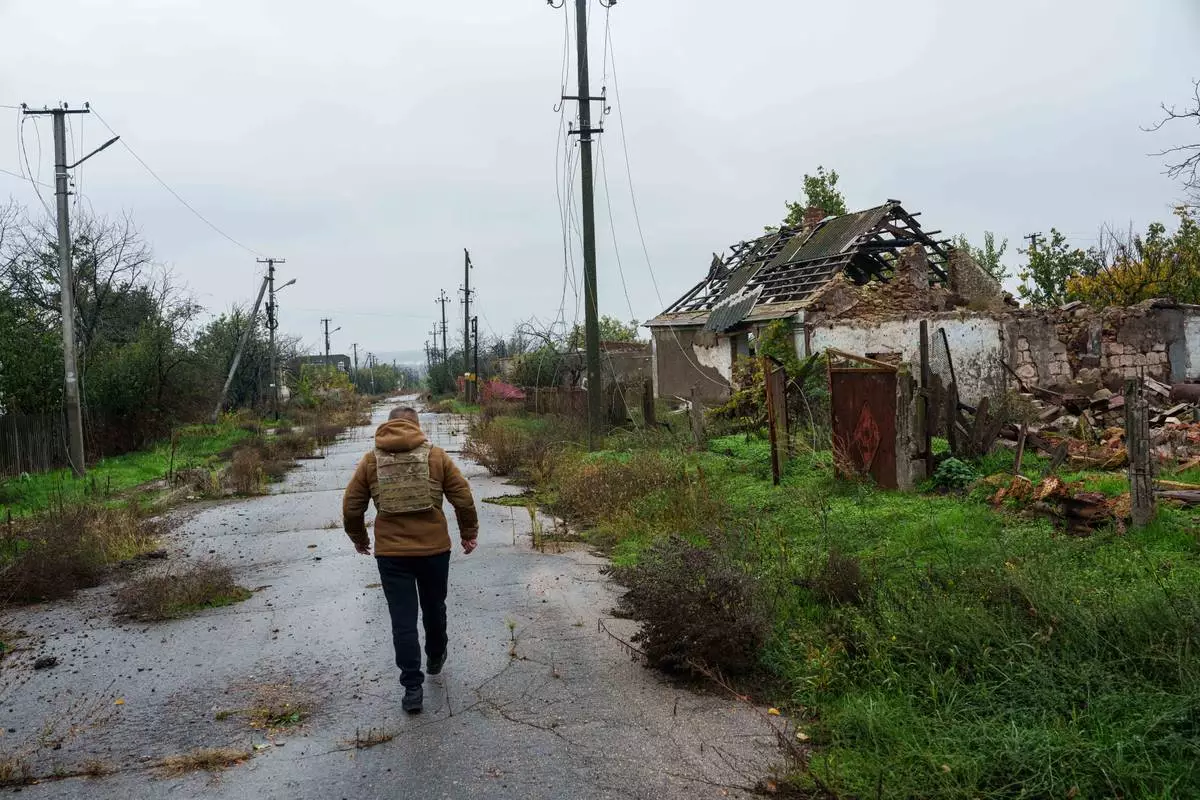
Vadym, a Ukrainian sergeant of the 42nd Marine Brigade walks through an area contaminated with anti-personnel mines in front of destroyed houses during an evacuation of local population to a safe area amid a local ceasefire linked to a humanitarian aid mission in Oleshky, in the village of Kozatske, Kherson region, Ukraine, Saturday, Oct. 31, 2026. (AP Photo/Evgeniy Maloletka)
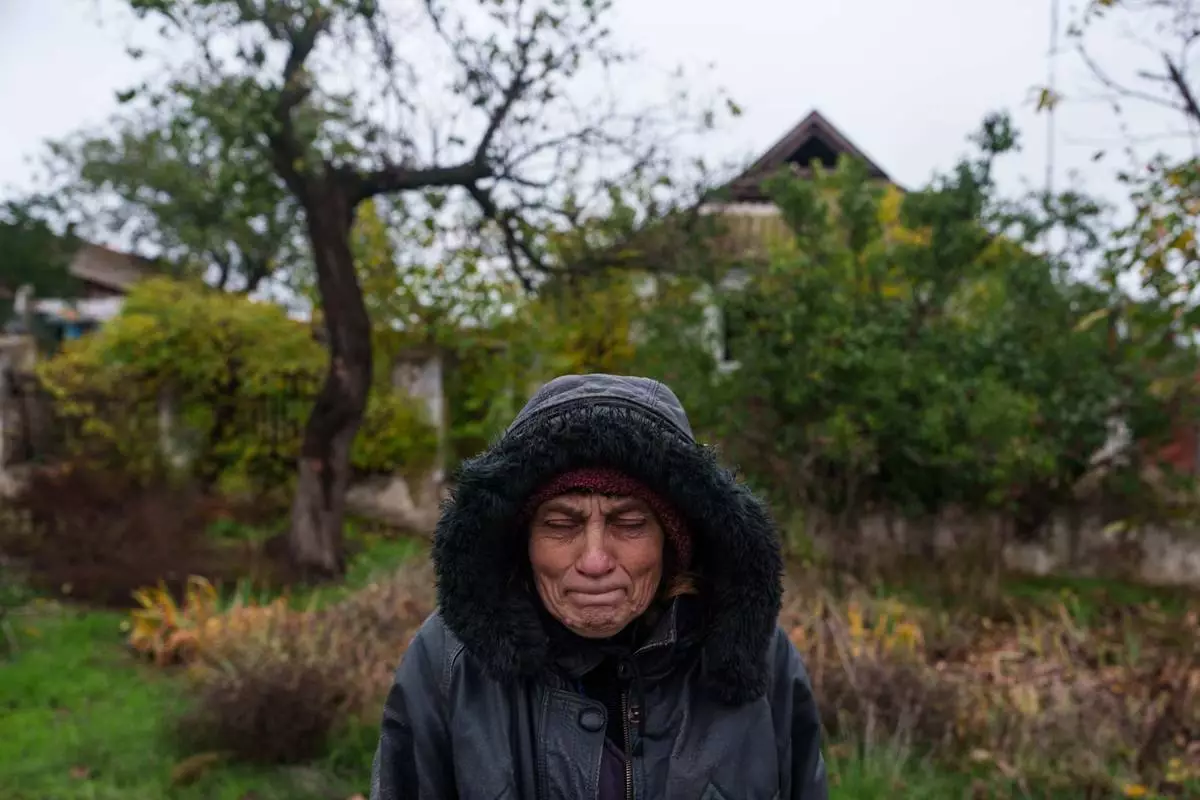
Natalia Diadiuk, 53, a local resident, reacts as she refuses to be evacuated during a localized ceasefire linked to a humanitarian aid mission to Oleshky, in the village of Kozatske, Kherson region, Ukraine, Saturday, Oct. 31, 2026. (AP Photo/Evgeniy Maloletka)
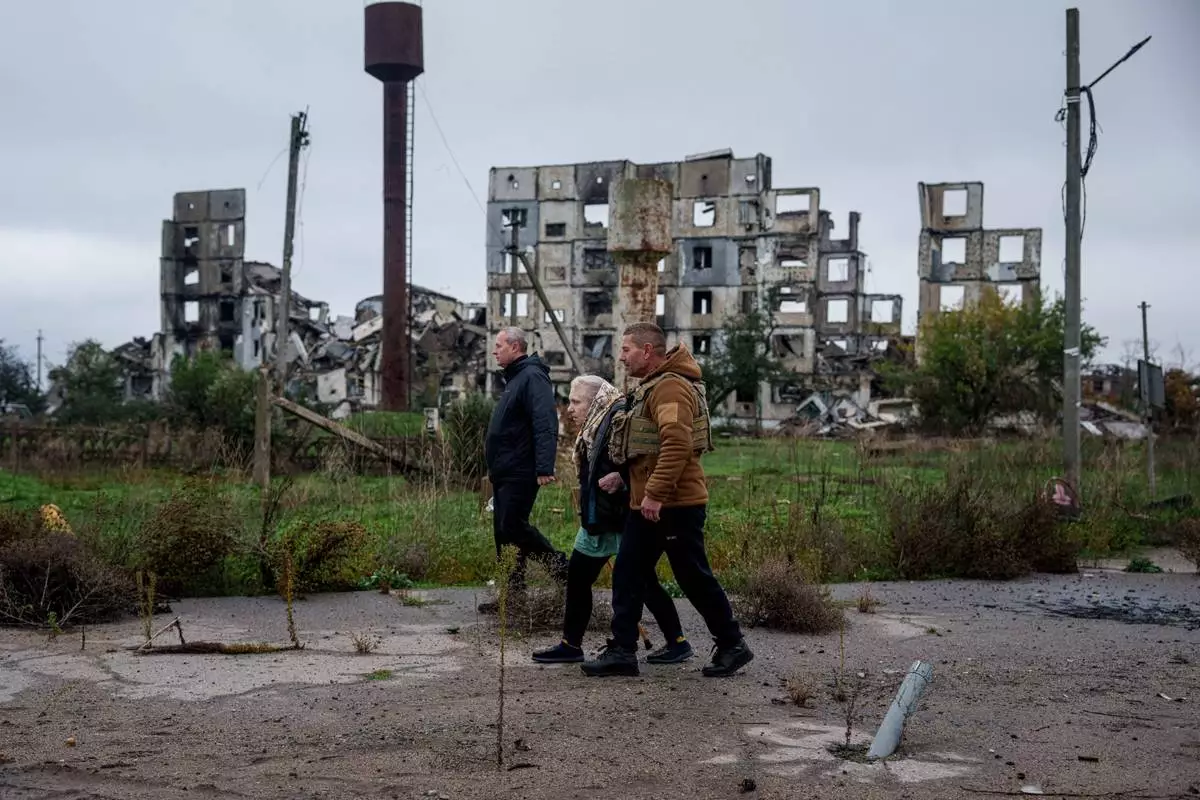
Oleh Tarabaka, head of the Nova Kakhovka military administration, left, and Vadym, a Ukrainian sergeant of the 42nd Marine Brigade, right, help evacuate Antonina, a local resident, as they walk past a destroyed residential building in an area contaminated with anti-personnel mines, during a localized ceasefire linked to a humanitarian aid mission to Oleshky, in the village of Kozatske, Kherson region, Ukraine, Saturday, Oct. 31, 2026. (AP Photo/Evgeniy Maloletka)