WASHINGTON (AP) — Canada might seem an unlikely target for a U.S. trade war.
No country on Earth buys as much from the United States as its northern neighbor. For American farmers, Canada is second only to Mexico as an export market.
A North American trade pact — negotiated by President Donald Trump during his first term — means that most American products enter Canada duty-free. Rankings of the world’s most open economies usually put Canada near the top.
But when Trump looks at Canada, he says, he sees a predator out to cheat the United States and strangle its industries.
America has been “ripped off for 50 years by Canada,” the president declared Saturday when asked if he was considering pulling out of the three-way agreement he signed with the leaders of Canada and Mexico in late 2018.
Relations between the U.S. and Canada have deteriorated since their latest trade talks collapsed Aug. 21. Trump has goaded Canada's leaders with personal attacks and portrayed the longtime U.S. ally as weak. After alienating the Canadian public last year by repeatedly floating the idea of making Canada the 51st state, he signed an executive order last month directing the federal government to change Lake Ontario's name to “Lake America.”
Each side blamed the other for the failed negotiations. Trump slapped 50% tariffs on $20 billion worth of Canadian products three weeks ago to protest what he described as discrimination against U.S. auto, dairy and alcoholic beverage exports.
When Canada's government retaliated Tuesday with tariffs of its own, the president moved to ban imports of the dairy byproduct whey, most alcoholic beverages and motorcycles and mopeds from Canada, though he said several products, including toilet paper, bedsheets and fishing rods, would be removed as tariff targets.
Landing on the list of nations with allegedly unfair trade policies is a jarring turn of events for Canada, a country that built its economy around international commerce. Canada’s trade is equal to 64% of its economic output, the World Bank says, versus 25% for America.
The conservative Heritage Foundation in Washington ranked Canada No. 14 (out of 184 economies) on its Index of Economic Freedom; the United States landed eight spots lower at No. 22. The libertarian Fraser Institute in Vancouver likewise ranked Canada No. 11 (out of 165 countries and territories) on its Economic Freedom of the World report.
Before the latest blowup, Canada’s effective tariff rate on U.S. imports was about 2.4%, less than half the 5% that the United States imposed on Canada, according to calculations by Oxford Economics. Most U.S. exports enter Canada duty-free under the US-Mexico-Canada Agreement that took effect on July 1, 2020.
Despite keeping its economy open to trade overall, Canada does protect several domestic industries. Barry Appleton, co-director of New York Law School’s Center for International Law, calls Canada “a modestly protected economy with two or three genuinely closed sectors.’’
The U.S. has complained for decades, for instance, about what it calls unfair subsidies for Canadian softwood lumber producers. Canada disputes those allegations.
In his 2023 memoir, Robert Lighthizer, U.S. trade representative in Trump’s first term, described Canada as “a quite parochial — and at times quite protectionist — country.’’ The system Canada set up to protect its dairy industry, Lighthizer wrote, “would make a Soviet commissar blush.’’
Canada shields its dairy producers through a convoluted system that imposes tariffs of more than 200% on most dairy products — nearly 300% on some items, such as butter — once they've exceeded a quota, according to Leonard Polzin, a specialist in dairy markets at the University of Wisconsin.
Polzin said the Canadians have a strong incentive to protect their politically sensitive dairy industry from competition with America. Wisconsin alone produces more milk than all of Canada. American dairy producers are so adept at producing large quantities of low-cost milk, Polzin said, that if Canada opened its market completely “we would dump so much product there’s no way they could remain as a viable industry.’’
Trump claimed falsely on social media Tuesday that “Canada doesn’t let our Great Dairy Farmers sell into the Canadian Market.’’
In fact, the United States agreed in the USMCA to allow Canada to continue the supply management system in return for giving American dairy farmers more access to the Canadian market. And American dairy producers have made headway: U.S. dairy exports to Canada rose more than 11% last year on top of an 8% increase in 2024, according to the U.S. Department of Agriculture.
The United States already runs a hefty trade surplus in dairy with its northern neighbor, exporting $1.3 billion worth of dairy products to Canada last year while importing just $585 million, according to the USDA.
Overall, the United States runs a trade deficit with Canada — $27.3 billion last year — and Trump isn’t happy about it.
But the gap between what the U.S. sells to Canada and what it buys can be explained by one industry: oil. Canada exported more than $85 billion worth of crude oil to the United States in 2025.
Refineries in the U.S. Midwest need heavy sour crude oil from Alberta’s oil sands deposits.
“It’s the only oil they can use,” Appleton said. “They can’t use Texas crude. They can’t use Venezuelan crude. They’re not set up for it. It would take years and billions of dollars to shift over.’’
What’s more, the Canadian oil sells at a discount to the benchmark U.S. crude oil.
The neighboring countries need each other economically. Canada sends about 70% of its exports to the United States. U.S. refineries need Alberta’s oil. American farmers need Canadian potash fertilizer. Communities on the northern U.S. border rely on electricity generated in Canada.
So there’s a strong incentive for the two sides to come to an agreement. Inu Manak, senior fellow at the Peterson Institute for International Economics, said that since the U.S. ban on some Canadian products is not set to take effect until Sept. 29, they have time to resume negotiations.
“This is not going to happen for three weeks,” she said. “So it’s like, ‘We’re going to retaliate, but not yet.’ … There could be a way out of this.’’
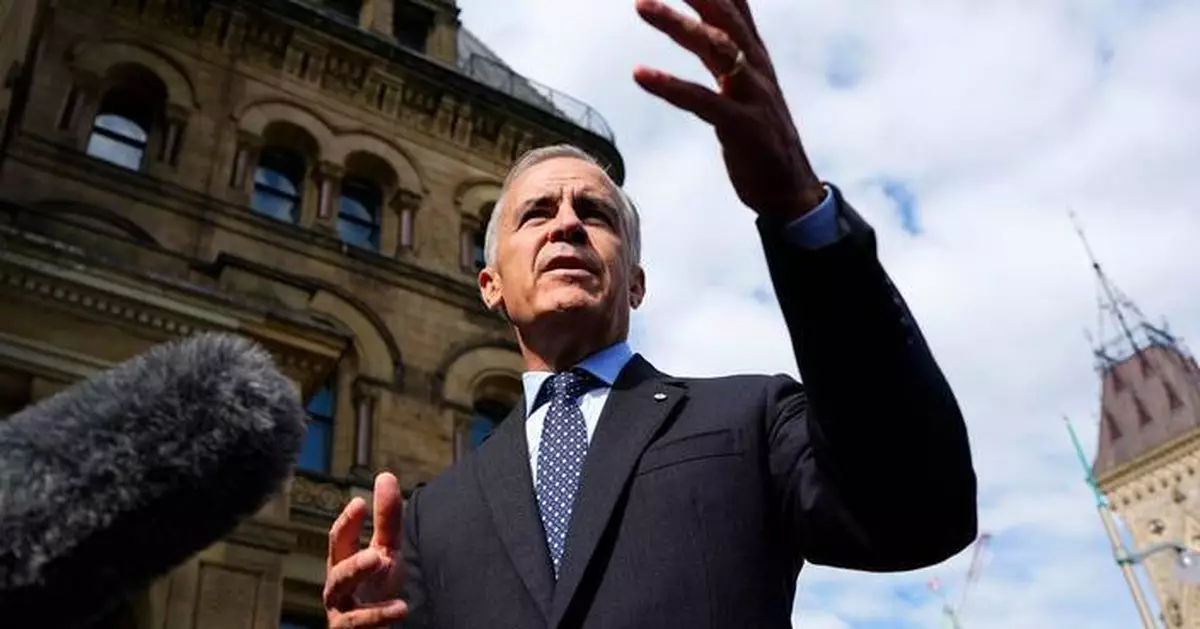
Canadian Prime Minister Mark Carney said his country remained open to an agreement: “Canada is always ready to strike a fair deal.”
Trump said Saturday that once Canada treats American farmers better by lowering tariffs, “you’ll probably see a deal with Canada fairly soon.” Speaking in Dublin alongside Ireland’s prime minister, the president said that Canada, just like Iran, “wants to make a deal very badly” with his administration.
Trump and his trade negotiators also are pushing to get Canada to surrender some of its manufacturing to the United States — a tough sell in Ottawa, according to Manak.
Appleton noted that the trade dispute jeopardizes the USMCA, which helped create a thriving automotive industry that straddles the U.S., Canada and Mexico.
“We had the best integrated North American economy going,’’ he said. “And now we don’t. … This is like having a very bad standoff with your 14-year-old. Nobody’s happy in this game.’’
Associated Press writers Rob Gillies in Toronto and Darlene Superville in Dublin contributed to this story.
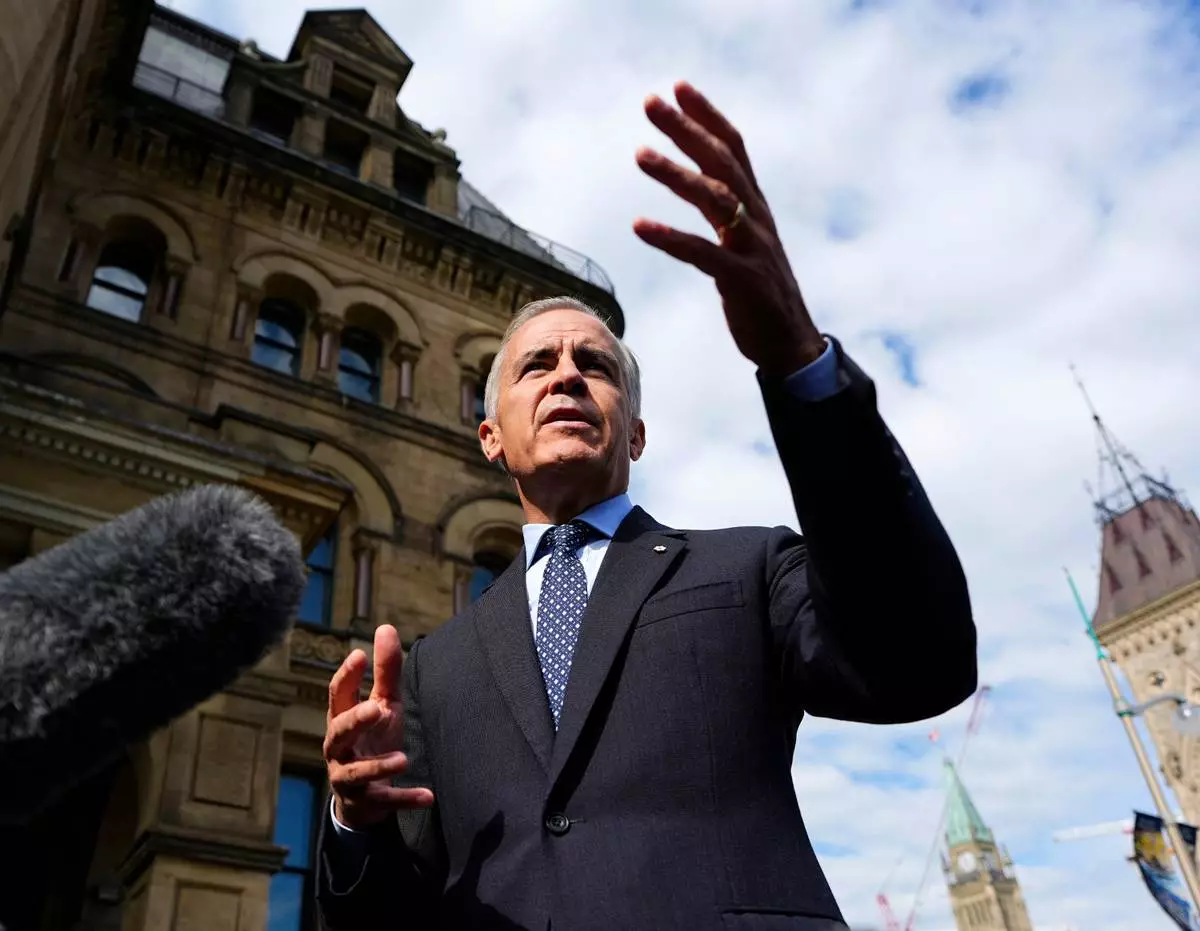
Prime Minister Mark Carney speaks to journalists as he arrives at the Office of the Prime Minister and Privy Council in Ottawa, on Tuesday, Sept. 1, 2026. (Justin Tang/The Canadian Press via AP)
LOS ANGELES (AP) — The U.S. Justice Department failed to secure felony convictions against most of the 102 protesters arrested in four major cities last year on charges of assaulting federal authorities — a record far below the norm in federal assault prosecutions.
All of the dozen cases that made it to trial, mostly in Los Angeles, ended in acquittal, mistrial or dismissal. Experts say that's surprising for a department known for its ability to win at trial. The last three felony assault cases, in LA and Portland, will go to trial this fall.
The dismal record has raised questions about rushed investigations and aggressive charging tactics by prosecutors under pressure to show the Trump administration is cracking down on people who assault law enforcement. It comes as the Justice Department is facing broader setbacks in politically charged investigations, with grand juries repeatedly refusing to return indictments and trial juries granting acquittals.
“Prosecutors tend to win because they control what cases they pursue and they have a lot of resources and discretion,” said Mary Fan, a former federal prosecutor and law professor at the University of Washington.
The fact that the government failed to win any felony assault convictions at trial calls into question “whether or not these charges should have ever been brought in the first place,” she said.
The Associated Press' analysis focused on arrests made during protests last summer and fall in LA, Chicago, Portland, Oregon, and Washington, D.C. — cities with significant protests where President Donald Trump sought to or successfully deployed the National Guard.
Then-Attorney General Pam Bondi said those who interfered with federal law enforcement would face “severe consequences.”
Most of the arrests — 102 — were for felony assault on a federal officer, which can carry a sentence of up to 20 years in prison. Of those cases, 41% were dismissed and 34% were pleaded down to misdemeanors. Ten people pleaded guilty to felony assault. Nine people got prison time.
Of those arrested on other charges, seven were sentenced to prison for offenses including arson and obstructing law enforcement. A handful of defendants have diversion agreements, meaning their case will be dismissed if they demonstrate good behavior.
The AP's analysis shows that the Justice Department’s record failed to meaningfully improve since December, when an initial assessment showed early struggles to prosecute people on the charges for which they were arrested.
The Justice Department said in a statement that federal prosecutors are right to prioritize cases against people accused of assaulting federal officers and that “each case is based on the facts.”
“If there are mitigating factors identified in a case, then prosecutors must also act appropriately to inform the court, and in some cases downgrade or drop charges," the department said.
It’s rare for federal prosecutors to lose at trial. In 2024, 82% of defendants charged with felony or misdemeanor assault were convicted at trial or with a plea deal, according to data from the Administrative Office of the U.S. Courts. AP’s analysis found that less than half of the protesters charged for either felony or misdemeanor assault were convicted.
In Portland, a jury couldn’t reach agreement on felony assault charges for Oriana Korol, who was playing clarinet in a marching band demonstrating outside the city’s ICE building last October when a scuffle involving officers broke out. Officers pepper sprayed her and pushed her to the ground, where she struck one with her foot, according to court documents.
After a mistrial, prosecutors filed a reduced misdemeanor assault charge. She pleaded guilty and was sentenced Sept. 1 to time served and one year of supervised release.
Her attorneys wrote in a court filing that she “has accepted responsibility for the bad choices she made over a few seconds that caused no injury.”
Jonathan Caravello, a lecturer at California State University Channel Islands, was acquitted of assault on a federal officer after a three-day trial. He was accused of throwing a tear gas canister deployed by immigration agents back at them while protesting a raid at a Southern California cannabis farm.
Caravello said he was trying to get the canister away from the crowd. Videos showed he had tossed it high above officers’ heads and it landed far behind them. The jury acquitted Caravello after a quick deliberation.
“They’re trying to get a chilling effect out of these charges,” said Caravello, who turned down a misdemeanor plea deal.
Michael Rabbitt was among six co-defendants accused of felony conspiracy to impede a government vehicle from accessing an ICE facility near Chicago last September.
The vehicle slowly advanced despite being surrounded by protesters, leading some to put their hands on it, Rabbitt said.
After the government dismissed charges against two of the defendants, defense attorneys requested transcripts of the grand jury proceedings that led to the conspiracy indictment. The government eventually dropped the conspiracy charge and proceeded on misdemeanor counts of impeding a federal officer.
The judge later reviewed the unredacted transcripts and admonished prosecutors for improper behavior before the grand jury. The charges were dismissed days before trial.
Rabbitt said he was proud they fought the charges.
“This case was bigger than us,” he said. “I’m proud that we won this case, not just for us, but for protesters across the country.”
Though many federal criminal cases end in plea deals, some legal experts say it's rare for felony assault to be pleaded down and may signal overcharging — filing a more severe initial charge so defendants will be more willing to plead guilty to one with a lighter sentence.
“I think when prosecutors bring charges ethically, they should be prepared to prove them beyond a reasonable doubt,” said Laurie Levenson, a former federal prosecutor who is a professor at Loyola Law School in Los Angeles.
The U.S. Attorney’s office overseeing Los Angeles said it brought the prosecutions in response to a “wave of violence against law enforcement officers who were doing their jobs." It voluntarily dismissed charges against some defendants after further investigation, it said.
LA prosecutors have arrested three additional people for felony assault at immigration-related protests this year. One pleaded guilty to a felony and two to misdemeanors.
In Chicago, all but one of 19 felony assault cases were dismissed. The U.S. Attorney’s offices in the Northern District of Illinois, District of Columbia and Oregon did not respond to requests for comment.
A man accused of throwing a Molotov cocktail at a hotel outside Los Angeles where federal authorities were staying was sentenced to five years in prison. Two others were sentenced to more than three years after pouring lighter fluid on a burning California Highway Patrol vehicle.
Federal judges sentenced eight people to decades in prison for their participation in a demonstration outside a detention center in Texas last July where a police officer was shot in the neck.
Three people were convicted at trial of conspiracy to impede or injure an officer for protesting outside a detention facility in Spokane, Washington, last June. The Spokane and Texas cases were not included in AP’s analysis because they did not occur in one of the four cities where Trump tried to or deployed troops.
__
Rush reported from Portland, Oregon. Associated Press writers Eric Tucker and Alanna Durkin Richer contributed from Washington.
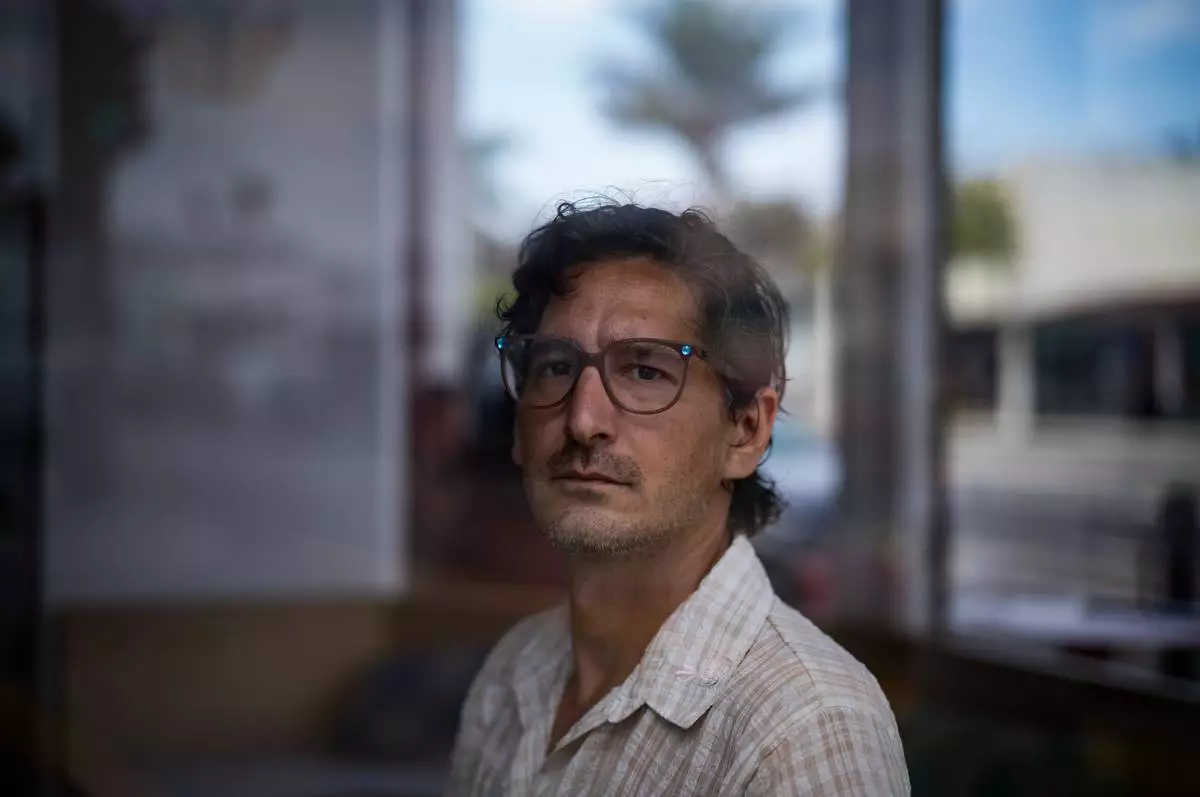
Jonathan Caravello, a lecturer at California State University Channel Islands, sits for a photo in Ventura, Calif., Friday, Aug. 28, 2026. (AP Photo/Jae C. Hong)
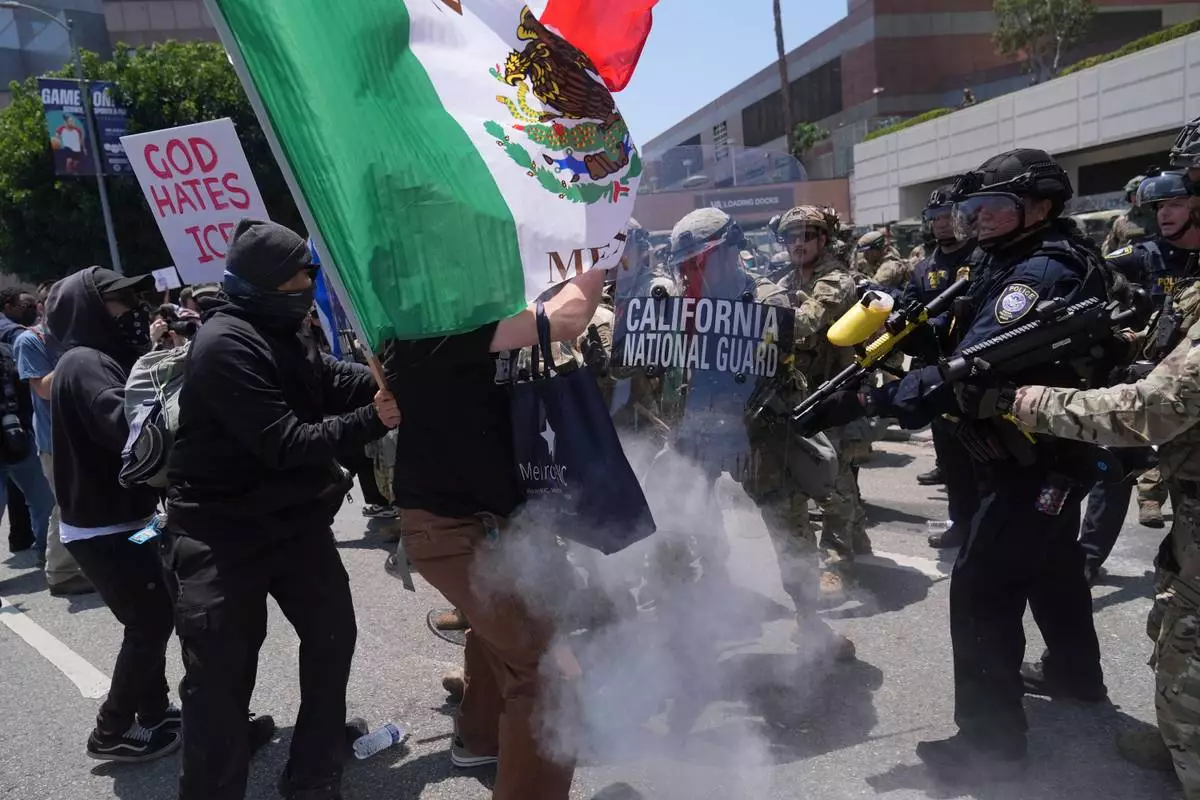
FILE - Protesters clash with authorities in downtown Los Angeles, June 8, 2025, following the night's immigration raid protest. (AP Photo/Jae Hong, File)
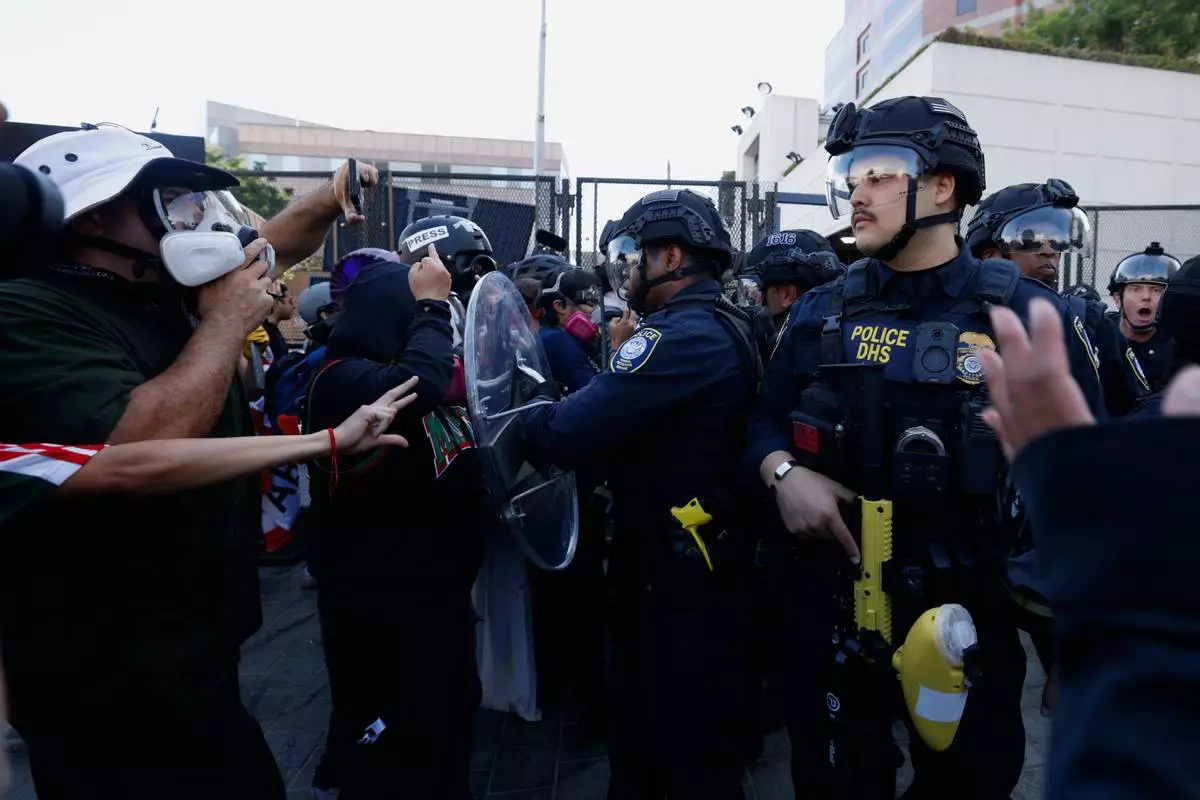
FILE - Protesters confront federal law enforcement agents outside the Metropolitan Detention Center on June 6, 2026, commemorating federal immigration raids and community protests one year ago in Los Angeles. (AP Photo/Jill Connelly, File)
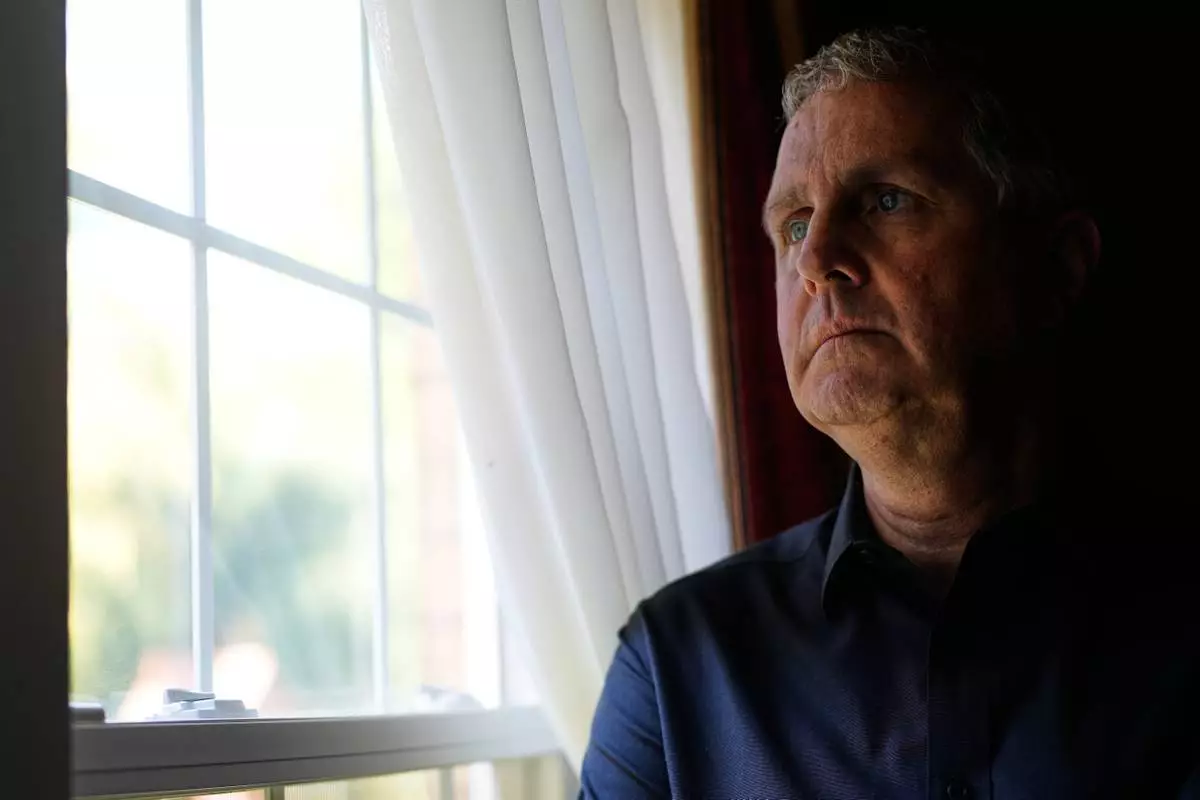
Michael Rabbitt poses for a photo at his home in Chicago, Thursday, Aug. 27, 2026. (AP Photo/Nam Y. Huh)