The 16th Asia-Pacific Economic Cooperation (APEC) Energy Ministerial Meeting concluded in Beijing on Friday with fruitful outcomes.
Ministers and representatives from APEC member economies, along with heads of international organizations, held candid, in-depth and constructive discussions over a day and a half of discussions.
The meeting issued a joint statement and adopted three specialized documents: the Vision and Proposed Actions on Universal Access to High-Quality Energy in APEC, the APEC Policy Recommendations on the Mutual Enhancement Between AI and Energy in the Asia-Pacific, and the APEC Non-binding Principles for Promoting Energy Security Synergy.
As the APEC 2026 host, China introduced five voluntary contributions addressing technological and practical challenges that member economies face in energy transition and urban development. Delivered through policy reports, technical solutions and capacity-building programs, these contributions are open to all economies, according to the National Energy Administration.
"These five contributions cover power system resilience, zero-carbon city development and clean energy growth, drawing on China's mature technologies and complete industrial chains in ultra-high-voltage transmission, flexible direct current, offshore wind power, shared energy storage and smart microgrids. By compiling and publishing these solutions, we aim to help economies lower the cost of technological exploration and accelerate their transitions in ways suited to local conditions," said Wang Jianbo, deputy director of the National Energy Administration
The APEC Policy Recommendations on the Mutual Enhancement Between AI and Energy marks the organization's first consensus document focused on two-way AI-energy empowerment. It defines both the supporting role of energy systems for computing infrastructure and the value of AI in boosting energy efficiency and resilience.
"Participants agreed to establish a Task Force on the Mutual Enhancement of AI and Energy under the APEC Energy Working Group. This is an important institutional innovation from the meeting, offering a new platform for technical cooperation and policy exchange among APEC economies in this field," said Wang Hongzhi, director of the National Energy Administration.

APEC energy ministers conclude Beijing meeting with wide-ranging outcomes
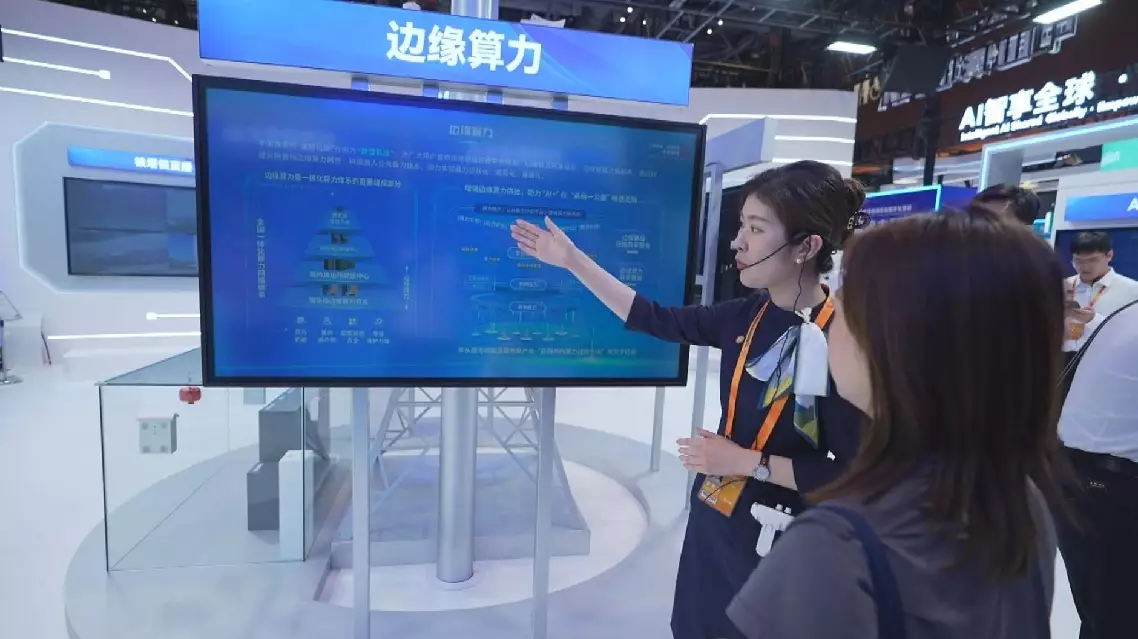
Computing power services are gaining momentum as artificial intelligence (AI) technology evolves, opening new avenues for the development of trade in services and becoming a highlight of the ongoing 2026 China International Fair for Trade in Services (CIFTIS) in Beijing.
The five-day CIFTIS opened on Wednesday, drawing participants from 90 countries, regions and international organizations, with over 1,800 companies showcasing their service products on-site.
Exhibitors at the 2026 Thematic Exhibition: Telecommunications, Computers and Information Services are shifting their focus from traditional communication offerings to integrated services combining computing power and AI.
"Currently, we operate over 2 million base stations, and each base station has a supporting communication machine room. We have integrated computing facilities into these machine rooms, upgrading them into data centers that can provide localized, distributed computing services. This enables real-time computing support for applications such as AI-powered forest fire prevention, disaster mitigation, and water quality monitoring in local areas," said Qiao Zhi, a staff member of China Tower Beijing Branch.
Beyond these application services, China's industry chain leaders are showcasing a broad array of innovative solutions at the upstream segment, including chip design, testing, verification, and technical licensing. Chinese service providers are offering tailored solutions for a diverse range of regions and markets.
"For example, European and American clients tend to prefer large-model, high-performance chips, while clients from the Middle East and Southeast Asia focus more on edge-side AI chips, mainly to assist their smart city projects and robotics initiatives. Chinese enterprises can meet the customized demands of different regions, different customers and different scenarios," said Wang Wenqian, head of research and development of the Joinsilicon, which provides customized products and solutions for the semiconductor industry.
Services that can be digitally delivered, including those related to computing power, are becoming an important engine driving the growth of services trade. According to China's Trade in Services Development Index Report 2026 released at the CIFTIS, the share of digitally deliverable services in global services exports rose to 57.9 percent in 2025.
Computing power services emerge as new growth driver for trade in services