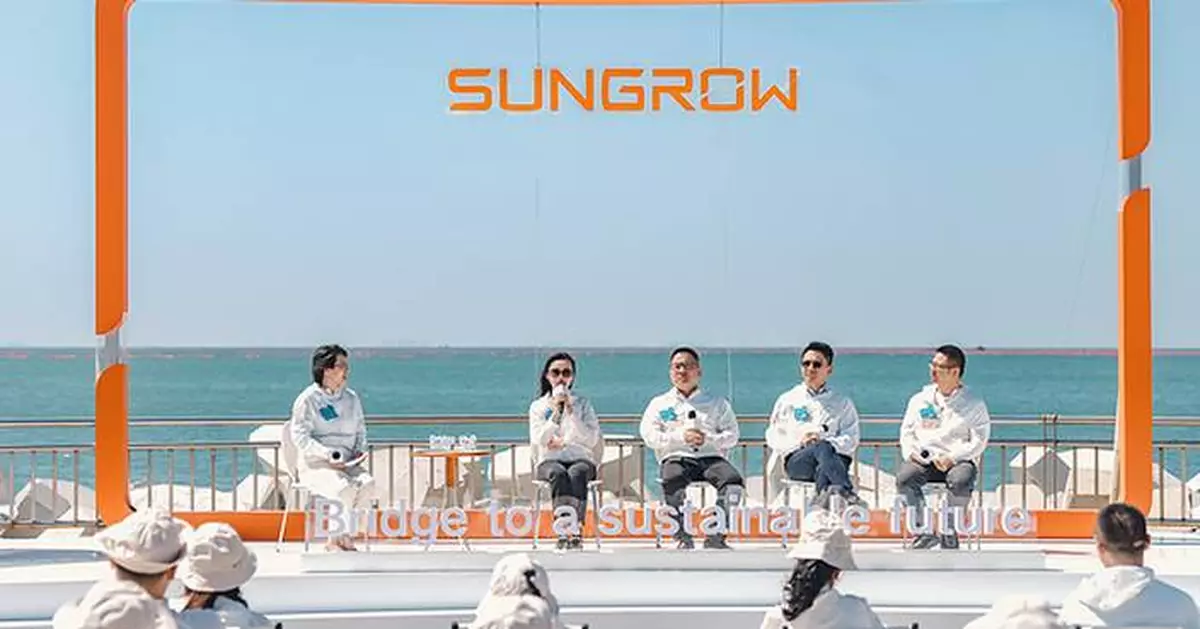
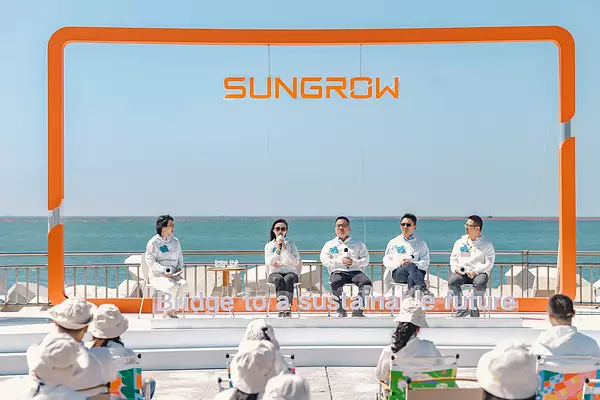
YANTAI, China, Sept. 14, 2026 /PRNewswire/ -- Sungrow, a global leading renewable energy company, recently hosted the latest edition of its PhD Talk series in China's Bohai Bay, bringing together experts and industry representatives in offshore PV, island microgrids, deep-water offshore wind and marine conservation.
Under the theme "The Power of Bridge: Bridge to The Deep Blue," the event identified five key trends shaping offshore renewables in the move from demonstration projects toward commercial deployment.
Offshore systems must withstand salt spray, high humidity, waves, tides and typhoons while navigating limited operation and maintenance (O&M) windows, insufficient grid support and coordination across multiple types of equipment.
Trend 1: Scenario-Defined Design Replaces a One-Size-Fits-All Approach
Offshore equipment cannot simply replicate land-based products, and different marine environments demand different designs. David Sun, General Manager of the R&D Center at Sungrow's Utility PV Business Unit, noted that tropical waters bring heat and humidity, cold-water environments create condensation risks, and nearshore industrial zones expose equipment to chemical corrosion.
Sungrow therefore uses a unified, high-standard technology platform while adapting materials, sealing processes and thermal management strategies to local conditions.
Trend 2: AI-Powered Reliability Supports Offshore Solar's Move to Commercial Scale
As offshore PV moves from demonstration projects toward commercial operation, harsher environmental loads and mounting cost pressures remain key challenges, according to Hui Xing, Chief Engineer of POWERCHINA Northwest Engineering Corporation Limited's New Energy Engineering Institute.
David further emphasized that project economics extend beyond upfront equipment costs to downtime, offshore inspections and long-term maintenance. Sungrow's Smart IV Curve Diagnosis identifies string faults, while self-learning algorithms monitor inverter air-duct health, enabling early warnings and dust removal. MPPT-level insulation detection reduces fault-location time to one-sixth of that required by conventional inverter-level diagnosis, while AI-based fault localization pinpoints issues to individual modules within a string.
Trend 3: Lifecycle Reliability and Proactive Safety Become Core Design Requirements
The SG465HX utility string inverter incorporates IP66 protection, C5-H corrosion resistance, a fully sealed electronics chamber, an IP68-rated fan, weather-resistant sealing materials and intelligent active dehumidification.
In a 1,440-hour cyclic neutral salt spray test (two hours in 5% sodium chloride spray and 22 hours at 40±2°C and 93% relative humidity per cycle), no corrosion appeared on the enclosure, structural parts or core internal components. Sungrow also received a third-party C5-H certification report.
The inverter's proactive safety features include intelligent string shutdown, AC and DC terminal temperature monitoring, a DC switch with a trip mechanism, and 24-hour insulation monitoring. Sungrow also developed two-stage waterproof terminal caps for protection during transportation, construction and long-term operation, including IP68-rated PA66 caps for unused terminals. A dedicated offshore DC switch uses corrosion- and wear-resistant coatings to reduce the risk of contact sticking and failure to interrupt fault current caused by salt spray.
Trend 4: Grid-Forming Technology Becomes the Backbone of Island Microgrid Stability
Island microgrids face three core challenges: generation uncertainty, load uncertainty and the absence of external grid support, making grid-forming technology and coordinated power-system control essential to stable power supply, according to Dr. Liu Hangyue, Deputy General Manager of Sungrow's Microgrid and Grid Solutions Center.
David said Sungrow's inverter portfolio offers grid-forming capability under all grid conditions, letting PV inverters in microgrids establish voltage and support frequency through grid-forming algorithms. In PowerMatrix, each sub-array can operate independently in grid-forming mode, enabling 10-millisecond voltage stabilization and a 5-millisecond inertia response.
Future island energy systems will require coordinated control across solar, wind, storage, the grid and loads, rather than relying on individual devices alone.
Trend 5: Deep-Water Offshore Wind Shifts from Equipment Adaptation to System-Level Co-Design
As offshore wind expands into deeper waters and farther from shore, the challenge is shifting from individual-device reliability to system-wide coordination and value-chain collaboration. Larger turbines can reduce costs and improve efficiency but introduce new issues involving fluid-structure interaction, material properties and multidisciplinary coordination, according to Xu Guodong, Deputy Chief Engineer of Windey Energy Technology Group.
Addressing this shift, Dr. Wang Lingxiang, Vice President of Sungrow and President of its Wind Energy Business Unit, said deep-water sites, evolving power-system requirements and complex marine conditions place greater demands on the reliability, overload capability and intelligent O&M of wind converters.
Electrical equipment must move from passive adaptation to active integration through system-level co-design with generators, cables and transformers, as well as participation in turbine load control and intelligent shutdown strategies. Grid-forming applications must also reflect specific grid-connection and power-transmission configurations, strengthening grid support while safeguarding generators and managing turbine loads. Hardware upgrades should be based on system design requirements.
Beyond technology, Sungrow Foundation joined WWF and the One Planet Foundation to launch a marine "Sun Forest" ecological restoration initiative in Bohai Bay, aiming to restore seagrass and macroalgal beds to improve marine habitats. The foundation also donated a 10.35 kW/10 kWh solar-plus-storage system, expected to generate approximately 12,000 kWh annually, to support emergency and stable power supply for an island community.
This edition of Sungrow's PhD Talk series traced the industry's shift from a focus on individual equipment performance toward scenario-specific design, lifecycle reliability, intelligent O&M and system-wide coordination. To support this transition, Sungrow will continue exploring solutions for different marine environments and energy applications through innovation in power conversion and grid technologies.
** This press release is distributed by PR Newswire through automated distribution system, for which the client assumes full responsibility. **
Sungrow PhD Talk Outlines 5 Key Trends in Offshore Renewables
CHENGDU, China, Sept. 14, 2026 /PRNewswire/ -- Sichuan Kelun-Biotech Biopharmaceutical Co., Ltd. ("Kelun-Biotech" or "the Company", 6990.HK) announced that results from the phase III registrational study of its novel human epidermal growth factor receptor 2 (HER2)-targeted antibody–drug conjugate (ADC) trastuzumab botidotin (舒泰莱®) in HER2-positive unresectable or metastatic breast cancer (BC) have been published in Journal of Clinical Oncology (JCO, impact factor (IF)=44.7). Professor Xichun Hu and Professor Hongxia Wang of Fudan University Shanghai Cancer Center, and Dr. Junyou Ge, Director of the National Engineering Research Center of Targeted Biologics act as the co-senior authors. Professor Jian Zhang of Fudan University Shanghai Cancer Center, Professor Quchang Ouyang of Hunan Cancer Hospital, Professor Qingyuan Zhang of Harbin Medical University Cancer Hospital, Professor Huihui Li of Cancer Hospital of Shandong First Medical University, and Professor Xu Wang of Tianjin Medical University Cancer Institute and Hospital act as the co-first authors. These findings had previously been selected as a Late-Breaking Abstract (LBA) and presented as an oral presentation at the 2025 European Society for Medical Oncology (ESMO) Congress.
This randomized, open-label, multicenter phase III study was designed to evaluate the efficacy and safety of trastuzumab botidotin monotherapy versus trastuzumab emtansine (T-DM1) in patients with HER2-positive unresectable or metastatic BC who had received prior trastuzumab and taxane-containing regimens. A total of 365 patients were randomized 1:1 to receive trastuzumab botidotin or T-DM1. The primary endpoint was progression-free survival (PFS) assessed by blinded independent central review (BICR), and secondary endpoints included overall survival (OS), objective response rate (ORR), and duration of response (DoR).
As of the data cutoff date of April 26, 2025, with a median follow-up of 14.9 months, efficacy results showed:
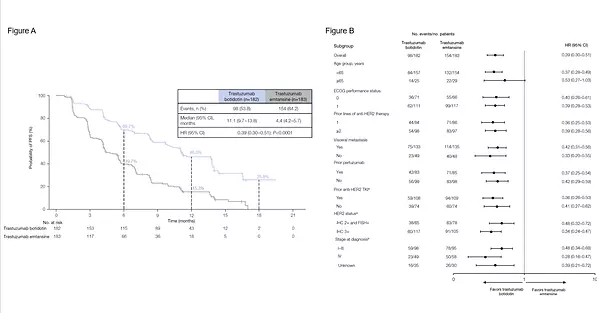
- Median PFS was significantly prolonged in the trastuzumab botidotin group compared with the T-DM1 group (11.1 months vs. 4.4 months; hazard ratio (HR) = 0.39) (Figure A), meeting the primary endpoint of the study; consistent PFS benefit was observed across all prespecified subgroups (Figure B).
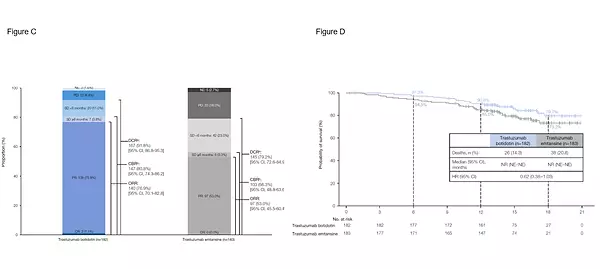
- Trastuzumab botidotin group demonstrated deeper and more durable tumor responses compared with T-DM1 group, with an ORR of 76.9% vs. 53.0% and a median DoR of 12.2 months vs. 5.7 months (Figure C).
- OS data were not mature in both groups, but an OS benefit trend was observed in trastuzumab botidotin group, demonstrating a 38% reduction in the risk of death (Figure D).
In terms of safety, patients in the trastuzumab botidotin group had a low incidence of interstitial lung disease (ILD), and the incidences of hematologic, hepatic, and gastrointestinal toxicities were notably lower than those in the T-DM1 group, along with lower rates of serious adverse events (SAEs) and treatment discontinuations. The most common treatment-related adverse events (TRAEs) in trastuzumab botidotin group were ocular events, which could be recovered or reversed after management with standardized strategies.
The publication of the phase III results for trastuzumab botidotin in Journal of Clinical Oncology marks a major international academic breakthrough for a domestically developed HER2 ADC backed by high-level clinical evidence. This is the first phase III trial in China for a HER2 ADC compared head-to-head with T-DM1 with positive results. The data showed that trastuzumab botidotin demonstrated improvements in key efficacy endpoints including PFS, ORR, and DoR, along with a favorable safety profile. Based on these positive results, trastuzumab botidotin has been approved by China's National Medical Products Administration (NMPA) for the treatment of second-line or later HER2-positive BC, becoming the first domestically developed HER2 ADC approved for this indication in China and providing a new treatment option for patients with HER2-positive advanced breast cancer.
About Trastuzumab botidotin(舒泰莱®)
Trastuzumab botidotin is a differentiated HER2 ADC to treat advanced HER2+ solid tumors. As an innovative HER2 ADC developed by the Company, it conjugates a novel, monomethyl auristatin F (MMAF) derivative (a highly cytotoxic tubulin inhibitor, Duo-5) via a stable, enzyme-cleavable linker to a HER2 monoclonal antibody with a DAR of 2. Trastuzumab botidotin specifically binds to HER2 on the surface of tumor cells and is internalized by tumor cells, releasing the toxin molecule Duo-5 inside the cell. Duo-5 induces tumor cell cycle arrest in the G2/M phase, leading to tumor cell apoptosis. After targeting HER2, trastuzumab botidotin can also inhibit the HER2 signaling pathway; it has antibody-dependent cell-mediated cytotoxicity (ADCC) activity.
Based on the results of a multi-center, randomized, open-label, controlled Phase 3 KL166-III-06 study, trastuzumab botidotin was approved for marketing by the NMPA for adult patients with unresectable or metastatic HER2 positive BC who have received one or more prior anti-HER2 therapy. At a pre-specified interim analysis, trastuzumab botidotin monotherapy demonstrated a statistically significant and clinically meaningful improvement in the primary endpoint of PFS as assessed by the BICR compared with T-DM1; the beneficial trend for OS of trastuzumab botidotin was also observed.
Currently, the Company has initiated an open, multi-center Phase 2 clinical study of trastuzumab botidotin in the treatment of HER2+ unresectable or metastatic BC that previously received a topoisomerase inhibitor payload ADC.
About Kelun-Biotech
Kelun-Biotech (6990.HK) is a holding subsidiary of Kelun Pharmaceutical, which focuses on the R&D, manufacturing, commercialization and global collaboration of innovative biological drugs and small molecule drugs. Kelun-Biotech focuses on major disease areas such as solid tumors, autoimmune, inflammatory, and metabolic diseases, and in establishing a globalized drug development and industrialization platform to address the unmet medical needs in China and the rest of world. Kelun-Biotech is committed to becoming a leading global enterprise in the field of innovative drugs. At present, Kelun-Biotech has more than 30 ongoing key innovative drug projects, of which 4 projects with 8 indications have been approved for marketing, 2 projects with 3 indications are in the NDA stage and more than 10 projects are in the clinical stage. Kelun-Biotech has established one of the world's leading proprietary ADC and novel DC platforms, OptiDC™, and has 2 ADC projects with 5 indications approved for marketing, and multiple ADC and novel DC assets in clinical or preclinical research stage. For more information, please visit https://en.kelun-biotech.com/.
** This press release is distributed by PR Newswire through automated distribution system, for which the client assumes full responsibility. **
Results from Phase III Study of Trastuzumab Botidotin versus T-DM1 in HER2-Positive Breast Cancer Published in JCO
Results from Phase III Study of Trastuzumab Botidotin versus T-DM1 in HER2-Positive Breast Cancer Published in JCO