China plays an important role in empowering countries in the Global South with its rich experience in development across the board, including in education, infrastructure, technology and long-term planning, a Brazilian scholar said reacting to Chinese President Xi Jinping's speech at the 18th BRICS Summit.
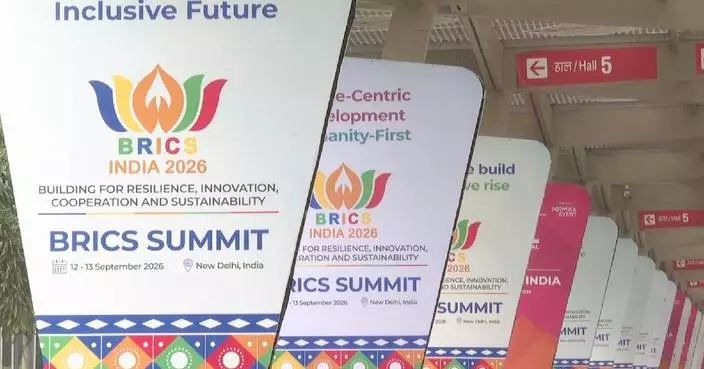
Xi attended Session II of the 18th BRICS Summit in New Delhi and delivered a speech on Sunday.
In his speech, the Chinese leader proposed five initiatives on "greater BRICS" cooperation in the areas of AI, trade and investment facilitation, the digital industry, smart manufacturing, and talent development.
"The most important point is that empowering the Global South cannot mean only giving it a stronger political voice and it must also mean giving it development capacity, and this is why Xi Jinping’s five initiatives are particularly significant. These initiatives address AI, trade, intelligent manufacturing, etc. So, this is where I believe China has a particularly important role. China's own developing experience demonstrates the importance of connecting all these issues, education, infrastructure, technology, long-term planning," Evandro Menezes Carvalho, a professor of International Law at Fluminense Federal University in Brazil, said in an interview with China Global Television Network (CGTN) via video link on Monday.
"Therefore, BRICS can help move the Global South from being primarily a consumer of technologies and a rule taker to become a producer of technologies and a rule shaper. That, ultimately, is what empowerment means. Not replacing one center of power with another, but creating the conditions for developing countries to acquire autonomy, development capacity, a voice in shaping the future. This is the main objective of BRICS," he added.
He said BRICS not only provides a platform to enhance China-India cooperation but also shows the world how to collaborate while bridging differences.
"India holds the BRICS presidency this year and China will assume it next year. This creates an unusual two-year window for continuity. Beijing and New Delhi can demonstrate that leadership in BRICS is a shared responsibility. Chinese and Indian officials have already emphasized cooperation between them. And there is a larger historical point. If China and India cooperate, the voice of the Global South becomes considerably stronger. So, BRICS can become more than a platform where China and India meet. It can become a platform where they learn to manage differences through cooperation. And that would send a powerful message for all countries in the world. Multipolarity requires the ability to coexist, cooperate and build common interests despite differences," he said.

China plays key role in empowering Global South countries: Brazilian scholar