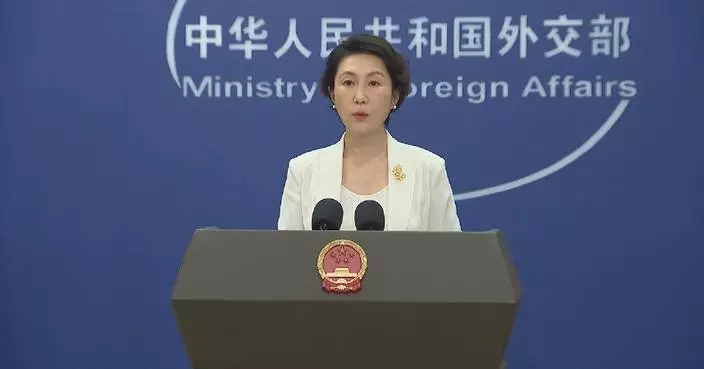
The Beijing Xiangshan Forum, which opened on Tuesday, has provided an inclusive platform for countries to express their views and address security concerns, according to a Chinese military expert recently.
The three-day event, themed "Build Consensus on Stability, Advance Security Governance Together", features four plenary sessions and eight parallel sessions.
"Countries can fully utilize the Beijing Xiangshan Forum as a platform to articulate their views; its non-exclusive nature is its most significant characteristic. For instance, many nations often overlooked by the international community can leverage the forum's platform to voice their security concerns, making the event constructive in a meaningful sense. It also resonates with the concept of 'common security' found in the Global Security Initiative proposed by China," said Fu Zhengnan, a research fellow at the People's Liberation Army (PLA) Academy of Military Sciences.
Delegations from almost 100 countries, regions and international organizations are attending the forum, with more than 60 representatives at the ministerial or military chief level and above.
The forum also includes closed-door seminars on sensitive issues, including the Ukraine crisis and the situation in the Middle East.
Launched in 2006 as a "track-two" think-tank exchange, the Beijing Xiangshan Forum has expanded over the past two decades to bring together government officials, military leaders and scholars from around the world.

Xiangshan Forum promotes inclusive security dialogue, cooperation: military expert
A super El Nino event officially formed in September 2026, monitoring data from China's National Climate Center showed on Friday.
Zhao Junhu, chief forecaster at the center, said that the equatorial central and eastern Pacific entered an El Nino state in May this year, with sea surface temperatures in the key monitoring region rising rapidly and continuously from May to September.
The three-month running mean of the sea surface temperature (SST) index in the monitoring region has remained above 0.5 degrees Celsius for five consecutive months. The index exceeded 2.5 degrees Celsius for the July-September period, meeting the threshold for a super El Nino event.
The event is classified as an eastern Pacific-type El Nino, in which the warmest sea surface temperatures are concentrated in the equatorial eastern Pacific.
Monitoring data showed that sea surface temperatures across most of the equatorial Pacific in September were above average of the same period, with temperatures in the warm pool of the eastern Pacific exceeding the climatological average by more than 3 degrees Celsius.
The SST index for the monitoring region reached 2.94 degrees Celsius in September, up 0.35 degrees Celsius from August. The average index for the July-September period stood at 2.54 degrees Celsius.
Based on a combination of domestic and international dynamical climate models and statistical forecasting methods, the center expects sea surface temperatures in the equatorial central and eastern Pacific to continue rising over the next three months, peaking in late autumn or early winter, Zhao said.
The event is expected to become the strongest El Nino on record since systematic monitoring began, he added.
Super El Nino event formed in September: China's National Climate Center