A joint excavation at Karnak Temple Complex in southern Egypt's Luxor, conducted by a team of Egyptian and Chinese archaeologists, has uncovered a relief of Hapi, the deity associated with the Nile's annual flood.
The relief, in an unexpectedly archaic style that may offer fresh clues to Egyptian religious and artistic life more than 2,500 years ago.
The team also reported the discovery of a previously undocumented sacred lake, a relief depicting a sacred female figure and inscribed stone fragments at the Montu precinct within the Karnak Temple Complex.
Since the collaboration began in 2018, the team has uncovered the complete architectural layouts of five chapels dedicated to Osiris, the ruler of the underworld.
In the fifth chapel, excavated recently, archaeologists reassembled fallen blocks into a wall, revealing reliefs of Hapi, depicted as a pair of twin figures, carrying offerings toward the temple entrance.
"They are holding offerings and facing the temple entrance, with one pair on the left and another on the right. Each is there to present an offering. In front of each Hapi figure is an inscription identifying what is being offered," said team member Wen Jing, an associate research fellow at the Chinese Academy of Social Sciences’ Institute of World History.
For ancient Egyptians, the Nile's annual floods brought water and left fertile silt across the fields, allowing farmers to plant crops. Hapi, associated with that abundance, became a symbol of sustenance and life. Hapi was frequently depicted as a pair of plump deities, symbolizing the unification of Upper and Lower Egypt.
"The Nile's abundance had to be expressed in ancient Egyptian reliefs and wall paintings. But abundance is abstract. How do you depict it? They portrayed a plump male figure to tell people that this was Hapi, the Nile's bounty," Wen said.
Hapi's presence in chapel dedicated to Osiris may seem unexpected, but ancient Egyptian temples were not reserved for a single deity. Gods from across the pantheon often appeared together, with overlapping roles and associations.
"For ancient Egyptians, the gods were one big family. It was as though they all knew one another. Other gods often appear in the temple of a particular god. Hapi appears especially often because he represents the bounty of the Nile," Wen said.
The fifth chapel was built during the 25th and 26th Dynasties, roughly 747 to 525 BCE.
Yet the plumpness of the Hapi figures recall an artistic tradition associated with the Old Kingdom, Egypt's pyramid-building era, which had ended more than 1,500 years earlier.
"Figures from the 26th Dynasty were slenderer, but these Hapis are rather round, perhaps overly round. By then, Egypt had weakened somewhat and was no longer as powerful as it had been in the Old Kingdom, during the age of the pyramids. People may have looked to their roots, incorporating earlier artistic styles into the architecture of their own time as a way of seeking cohesion," Wen said.
Hapi continued to appear on temple walls through the Ptolemaic period, from 305 to 30 BCE, Egypt's final ancient dynasty. The new reliefs offer another clue to the enduring popularity of a deity whose image was bound to the Nile and the civilization it sustained.
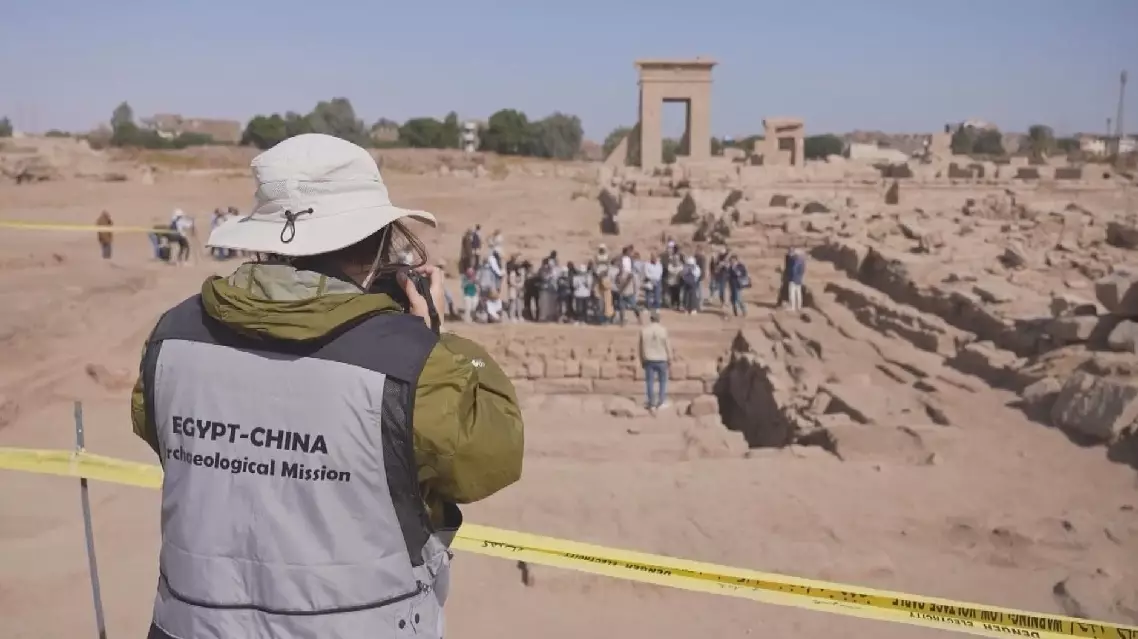
Archaeologists from Egypt, China unearth Nile god relief at Karnak