WAKEFIELD, Mass.--(BUSINESS WIRE)--Sep 16, 2026--
Quality management systems form the foundation for clearly defined and documented business processes. With the publication of ISO 9001:2026, companies are entering the implementation phase of the world’s most important standard for quality management systems. TÜV SÜD is highlighting the practical implications of the revision. In addition to adapting existing management systems, companies should also consider the impact on industry-specific quality standards based on ISO 9001.
This press release features multimedia. View the full release here: https://www.businesswire.com/news/home/20260916212130/en/
“The revision preserves the core principles that have made ISO 9001 the world's leading quality management standard while introducing important updates that reflect today's business environment,” says Jorge Correa, Deputy Head of Certification Body at TÜV SÜD America. “Organizations that take a proactive approach to understanding and implementing the revised requirements will be better positioned to maintain certification readiness, improve performance, and realize the full benefits of an effective quality management system.”
Among other things, the revised standard places greater emphasis on climate-related aspects, specifies requirements for managing risks and opportunities, and highlights the importance of a culture of quality and ethical conduct. The publication also marks the start of a 36-month transition period for the conversion of existing quality management systems. Certificates issued under ISO 9001:2015 remain valid during this period. TÜV SÜD has compiled a detailed analysis of the changes in ISO 9001:2026 on its ISO 9001 revision page.
What Companies Should Do Now
Companies should now systematically review their existing processes and responsibilities against the new requirements of ISO 9001:2026. In addition to a gap analysis, the concurrently revised ISO 9000 series and the significantly expanded Annex A of ISO 9001 can provide important guidance for practical implementation.
“Particularly in areas such as quality culture and ethical conduct, audits will focus less on additional documentation and more on demonstrating effective and consistently applied practices,” says Jorge Correa. “Organizations should begin preparing early by defining responsibilities, engaging leadership, and integrating these priorities into existing business processes.”
Impact on Industry-Specific Standards
However, the publication of ISO 9001:2026 has implications not only for companies certified to this standard. ISO 9001 forms the basis for numerous industry-specific quality management standards and thus also influences their further development.
This is particularly relevant for the automotive industry. IATF 16949 is based on ISO 9001 and is currently undergoing revision as well. As of now, the revised version is expected to be published in mid-2027. Among other things, the goal is to formulate requirements more clearly and reduce overlaps with ISO 9001. In addition, the transition provisions are to be aligned with the deadlines for ISO 9001:2026.
The situation is different in the medical device sector. ISO 13485:2016 was confirmed in early 2026 as part of its systematic review and remains valid without change until April 2030. For manufacturers of medical devices, the revision of ISO 9001 does not currently result in any immediate changes to the normative requirements.
“Organizations should not view the revision of ISO 9001 in isolation,” says Jorge Correa. “Particularly in regulated and quality-critical industries, it is important to monitor the evolution of industry-specific standards and related requirements. Doing so helps organizations anticipate future expectations, assess potential impacts, strengthen operational performance, support long-term business resilience and prepare for necessary adjustments more effectively.”
To learn more join our Webinar - ISO 9001:2026 Understanding the Changes & Transition Planning on Thursday, October 29th at 11am ET for 1 hour with Q&A.
Looking for additional training?
TÜV SÜD Academy offers ISO 9001 online training workshops designed to help organizations prepare for and transition to ISO 9001:2026. Explore training options designed to support every stage of your transition journey.
Founded in 1866 as the Steam Boiler Inspection Association, TÜV SÜD is now a global company. More than 30,000 employees at over 1,000 locations in around 50 countries work to optimize technology, systems, and expertise. They make a significant contribution to ensuring that technical innovations such as Industry 4.0, autonomous driving, and renewable energy are safe and reliable. tuvsud.com/en-us

Jorge Correa, Deputy Head of Certification Body at TÜV SÜD America
On the way home from a recent trip, Eriech Tapia drove past a sea of dark industrial buildings lining an already jam-packed northern Virginia road: data centers.
“It was interesting to see how many were going up,” said Tapia, a 30-year-old Republican from Arlington, Virginia, who works in higher education advocacy and policy. He said the data centers lend valuable computing power that can help keep the U.S. competitive with other nations, but he also worries about how much electricity they use.
Like Tapia, Americans have grown more concerned about the environmental impacts of artificial intelligence over the last year, according to a new poll from The Associated Press-NORC Center for Public Affairs Research and the Energy Policy Institute at the University of Chicago.
The survey data say about half, 53%, of Americans are “extremely” or “very” concerned about artificial intelligence's environmental impacts. That is up from 41% last year. Democrats are driving much of the increase in environmental concern, but the poll also reveals broader worries about the local impact of data centers, which power AI and cloud computing.
“We're undertaking a massive experiment in real time, and I don't think there'll be any putting the milk back in the bottle. Change is scary, and I think some of that is being reflected here,” said Michael Greenstone, who directs the University of Chicago institute that collaborated on the survey.
There are thousands of data centers in the U.S. with construction planned for more. Those include smaller, conventional centers that have been around for decades, as well as larger hyperscale ones that are being built to serve artificial intelligence’s added processing needs. Virginia and Texas have the most facilities currently in operation, and other top contenders include California, Ohio and New York.
While 87% of existing data centers are in urban areas, most new data centers are planned for rural areas, according to a Pew Research Center analysis from earlier this year.
“I think that decisions are being made for the company, not for the community that they're being built in,” said Nancy Antunes, a 60-year-old retired Democrat from Waltham, Massachusetts.
A recent United Nations University report predicted that data centers' environmental footprint, which already rivals some of the world's largest countries, will grow rapidly as AI is more widely adopted.
Democrats are increasingly worried about AI's environmental consequences. About two-thirds of Democrats say they are “extremely” or “very” concerned about how AI will affect the environment, the poll found, up from about half in 2025. By contrast, about half of independents and about 4 in 10 Republicans are highly concerned about the environmental impact of AI.
Overall, Americans are more worried about the environmental impact of AI than other industries with a substantial environmental footprint. Only about 3 in 10 U.S. adults are highly concerned about the impact of meat production or air travel.
While concerns about environmental impacts are higher among Democrats, there is a broad sense of wariness about a rapid data center boom.
About 6 in 10 Americans support limiting the number of new data centers that can be built, including most Democrats and Republicans.
“There’s a lot of water usage by AI data centers that’s taking away from other things like agriculture and farmers and places that really need it, and people who really need it,” said 21-year-old computer science student Gedeon Kebede, a Democrat from Cincinnati, Ohio.
A majority of Americans are “extremely” or “very” concerned about the impact of data centers on electricity prices or the water supply in the communities where they are built.
Data centers' use of water to cool AI chips and computers is “nationally modest but potentially locally decisive,” energy systems engineer Fengqi You with Cornell University said in an email. While data centers aren't the largest water gobblers in the country, a single large campus can still place stress on a smaller municipal area.
The centers are also powered by tremendous amounts of electricity, particularly larger ones, raising concerns about where that energy will come from. Data centers could account for 11.8% of the U.S.' electricity consumption by 2030, according to a Lawrence Berkeley National Laboratory Report.
“We’re talking about building electric infrastructure on a scale of entire cities, or in some cases, entire states just to serve one data center,” said Erik Nordman, director of Michigan State University's Institute of Public Utilities.
About two-thirds of U.S. adults support requiring data centers to use clean energy sources, such as wind or solar, to supply their electricity needs. About 8 in 10 Democrats support this, along with 56% of Republicans.
Still, some Americans say data center worries feel distant. Mary Fisher, 68, hasn't seen any come up in her Jacksonville, Florida, neighborhood.
“You know, it hasn’t come across my desk as something I should be concerned about,” said Fisher, who is retired and identifies as a Republican.
About one-quarter of U.S. adults say data centers are “extremely” or “very” beneficial when it comes to technological advancement, and about 2 in 10 say the same about job creation. Many U.S. adults say data centers are “somewhat” beneficial or aren't sure, while about one-quarter say they're “not very” or “not at all” beneficial for technological advancement, and about a third don't see a benefit for job creation.
“I see a huge increase in the number of temporary construction workers that are coming to areas, which is vitally important to the U.S. economy,” said Tapia, the higher education advocate.
Republicans are more likely than Democrats to see data centers' benefits. But about 3 in 10 Republicans still think the centers are “not very” or “not at all” beneficial for improved infrastructure and job creation.
Kebede, the computer science student, said he feels pressured to use artificial intelligence. Despite his concerns surrounding the technology, he still wants to be a competitive applicant for the jobs of the future.
“I think a lot of people just feel that it's very much a bubble,” he said. “Ultimately, when it pops, it's going to be very detrimental to everyone, whether you bought into the AI hype or not.”
The AP-NORC poll of 3,424 adults was conducted July 6-24, 2026, using a combined sample of interviews from NORC’s probability-based AmeriSpeak Panel, which is designed to be representative of the U.S. population, and interviews from opt-in online panels. The margin of sampling error for all respondents is plus or minus 2.2 percentage points. The AmeriSpeak panel is recruited randomly using address-based sampling methods, and respondents later were interviewed online or by phone. To incorporate the nonprobability sample, NORC used TrueNorth calibration, an innovative hybrid calibration approach developed at NORC to explicitly account for potential bias associated with the nonprobability sample.
The Associated Press’ health and science coverage receives financial support from the AP Fund for Journalism and private foundations. AP is solely responsible for all content. Find AP’s standards for working with philanthropies, a list of supporters and funded coverage areas at AP.org.
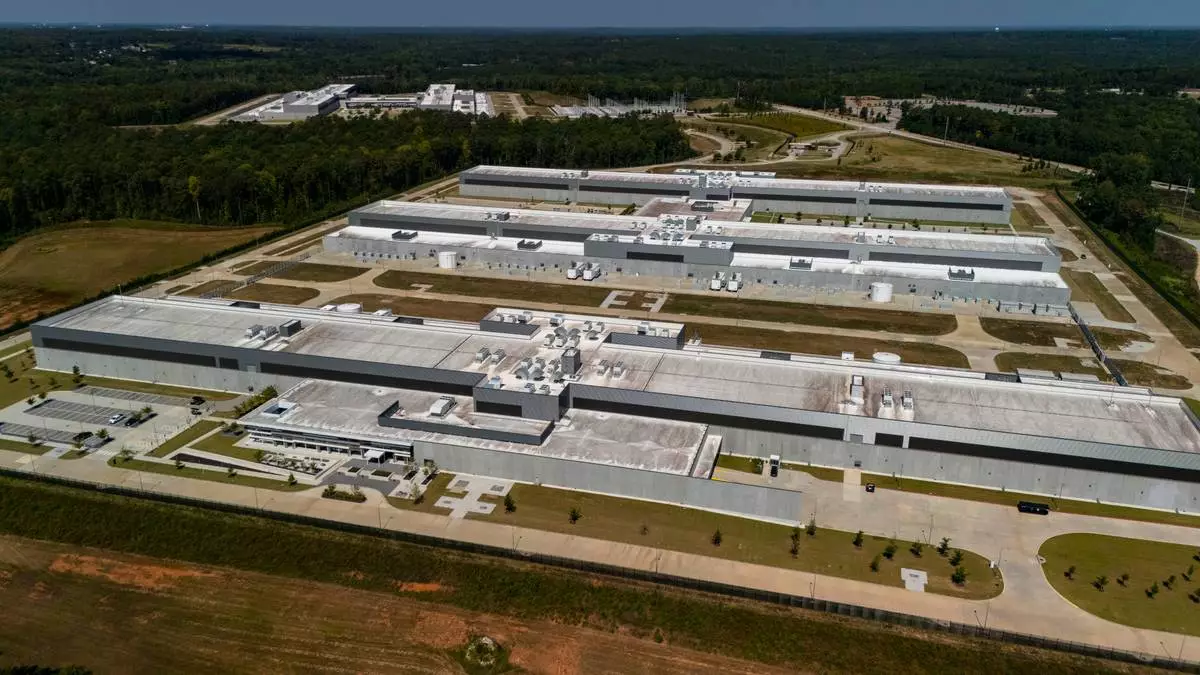
Meta data centers operate, Saturday, Sept. 5, 2026, near Social Circle, Ga. (AP Photo/Mike Stewart)