KNOXVILLE, Tenn.--(BUSINESS WIRE)--Sep 16, 2026--
Pilot, North America’s largest network of travel centers, is celebrating the positive impact its guests and team members have collectively made over the last nine years, raising nearly $11.5 million in support of the American Heart Association. This achievement reflects the power of community action and Pilot’s commitment to safety, uniting people in the fight against heart disease and stroke to help save and improve lives.
This press release features multimedia. View the full release here: https://www.businesswire.com/news/home/20260916789001/en/
To celebrate this milestone, Pilot joined the Heart Association at its 2026 Greater Knoxville Heart Walk on September 12, 2026. The event brought together Pilot leadership, team members and Heart Association representatives to honor nearly a decade of giving and impact.
Since 2017, Pilot has supported the Heart Association through annual in-store fundraising campaigns. Each year during Heart Month in February and Stroke Month in May, Pilot’s guests have turned routine fill-ups into critical funds by rounding up eligible purchases to the nearest dollar at checkout or purchasing a paper heart.
“At Pilot, our purpose is to show people they matter at every turn, and supporting the safety and wellness of our team members, guests and surrounding communities through heart health and stroke awareness education is one of the most critical and meaningful ways we can live out that purpose,” said Adrienne Ingoldt, senior vice president, communications, risk and procurement at Pilot and member of the American Heart Association’s National Life is Why® Council of Retailers. “Reaching this milestone reflects the generosity of our more than 30,000 team members and the 1.2 million guests who come through our doors every day. They truly are the heartbeat of this achievement.”
Every dollar raised through Pilot’s campaigns supports the mission of the American Heart Association: advancing health and hope for everyone, everywhere. In the greater Knoxville area alone, Pilot’s support has helped expand Hands-Only CPR education and training to more than 200,000 people. Additionally, Pilot has hosted on-site trainings at its corporate office and travel center locations on topics such as CPR and stroke identification and response. This critical education enables people to help save lives by giving them the tools to quickly identify potential symptoms and take action to get life-saving care when necessary.
“Surpassing $11 million raised is a powerful testament to the commitment of Pilot and its guests to advancing heart health in communities nationwide,” said Lisa Hinton, national senior vice president of corporate relations for the American Heart Association. “This support helps drive progress in preventing heart disease and stroke and brings us closer to a future where everyone, everywhere can live longer, healthier lives.”
Pilot’s support of the Heart Association is fueled by the company’s Miles of Good giving program. For more information, visit PilotCompany.com.
About Pilot
Pilot Travel Centers LLC (“Pilot”) keeps North America’s drivers moving as the leading energy and experience provider people rely on to fuel their journeys. Founded in 1958 and headquartered in Knoxville, Tennessee, Pilot is a wholly owned subsidiary of Berkshire Hathaway Inc. and employs approximately 30,000 team members. As the largest network of travel centers, Pilot has more than 900 locations in 43 states and five Canadian provinces, serving an average of 1.2 million guests per day. In addition to travel center services, Pilot and its partners offer trucking fleets a variety of solutions for fuel, credit, factoring, maintenance and rewards. The company operates the third largest fuel tanker fleet in North America and supplies approximately 12 billion gallons of fuel per year. Pilot is committed to shaping the future of energy as one of the largest providers of biodiesel and renewable fuels and through the development of its EV charging network and low carbon fueling alternatives. For additional information about Pilot, visit PilotCompany.com.
About the American Heart Association
The American Heart Association is a relentless force for a world of longer, healthier lives. Dedicated to ensuring equitable health in all communities, the organization has been a leading source of health information for more than one hundred years. Supported by more than 35 million volunteers globally, we fund groundbreaking research, advocate for the public’s health, and provide critical resources to save and improve lives affected by cardiovascular disease and stroke. By driving breakthroughs and implementing proven solutions in science, policy, and care, we work tirelessly to advance health and transform lives every day. Connect with us on heart.org, Facebook, X or by calling 1-800-AHA-USA1.

Pilot is celebrating the positive impact its guests and team members have collectively made over the last nine years, raising nearly $11.5 million in support of the American Heart Association.
On the way home from a recent trip, Eriech Tapia drove past a sea of dark industrial buildings lining an already jam-packed northern Virginia road: data centers.
“It was interesting to see how many were going up,” said Tapia, a 30-year-old Republican from Arlington, Virginia, who works in higher education advocacy and policy. He said the data centers lend valuable computing power that can help keep the U.S. competitive with other nations, but he also worries about how much electricity they use.
Like Tapia, Americans have grown more concerned about the environmental impacts of artificial intelligence over the last year, according to a new poll from The Associated Press-NORC Center for Public Affairs Research and the Energy Policy Institute at the University of Chicago.
The survey data say about half, 53%, of Americans are “extremely” or “very” concerned about artificial intelligence's environmental impacts. That is up from 41% last year. Democrats are driving much of the increase in environmental concern, but the poll also reveals broader worries about the local impact of data centers, which power AI and cloud computing.
“We're undertaking a massive experiment in real time, and I don't think there'll be any putting the milk back in the bottle. Change is scary, and I think some of that is being reflected here,” said Michael Greenstone, who directs the University of Chicago institute that collaborated on the survey.
There are thousands of data centers in the U.S. with construction planned for more. Those include smaller, conventional centers that have been around for decades, as well as larger hyperscale ones that are being built to serve artificial intelligence’s added processing needs. Virginia and Texas have the most facilities currently in operation, and other top contenders include California, Ohio and New York.
While 87% of existing data centers are in urban areas, most new data centers are planned for rural areas, according to a Pew Research Center analysis from earlier this year.
“I think that decisions are being made for the company, not for the community that they're being built in,” said Nancy Antunes, a 60-year-old retired Democrat from Waltham, Massachusetts.
A recent United Nations University report predicted that data centers' environmental footprint, which already rivals some of the world's largest countries, will grow rapidly as AI is more widely adopted.
Democrats are increasingly worried about AI's environmental consequences. About two-thirds of Democrats say they are “extremely” or “very” concerned about how AI will affect the environment, the poll found, up from about half in 2025. By contrast, about half of independents and about 4 in 10 Republicans are highly concerned about the environmental impact of AI.
Overall, Americans are more worried about the environmental impact of AI than other industries with a substantial environmental footprint. Only about 3 in 10 U.S. adults are highly concerned about the impact of meat production or air travel.
While concerns about environmental impacts are higher among Democrats, there is a broad sense of wariness about a rapid data center boom.
About 6 in 10 Americans support limiting the number of new data centers that can be built, including most Democrats and Republicans.
“There’s a lot of water usage by AI data centers that’s taking away from other things like agriculture and farmers and places that really need it, and people who really need it,” said 21-year-old computer science student Gedeon Kebede, a Democrat from Cincinnati, Ohio.
A majority of Americans are “extremely” or “very” concerned about the impact of data centers on electricity prices or the water supply in the communities where they are built.
Data centers' use of water to cool AI chips and computers is “nationally modest but potentially locally decisive,” energy systems engineer Fengqi You with Cornell University said in an email. While data centers aren't the largest water gobblers in the country, a single large campus can still place stress on a smaller municipal area.
The centers are also powered by tremendous amounts of electricity, particularly larger ones, raising concerns about where that energy will come from. Data centers could account for 11.8% of the U.S.' electricity consumption by 2030, according to a Lawrence Berkeley National Laboratory Report.
“We’re talking about building electric infrastructure on a scale of entire cities, or in some cases, entire states just to serve one data center,” said Erik Nordman, director of Michigan State University's Institute of Public Utilities.
About two-thirds of U.S. adults support requiring data centers to use clean energy sources, such as wind or solar, to supply their electricity needs. About 8 in 10 Democrats support this, along with 56% of Republicans.
Still, some Americans say data center worries feel distant. Mary Fisher, 68, hasn't seen any come up in her Jacksonville, Florida, neighborhood.
“You know, it hasn’t come across my desk as something I should be concerned about,” said Fisher, who is retired and identifies as a Republican.
About one-quarter of U.S. adults say data centers are “extremely” or “very” beneficial when it comes to technological advancement, and about 2 in 10 say the same about job creation. Many U.S. adults say data centers are “somewhat” beneficial or aren't sure, while about one-quarter say they're “not very” or “not at all” beneficial for technological advancement, and about a third don't see a benefit for job creation.
“I see a huge increase in the number of temporary construction workers that are coming to areas, which is vitally important to the U.S. economy,” said Tapia, the higher education advocate.
Republicans are more likely than Democrats to see data centers' benefits. But about 3 in 10 Republicans still think the centers are “not very” or “not at all” beneficial for improved infrastructure and job creation.
Kebede, the computer science student, said he feels pressured to use artificial intelligence. Despite his concerns surrounding the technology, he still wants to be a competitive applicant for the jobs of the future.
“I think a lot of people just feel that it's very much a bubble,” he said. “Ultimately, when it pops, it's going to be very detrimental to everyone, whether you bought into the AI hype or not.”
The AP-NORC poll of 3,424 adults was conducted July 6-24, 2026, using a combined sample of interviews from NORC’s probability-based AmeriSpeak Panel, which is designed to be representative of the U.S. population, and interviews from opt-in online panels. The margin of sampling error for all respondents is plus or minus 2.2 percentage points. The AmeriSpeak panel is recruited randomly using address-based sampling methods, and respondents later were interviewed online or by phone. To incorporate the nonprobability sample, NORC used TrueNorth calibration, an innovative hybrid calibration approach developed at NORC to explicitly account for potential bias associated with the nonprobability sample.
The Associated Press’ health and science coverage receives financial support from the AP Fund for Journalism and private foundations. AP is solely responsible for all content. Find AP’s standards for working with philanthropies, a list of supporters and funded coverage areas at AP.org.
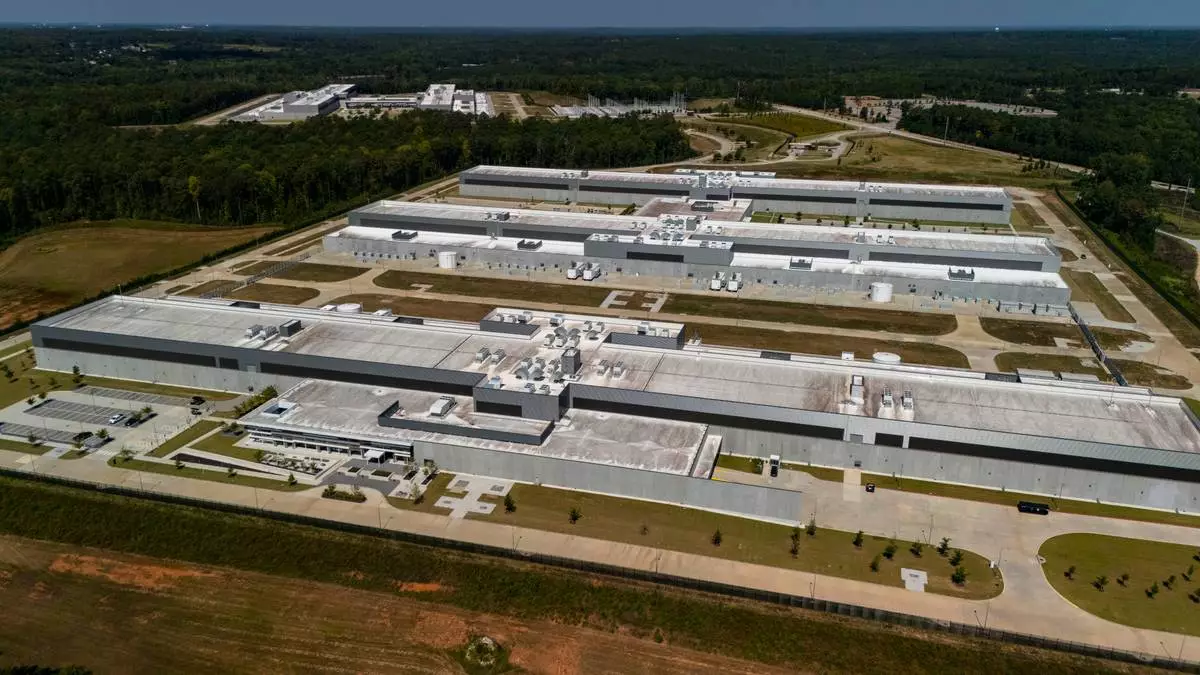
Meta data centers operate, Saturday, Sept. 5, 2026, near Social Circle, Ga. (AP Photo/Mike Stewart)