PHILADELPHIA (AP) — Betsy Ross is a dynamo with a T-shirt cannon.
America's 250th birthday has been a banner year for the actors of Historic Philadelphia, Inc. who immerse visitors in Colonial history via first-person interpretations and true stories. In the last few months, Betsy, played by Carol Spacht, has waved the checkered flag at a NASCAR race, met Punxsutawney Phil the weather-predicting groundhog, and competed against the Eagles' Jordan Mailata in a karaoke contest— all to the absolute delight of crowds and social media commenters.
While the quirky requests for appearances have been fun, many of the actors also feel an almost patriotic duty to tell the story of America's founding from the place where it actually happened and from the perspective of everyday people often left out of history books.
“I got chills,” says Johanna Dunphy, artistic director for Historic Philadelphia. “I was tearing up listening to John Adams ask if anyone heard him or cared... in the place where these conversations happened. It was so moving to hear people in the audience say they still believed in this idea, and in what America could be.”
Anticipating the influx of tourists, Historic Philadelphia expanded its programming — adding characters and storytellers, and increasing opportunities for visitors to interact with history in Philadelphia's Old City from Memorial Day to Labor Day.
Overall, the troupe nearly doubled its cast to about 60 at the start of the season, but directors held rolling auditions throughout the year.
There are some physical requirements— you can't have a thin-faced Ben Franklin, or a short Thomas Jefferson — but engaging with the stories and audiences is the most important quality.
“Even if their face doesn’t match anyone we need, we can find someone from history they gel with," Dunphy says. “Part of our mission is to tell the stories of the underrepresented Philadelphians who played such a huge role in building our city and country. And for people of color and women, there aren’t a lot of portraits to work from, so you can be more forgiving on appearance.”
For example, the troupe added a portrayal of Deborah Sampson, who disguised herself as a man to join the Revolutionary Army, and was the first woman to receive a pension for her service. There’s one portrait in existence, but most historians agree it is likely not an accurate portrayal— so the group has some leeway on the physical appearance of the actress playing her.
Many of the actors started as storytellers dressed in green polo shirts and stationed at benches throughout Old City and armed with a cadre of real historical anecdotes tied to their locations.
Once they graduate to being a first-person interpreter, many play a cast of different characters depending on the need. Spacht plays the founder of the Girl Scouts, a suffragette, socialite women and Quakers in addition to Betsy Ross.
There are roughly a dozen Betsies. The group staffs the Betsy Ross House, providing actresses every day it's open to raise the flag in the morning and do actual sewing work in Ross's upholstery workshop.
Spacht trained most of the other Betsies, teaching them authentic Colonial sewing methods. When she's in costume, she keeps a period-accurate pair of sewing scissors tied to her waist by a ribbon and a stack of paper squares in her pocket. She pulls them out to tell the story of how Ross claimed to have persuaded Washington to change his design from a six-point star to a five-point star. A few folds, two quick snips, and out comes identical stars to represent the colonies.
It's that experience, the ability to stay in character without seeming hokey, that delighted spectators and made her a perfect choice to partner with Visit PA- Pennsylvania's official tourism arm — to appear at all of those quirky events throughout the year.
“The thing I take away from Betsy is her resilience,” Spacht says. “She lost two husbands by the time she was 29 and she didn't shrink back into her shell. She continues to run a business, to raise her children, to live."
Many of the actors have other jobs throughout the year. Some come from several states away to participate during the prime season or on just weekends.
But even the actors who are full-time have side projects— one actor was cast in a play recently and another was hired to teach at a children's theater camp. Jackson Pavlik, who started playing Ben Franklin last year, has an album coming out this fall.
Pavlik says this has been a wild year full of unexpected bookings and experiences — mingling with baseball royalty like Derek Jeter at the MLB All Star game, for example.
“Being Ben Franklin... It's like you're Santa Claus,” Pavlik says. “Everybody treats you like they know you. They know the myth. But even in his time, Franklin was the most famous American. And you can use that when you're in character.”
Thanks to Thomas Jefferson's diary, we know it was a cool 76 degrees on July 4, 1776. On the semiquincentennial, it was a less moderate 101 degrees, presenting a challenge for the actors as parades and celebrations across the country were shortened, canceled or moved inside for safety.
Dunphy says all the costumes at Historic Philadelphia are authentic down to their shoes— meaning the clothes are made from natural fibers that breathe. There's no polyester in their wardrobe.
“You'd be surprised how much that can help when it's hot,” she says. “I mean, corsets are still miserable if you're a woman.”
“But my secret weapon is to go to Costco before the season starts and buy those freezie-pops that come like 250 to a box,” she says. “I buy at least two.”
And when your cast is so dedicated that the regiment of soldiers refuse to remove their jackets even when given permission, those little tubes of flavored ice can be a lifesaver.
From quirky stories about colonial-era prisoners being fed the overabundant lobsters of the time (and hating it) to accounts of a female Quaker spy hiding notes in her hair, their tales are meticulously researched and designed to pique people’s interest in history.
But as disputes about what parts of history are represented prominently at federal sites continue to roil in the courts, the group has maintained its mission of portraying diverse real characters that help people see themselves in history and in the nation’s founding. Philadelphia is appealing a federal court decision that allows the Trump Administration to remove an exhibit on slavery at the President's House in Philadelphia and replace it with an exhibit that opponents say has been whitewashed.
“There is that sort of added responsibility to tell the whole story. But in the same way … it wasn’t something that caused us to scramble because we have been doing this for 20 years,” says Jason Greenplate, the Once Upon a Nation Program Manager at Historic Philadelphia.
Greenplate says the group adds stories regularly about women, immigrants, both free and enslaved Black residents and poor people who joined the cause that became America.
Keith Henley has been portraying abolitionist and entrepreneur James Forten for more than a decade. The free Black man heard the first public reading of the Declaration of Independence when he was a boy and apprenticed as a sailmaker before serving in the Revolutionary Army.
“As historians and Americans, we know our situation seems somewhat bleak,” Henley says. “What the current administration is trying to do with American history as a whole, if we the people allow them to do that, then we have failed. So I make sure children and adults who walk away from James Forten — they will know the real story.”
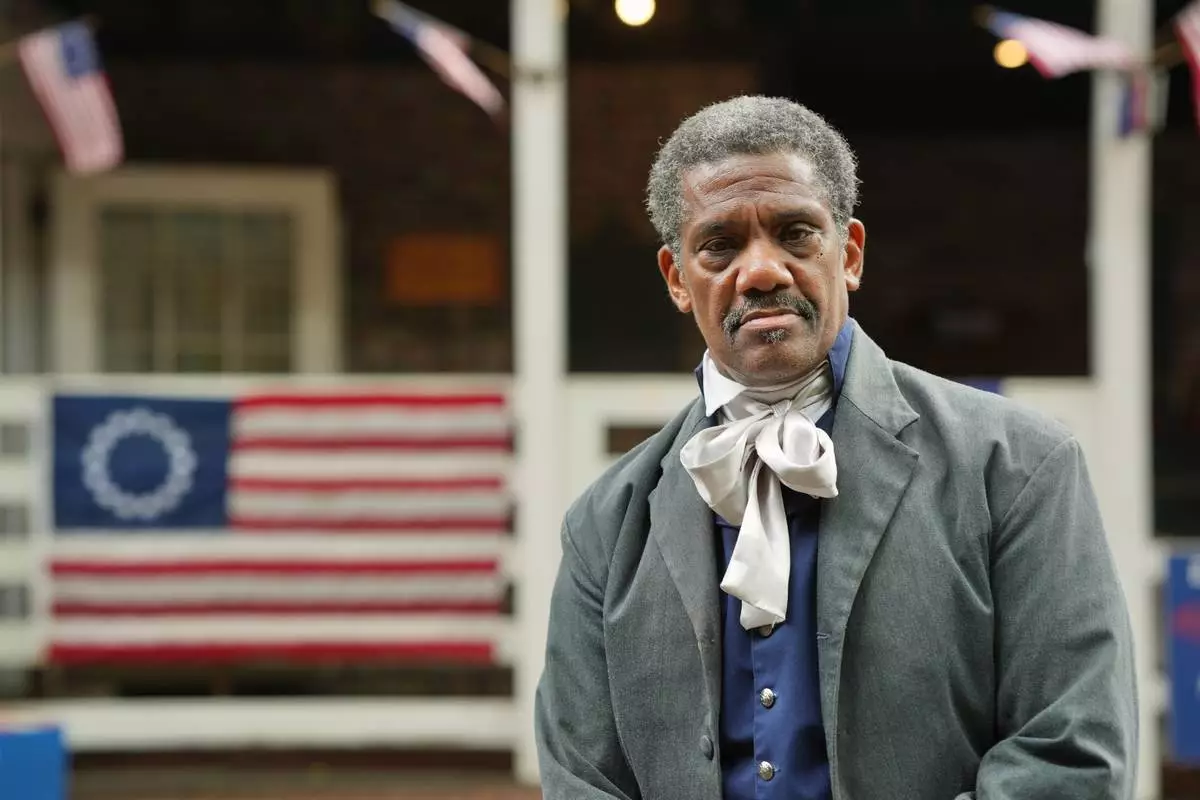
Historic reenactor Keith Henley, performing as abolitionist James Fowler, poses for a photo at the Betsy Ross House on July 28, 2026, in Philadelphia. (AP Photo/Mingson Lau)
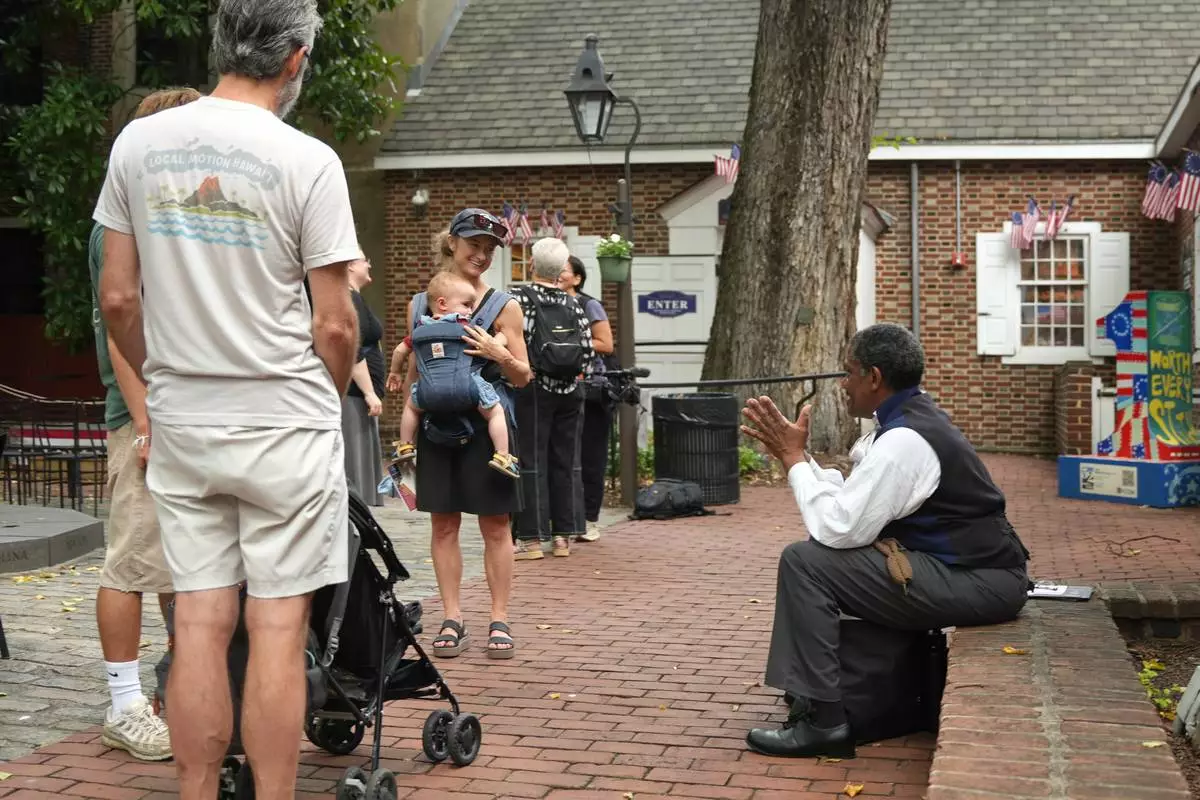
Historic reenactor Keith Henley, performing as the abolitionist James Fowler, right, greets visitors at the Betsy Ross House on July 28, 2026, in Philadelphia. (AP Photo/Mingson Lau)