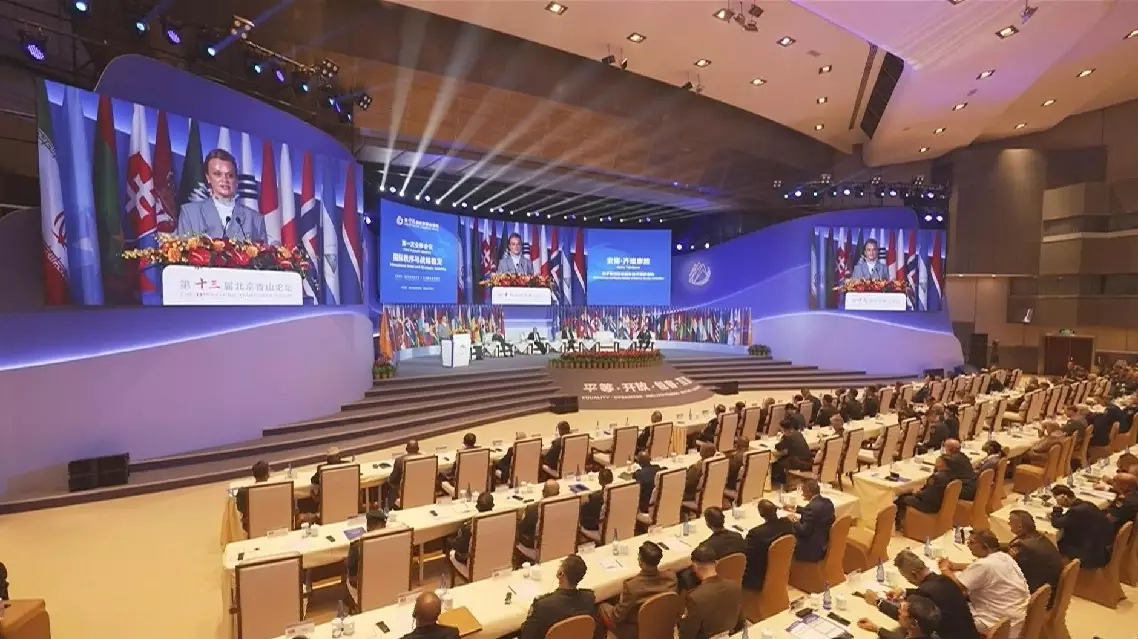
The 13th Beijing Xiangshan Forum held its first and second plenary sessions on Wednesday, bringing together a diverse group of international defense officials and experts to discuss the international order, strategic stability and solutions to global conflicts.
This year marks the 20th anniversary of the Beijing Xiangshan Forum, which is being held in Beijing from Tuesday to Thursday, featuring four plenary sessions and eight parallel sessions.
Maintaining strategic stability and finding political solutions to conflicts were the overarching focal points of the Wednesday sessions. Offering varied perspectives, participants engaged in in-depth discussions on how major powers can effectively manage their differences and how the international community can find viable solutions for regional hotspots.
During the plenaries, delegates from major international organizations, including the United Nations, the Shanghai Cooperation Organization (SCO) and the Association of Southeast Asian Nations (ASEAN), delivered speeches alongside defense ministers and senior defense officials from Russia, France, Vietnam, Singapore, Belarus, Iran and Germany.
Their addresses highlighted the latest challenges posed by armed conflicts, terrorism and emerging technologies. At the same time, speakers maintained a broader view of the roots of conflict, emphasizing that true security must be anchored in equity and mutual respect.
"From Vietnam's perspective, we believe that the security of one country should not build upon the insecurity of another. Sustainable security must be built through dialogue, just respect for each other's legitimate interests and international law. Vietnam stands ready to work together with and other countries to ensure that the Xiangshang Forum continues to serve as a platform for narrowing differences, expanding consensus and building just for peace, stability and development," said Duong Quy Nam, director of Vietnam's Institute for Defense International Relations.
Experts in attendance praised the plenaries for setting a course toward peace-oriented governance.
Bernt Berger, an associate fellow with the Center for Applied Research in Partnership with the Orient in Germany, said the forum's agenda has gained renewed relevance amid a fracturing world.
"[The forum has brought a crucial] topic back onto the agenda in a time when global conflict and power competition is the game. So, the forum has promoted global governance and it has brought people together from all over the world to talk about, A, how to shape global governance and B, how to deal with the issues that stand in the way. So, I think it's a very good forum for that," said Berger.
The annual forum aims to pool global insights on security governance and explore accessible paths to promote world peace. At the event, Chinese representatives highlighted China's vision for building a community with a shared future for humanity and its Global Security Initiative.
"As a well-known international defense and security dialogue platform provided by China and shared with the world, the Beijing Xiangshan Forum has played an important role in presenting and promoting China's Global Security Initiative and Global Governance Initiative. It serves to build the international consensus needed to put these initiatives into action," said Yu Xiaopeng, a research fellow with the Academy of Military Sciences of the People's Liberation Army (PLA).
"Stability is a shared aspiration of people around the world today. It serves the common interests of all countries and represents the broadest common denominator for the international community. How can stability be achieved? Not through the traditional model of security governance monopolized by a small number of major powers, but through security governance in which countries worldwide participate and work together to make it happen. It is what we call jointly promoting security governance. At the forum, we also heard representatives from many countries express strong recognition and appreciation for this year's theme, and clearly state their willingness to take part in global and regional security governance. This has laid a solid foundation for advancing the relevant agenda and carrying out cooperation in the next stage," said Zhang Chi, a professor with the National Defense University of the PLA.
Beijing Xiangshan Forum plenaries spotlight strategic stability, political solutions to conflict