The first Hualong One nuclear power project in south China's Hainan Province was officially put into operation on Thursday and is expected to play a significant role in cutting carbon dioxide emissions.
The project, named Unit 3 of the Phase II Changjiang Nuclear Power Plant, was developed by China Huaneng Group and includes two 1.2-million-kilowatt nuclear generating units. Unit 3 and Unit 4, both use Hualong One, China's home-grown third-generation pressurized water reactor technology.
Once fully operational, the clean power output will save more than 6.32 million metric tons of standard coal each year and cut carbon dioxide emissions by nearly 11.7 million metric tons.
"The project has completed 86 technological renovations, with an overall domestic production rate of approximately 98.1 percent. All three of its safety barriers are equipped with active and passive systems. When an accident occurs, it can dissipate residual heat from the reactor core through natural forces such as gravity and natural circulation, without external power supply. It is also equipped with a 2,400-tonne water tank as a passive cold source, which can ensure safety for 72 hours without an external power supply in the event of an accident," said Li Wen, deputy director of Hainan Changjiang Nuclear Power Co., Ltd.
Li said Unit 4 completed a cold test earlier this month and is expected to be put into operation in August 2027.
Unit 3 is projected to produce about 9 billion kilowatt-hours of clean energy after operation, while the two units together can produce 18 billion kilowatt-hours of electricity annually, enough to meet the electricity needs of one third of the island province's population, Li added.
China aims to establish a clean, low-carbon, secure and efficient new energy system by 2030, according to a five-year plan recently issued by the National Development and Reform Commission and the National Energy Administration.
The plan calls for developing nuclear power proactively and in an orderly manner while prioritizing safety, targeting roughly 110 gigawatts of installed nuclear capacity in operation by 2030.
By the end of 2025, China had 112 nuclear power units in operation, under construction, or approved for construction. During the 15th Five-Year Plan period (2026-2030), the number of commercially operational nuclear power units is expected to exceed 100.
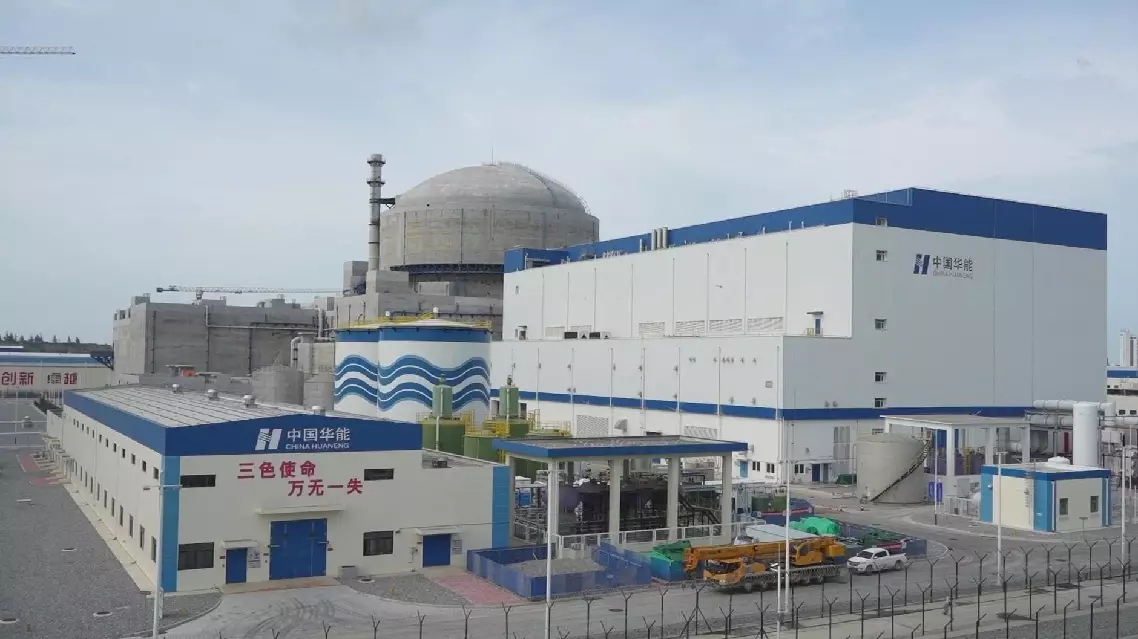
China’s Hualong One Nuclear Reactor Unit 3 Begins Operations in Hainan Province