China has begun disbursing the first tranche of an 800-billion-yuan (about 119 billion U.S. dollars) policy-based financing tool, channeling initial funds into advanced manufacturing and infrastructure projects to accelerate construction and expand investment.
The targeted financial tool, managed by major state policy banks, including the China Development Bank, the Agricultural Development Bank of China, and the Export-Import Bank of China, are designed to support major national strategies by replenishing capital for key projects.
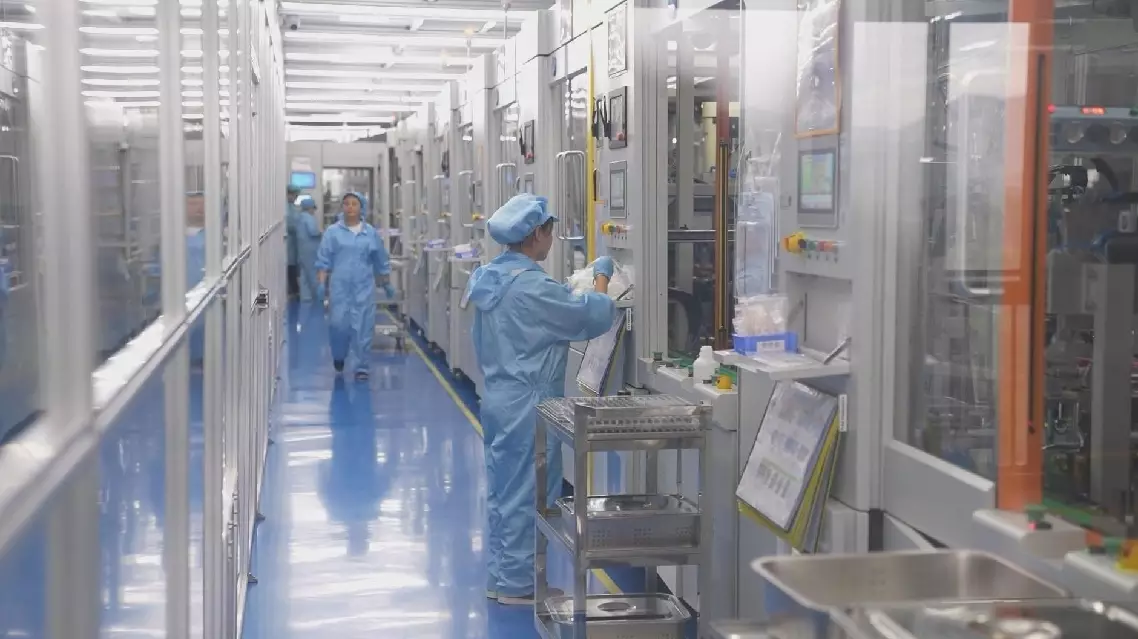
In Rui'an, a city in east China's Zhejiang Province, an automotive suspension system solution provider recently secured a 100-million-yuan (about 14.91 million U.S. dollars) fund from the Export-Import Bank of China for an intelligent suspension project, a key national new energy vehicle (NEV) initiative.
The funds will be used to replenish the project's capital, easing research and development cost pressures while significantly boosting financing credit.
"This allows us to use this money as our own base capital to unlock and pull in even more project loans. It is not only highly efficient, but also comes at a low cost," said Wang Xiaoyan, deputy general manager of Zhejiang Gold Intelligent Suspension Co., Ltd.
The financing instrument, announced by the Chinese government in March, is designed to provide project capital and attract larger amounts of private and bank financing for key infrastructure and strategic projects.
"[The funds] are primarily directed toward key areas such as the digital transformation of traditional industries, green and low-carbon energy, and demonstration applications of artificial intelligence to ensure the progress of project construction," said Ou Lin, vice president of the Zhejiang branch of the Export-Import Bank of China.
In Wuhan, capital city of central China's Hubei Province, an expressway project, in which a private enterprise holds a stake, has also become one of the first projects nationwide to receive support from the central funds. The project, once completed, will strengthen regional ties within the Wuhan metropolitan area and reduce logistics time and costs.
"We've increased support for private enterprises to ensure early, rapid, and substantial investment, to ensure investment and credit work hand in hand," said Ding Dong, a client manager at the China Development Bank's Hubei branch.
The funding will unlock roughly 7 billion yuan (about 1 billion U.S. dollars) in construction investment, according to Hu Zhihong, the project head of the Jiangxia-Liangzi Lake section of the Wuhan Metropolitan Area Ring Expressway.
"It is capable of leveraging a total investment of approximately seven billion yuan in construction projects. Once the funds are in place, it will ensure the high-quality completion of this year's investment and construction targets," said Hu.
In the first phase, the central funds are being disbursed in provinces including Yunnan, Fujian, and Sichuan.
China increased the size of this policy-based financing tool from 500 billion yuan in 2025 to 800 billion yuan this year. The central funds are expected to help unlock project investments worth 10 trillion yuan.
China starts disbursing 2026 policy financing funds to boost investment