UNITED NATIONS (AP) — The world is deeply divided and the U.N.’s most powerful body is paralyzed when it comes to ending conflicts. But there’s a way forward. So says the United Nations’ top official.
On his way out of office at year's end after nearly a decade, U.N. Secretary-General António Guterres — known for doom-and-gloom speeches about the state of the planet — said Thursday he finds hope and possibility in the coming years. But that, he says, is only if the world’s governments can finally cooperate on curtailing conflict, upending inequality and grappling with the arriving juggernaut of artificial intelligence.
“I believe in a number of fundamental things that need to be done, and need to happen for the world to be better — and I’m determined to fight to make those things happen,” Guterres told The Associated Press in a sit-down interview four days before world leaders convene for their annual meeting at the U.N. General Assembly.
His message to leaders and ministers from the U.N.’s 193 member nations coming to U.N. headquarters was no-nonsense: You need to very seriously analyze the fact that the world is facing at least three existential problems -- runaway artificial intelligence, galloping climate change, and escalating inequality that is becoming a serious driver of instability and conflict.
Guterres also warned that the “huge geopolitical divide” and paralysis in the Security Council have created an environment of impunity with powerful countries flouting international law and the U.N. Charter. The invasion of Ukraine by Russia and the attacks on Iran by the United States, both veto-wielding council members, are examples.
“Many countries say, ‘If superpowers can violate the law, why can’t we?’” the secretary-general said. “And so what we are seeing around the world is more and more situations in which countries simply do not care. They do whatever they want, knowing that there will be total impunity.”
The violations and impunity have caused death and enormous destruction, he said, and the combination of the Russia-Ukraine conflict and the broader Middle East conflict are having “a dramatic impact” on the world economy. Food and energy prices are going up, interest rates are rising and developing countries face enormous difficulties in responding to the needs of their people.
He expressed hope that these problems will force people to realize that the obstacles can’t be eliminated alone and require international cooperation.
That's especially true, he said, with reforms of the institutions formed by the victorious World War II powers — the U.N., especially the Security Council, and the major global financial institutions, the International Monetary Fund and World Bank. They must be overhauled to reflect the realities of the 21st century world where there are emerging economies and powers, he said, and their importance must be reflected in global institutions.
As U.N. chief, the secretary-general has no army, no intelligence service and not much money. But, Guterres said, he has two powers — to speak out on global issues and to convene the world’s nations.
Because of geopolitical divides, Guterres said the United Nations has “no leverage” on promoting peace in Ukraine and the Middle East. But he said he has been firm in defending the U.N. Charter and the territorial integrity of countries, and in condemning “horrible violations of human rights.”
He condemned Hamas’ “intolerable” attack in southern Israel on Oct. 7, 2023, and he also condemned “the horrible situation that Israel has created in Gaza with levels of death and destruction that have no parallel in the history of the United Nations.”
The United Nations is not “in a transactional approach to politics,” he stressed. It must be “a reference of values and principles for the whole world, because someone must affirm that the law of force cannot prevail over the force of law.”
“That, of course, sometimes limits our capacity to negotiate an agreement because one of the sides is a clear violator that doesn’t like to listen to the truth. But that will never, never make us move away from what are the values in which a civilized society must be based,” the U.N. chief said.
This year’s global gathering is also certain to spotlight the future of the U.N. and the threat of AI getting out of human control.
Guterres has called for international cooperation and guardrails for AI, which he called “a universal problem.” To deal with the escalating problem, he said, countries developing AI at “a higher capacity” should exchange information, establish mechanisms for transparency, have some guardrails and “help create what ideally would be a multilateral mechanism to guarantee that risks can be avoided.”
As for the United Nations., it has serious financial issues, largely due to the U.S. failure to pay billions of dollars to its regular operating budget and the separate budget for the U.N.’s far-flung peacekeeping operations. But it has avoided a financial meltdown and is in the throes of major reforms, which the Trump administration has pressed for.
Even with less resources, Guterres said, the U.N. has been able to maintain its activities, “and I think we demonstrated that we have the best control of public expenditure in any organization of any country in the world.”
Guterres has dealt with U.S. President Donald Trump for nearly six of his 10 years at the helm of the U.N., and he stressed the importance of the U.S.-U.N. relationship, which he said has sometimes been difficult, sometimes easier. Now, he said, the U.N. is cooperating with the U.S. on peace negotiations in the Western Sahara and other parts of the world.
When he meets Trump on Tuesday, the opening day of the global gathering, Guterres said he plans to raise peace in Ukraine and the Middle East, “and I hope that these two objectives might be able to unite the efforts of not only the U.S. and the U.N. but the whole of the international community.”
Edith M. Lederer has covered international affairs for The Associated Press for more than a half century.
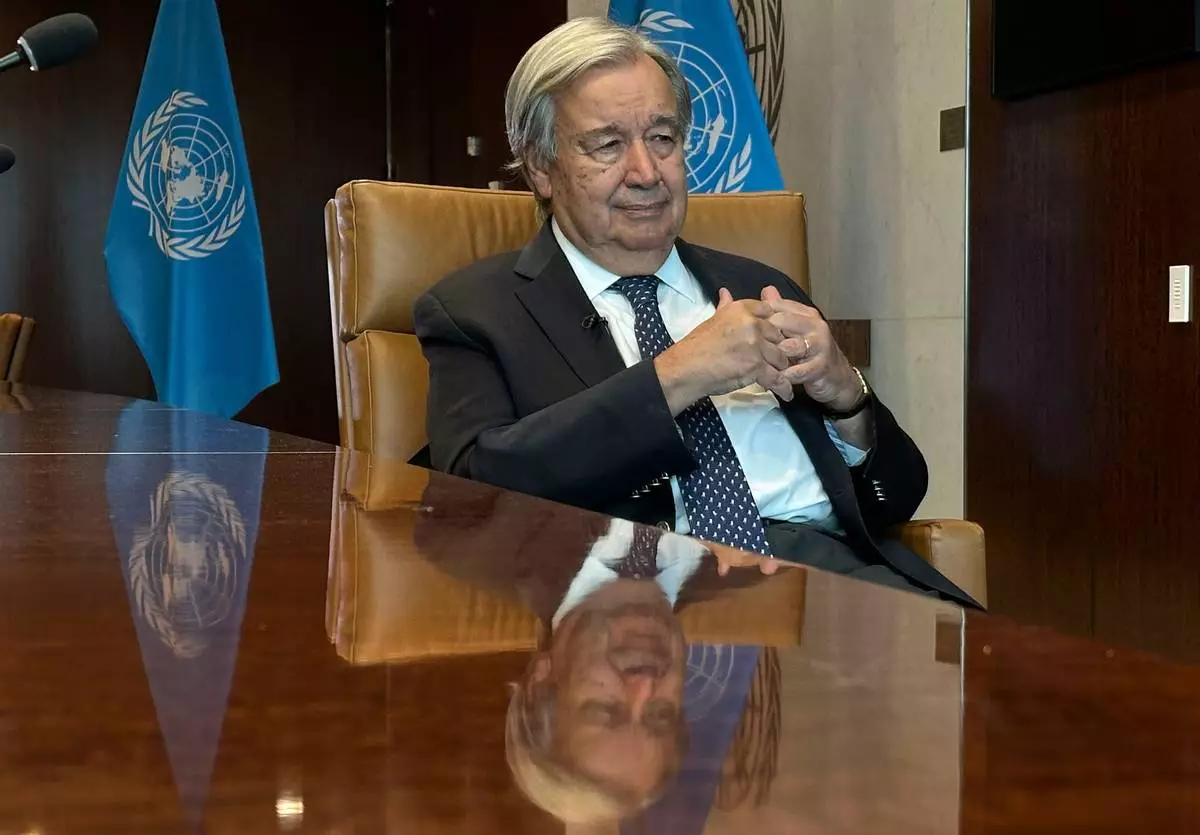
The United Nations Secretary-General Antonio Guterres speaks during an interview with The Associated Press at the United Nations headquarters, Thursday, Sept. 17, 2026. (AP Photo/David R Martin)