NANNING, China and QINZHOU, China, Sept. 18, 2026 /PRNewswire/ -- A news report from chinadaily.com.cn:
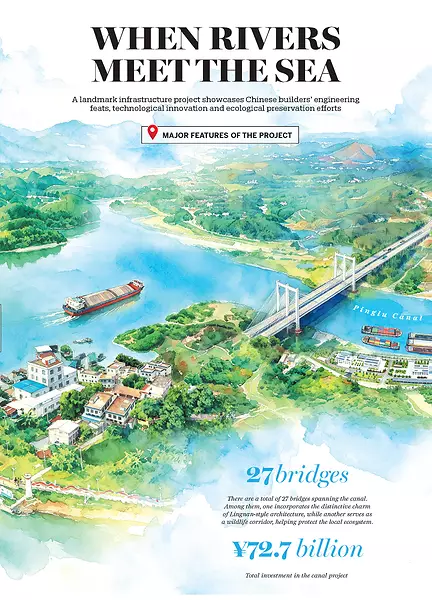
The Pinglu Canal in the Guangxi Zhuang autonomous region officially opens to traffic on Sept 16, reshaping the transport and logistics landscape of southwestern China. It is China's first major river-to-sea canal project to be planned and coordinated at a national level since the People's Republic of China was founded in 1949.
As a key part of the New International Land-Sea Trade Corridor that connects China's western regions to overseas markets, the canal is vital for establishing an integrated transport system that features "river-sea connectivity and multimodal freight", providing Guangxi and the broader southwestern region with the most convenient and cost-effective route to the sea.
Compared with the conventional waterway to Guangzhou Port in neighboring Guangdong province for export, the new shipping route via the canal enables goods from the southwestern region to reduce their river journey by more than 560 kilometers for maritime access, saving a projected 5.2 billion yuan ($771.36 million) in freight costs annually, industry insiders said.
The Pinglu Canal starts at the Pingtang River Estuary, which is located in the Xijin Reservoir area of Hengzhou, a city under the administration of Nanning, capital of Guangxi, extending southward to Qinzhou Port in the Beibu Gulf.
Spanning 134.2 km, the canal, which is designed to handle vessels of up to 5,000 metric tons, has a total elevation difference of 65 meters.
To ensure navigation safety and efficiency, the canal comprises three cascade hubs of Madao, Qishi and Qingnian, equipped with ship locks that work like water elevators, moving vessels up and down.
Among them, the Madao Hub features the world's largest water-saving ship lock for an inland waterway, according to Pinglu Canal Group.
A single chamber, 300 meters long and 34 meters wide, is equivalent to 1.5 standard football fields. Both ship locks working together can accommodate the passage of 12 vessels of 5,000 tons each.
To address a maximum water-level drop of 29.6 meters, almost as high as a 10-story building, the hub adopts a pioneering three-tier composite water-saving ship lock system, which consists of dual lock chambers, each equipped with three stacked water-saving basins and a sophisticated water transfer network that compares to underground arteries.
When vessels move downstream, part of the water in the lock chamber will be diverted to the water-saving basins to lower the water level. During upstream travel, the stored water flows back into the lock chamber, enabling the recycling of water, said Pan Jian, chief engineer of Guangxi Pinglu Canal Construction, a subsidiary of the group.
The innovative ship lock design enables a reduction of more than 60 percent in water consumption for operation, he added.
The next navigation hub, Qishi, uses the same ship lock operation mechanism, so it has also achieved a reduction of more than 60 percent in water use. The Qingnian Hub, the closest to the estuary, features the largest interconnected water-saving ship lock system in the country. The dual lock chambers aid mutual water transfer and recycling, achieving a water-saving rate of approximately 50 percent.
The three hubs can save more than 1 billion cubic meters of water, equivalent to the volume of 70 West Lakes, Chinese news agencies reported.
To ensure efficient and safe running, the canal has created the world's fastest valve operation in water-saving locks. Each working valve in the water transfer network weighs 70 tons, yet can open in one minute and close in 30 seconds, setting a record with a gate-closing speed of up to 16 meters per minute, two to four times faster than others of its kind internationally.
Pan said his team had conducted research on overseas canals and cooperated with industry-leading researchers and builders. "There were no existing standards to follow, so we built on our own strengths to explore and innovate," Pan said.
Focused on construction challenges involving hubs, waterways and bridges, they conducted more than 40 major research projects. They tackled key technical difficulties in such areas as high-efficiency water-saving ship locks, long-life concrete, large-scale comprehensive utilization of earth and rock materials, and high-slope stability control.
Their efforts have resulted in more than 90 patents. Several design and technical standards have achieved industry-leading levels.
Meanwhile, digital technologies are used throughout the entire process of the canal's construction, operation and maintenance to prevent risks and enable real-time responses, said technical staff members at a command and coordination center in the Qingnian Hub's management area. Most of them are fresh college graduates.
The Qingnian Hub, or Youth Hub, was named after a nearby sluice, which was built in 1959 and 1960 for irrigation as well as flood prevention. More than 7,000 young people completed the project under harsh conditions, using shoulder poles and carrying loads on their backs.
After operating for decades, the old Youth Ship Lock was removed in 2024 to make room for the canal. One of the three major navigation hubs is located just 1.5 km away from the old site. The Qingnian Hub retains the name, which represents the youths' pursuit of self-reliance and resilience in overcoming challenges.
"After learning the origin of the Youth Hub, I'm touched by that generation's dedication and perseverance, and feel pride in joining in the megaproject," said a staff member of the center. "Their story inspires me to contribute my strength to the local community's development."
In addition to innovative designs and engineering feats, ecological preservation has been highly valued throughout the canal construction and operation. Its environmental practices include providing a passage for migratory fish and building bridges dedicated to native animals. The mountain area where they live is now divided by the canal.
To preserve the local mangrove ecosystem, measures were taken such as in situ conservation, relocating 9,572 mangroves and planting 275,000 new ones.
About a century ago, revered revolutionary forerunner Sun Yat-sen envisioned a river-sea canal in Guangxi. Now the century-old dream has come true.
It is far more than a mere waterway; it is being followed by bustling trade, investment, industries and supply chains, giving fresh impetus to the local economy's growth, local officials said.
** This press release is distributed by PR Newswire through automated distribution system, for which the client assumes full responsibility. **
Pinglu Canal a historic breakthrough and economic asset
The Physical AI startup joins L'Oréal's flagship sustainable innovation program to address the beauty industry's most urgent challenges in climate, nature, and circularity
BOSTON, Sept. 18, 2026 /PRNewswire/ -- Laminar, the only physical AI company that powers Process-Aware Autonomy for self-driving factories, today announced its selection for the second Cohort of L'AcceleratOR, L'Oréal's innovation program designed to scale breakthrough sustainability solutions in the beauty industry and beyond.
"We are working to unlock new frontiers in the beauty industry through pioneering solutions," said Ezgi Barcenas, Chief Corporate Responsibility Officer at L'Oréal. "This second L'AcceleratOR cohort reflects our ambition to bring together entrepreneurial ingenuity, scientific progress and the global reach of L'Oréal to help scale breakthrough innovations."
Laminar was selected as one of 13 startups from nearly 1,000 applications across more than 100 countries. Endowed with €100 million over five years and run in partnership with the University of Cambridge Institute for Sustainability Leadership (CISL), "L'AcceleratOR" is a catalyst for scalable sustainable solutions of the future to solve the most urgent challenges in climate, nature, and circularity.
"Water-intensive process manufacturing industries like health and beauty must urgently rethink how their facilities use water for production processes," said Annie Lu, Laminar Chief Executive Officer & Co-Founder. "Laminar's physical AI tackles this critical water challenge by cutting water, chemical, and energy waste and reclaiming production time. Each Laminar Line deployed delivers greater visibility into our customer's production resource utilization and improves productivity and sustainability at the same time."
"We are pleased to join L'AcceleratOR alongside fellow innovators working on the sustainability challenges that matter most," Lu continued. "We look forward to collaborating with L'Oréal and CISL as we move toward pilot projects that demonstrate what Process-Aware Autonomy can do for water resilience — not just in beauty, but across every process manufacturing facility in the world."
Laminar Process-Aware Autonomy
Laminar pioneers a new category of Physical AI for process manufacturing that unlocks the full potential of more productive and sustainable production lines. The startup's Process-Aware Autonomy stack converts inefficient, pre-programmed automation to dynamic, self-driving processes that save time, chemicals, energy, and water — ultimately powering factories that are more agile and more sustainable.
- Process-Aware Sensors: Patented, inline sensors retrofit easily into existing infrastructure and generate a unique, digital fingerprint of what's flowing inside the pipe in real-time.
- Process-Aware AI: Factory-proven, foundational ML models interpret the digital fingerprints in the context of a specific manufacturing process to determine the current process state and autonomously drive the optimal next action.
- Process-Aware Insights: Laminar's trust layer that transforms millions of historical, real-time, and predictive process measurements into explainable decisions, verified savings, and actionable opportunities so operators can confidently run the best version of their factory.
Laminar Industry Recognition and Awards
Deployed across hundreds of lines on six continents with the top seven of the top ten global Food & Beverage companies like AB InBev, Coca-Cola, and Danone, Laminar's Process-Aware Autonomy delivers an average of 20% fewer chemicals used, 20% less water per cycle, and lines running 15% faster. At Unilever's Poznań facility alone, Laminar saved over €100,000 per line annually across just two lines.
This L'AcceleratOR partnership adds to a growing body of recognition from the world's most demanding institutions. Laminar recently received the 2026 FoodTech Innovation Award, won the 2026 Edison Award's Gold Award for the Manufacturing & Logistics category, was granted AB InBev's 2024 Cheers Award for outstanding startup partnership, and earned Unilever's 2023 Supplier Startup of the Year. Recently designated as a WEF Technology Pioneer, its solution is also deployed in World Economic Forum Lighthouse factories — a select group recognized for their leadership in cutting-edge industrial technology.
Headquartered at Greentown Labs in Somerville, MA — North America's leading cleantech community, Laminar is a woman-founded startup backed by top-tier investors, including Greycroft, Construct Capital, 2048 Ventures, and Flybridge Capital.
About L'Oréal
For 115 years, L'Oréal, the world's leading beauty player, has devoted itself to one thing only: fulfilling the beauty aspirations of consumers around the world. Our purpose, to create the beauty that moves the world, defines our approach to beauty as essential, inclusive, ethical, generous and committed to social and environmental sustainability. With our broad portfolio of 37 international brands and ambitious sustainability commitments in our L'Oréal for the Future programme, we offer each and every person around the world the best in terms of quality, efficacy, safety, sincerity and responsibility, while celebrating beauty in its infinite plurality. More information on https://www.loreal.com/en/mediaroom
About CISL
CISL is an impact-led institute within the University of Cambridge that activates leadership globally to transform economies for people, nature and climate. Through its global network and hubs in Cambridge, Cape Town and Brussels, CISL works with leaders and innovators across business, finance and government to accelerate action for a sustainable future. CISL has supported over 500 startups in the past 5 years through its accelerator programmes, community and workspace, and has been ranked as a top EU startup hub by the Financial Times for three years running. https://www.cisl.cam.ac.uk/innovation
About Laminar
Laminar's Process Aware Autonomy is an entirely new category of Physical AI reinventing how leading process manufacturers run more productive, sustainable factories. Our patented, inline sensors measure real-time fluid conditions in every production process, informing our factory-proven, foundational Process-Aware Models that interpret process states to drive optimal decisions that maintain quality standards and reduce waste. The Laminar Insights Platform serves as our trust layer for AI decision making and delivers real-time visibility into the time, water, chemical, and energy saved across every cycle, line, and facility. Across six continents, leading manufacturers like AB InBev, Coca-Cola, and Unilever trust Laminar to run their most critical processes and realize self-driving factories. Learn more at runlaminar.com
** This press release is distributed by PR Newswire through automated distribution system, for which the client assumes full responsibility. **
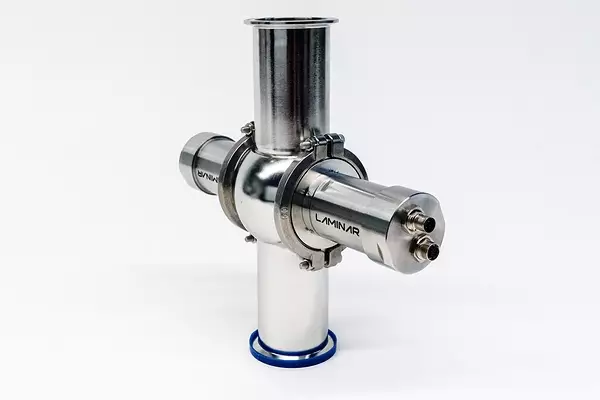
L'Oréal Selects Laminar for Second Cohort of L'AcceleratOR