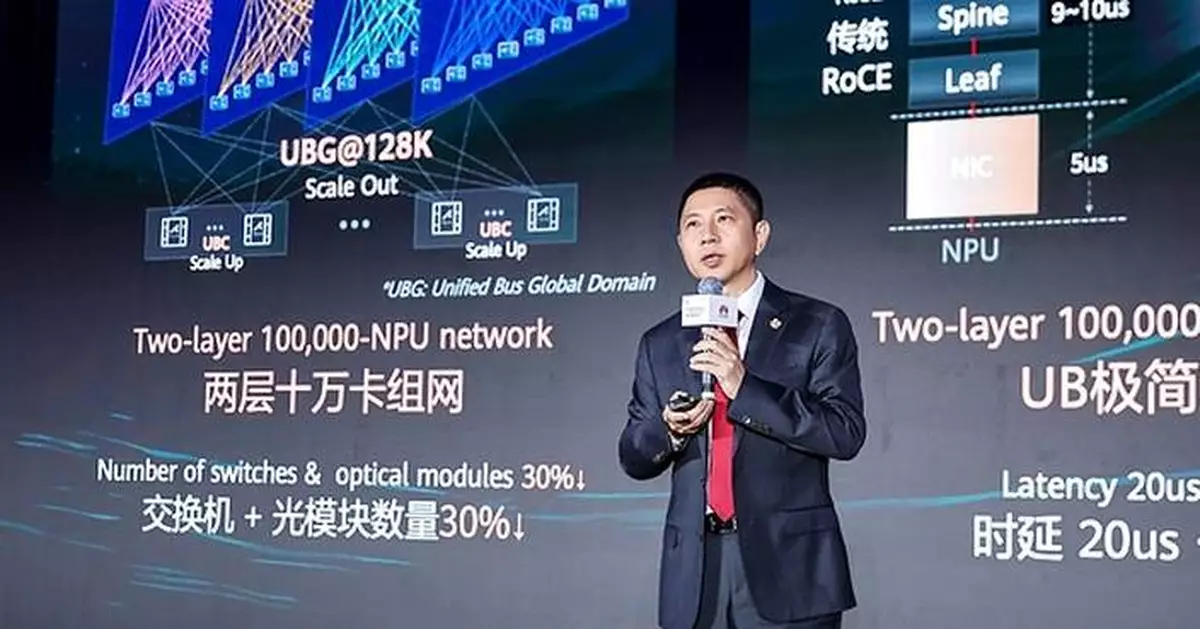
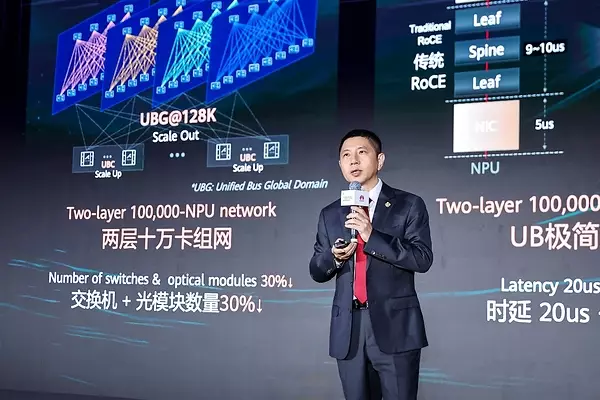
SHANGHAI, Sept. 18, 2026 /PRNewswire/ -- At HUAWEI CONNECT 2026, Huawei unveiled its upgraded Stellar AI Network Solution under the philosophy of secure, intelligent connectivity. With stand-out features such as efficient computing production, lossless delivery, and superfast application, this future-ready solution unleashes computing productivity while safeguarding services in the AI era.
Driven by explosive AI adoption, daily token consumption has surged 260-fold in a year. Huawei's upgraded Stellar AI Network—spanning AI Fabric, AI WAN, and AI Campus—responds to this by focusing on intelligent connectivity and security.
Stellar AI Fabric 2.0
- Intelligent connectivity: To tackle challenges like surging networking costs, slow protocol conversion, and traffic retransmissions caused by link flapping, Huawei has introduced the UBG switch SF9300 series. Paired with Ascend A5/A6, it forms a full-series UBG compute-network integrated solution. Specifically, two-layer multi-plane architecture eliminates the core layer, cutting network deployment costs by 30%. The unified protocol reduces end-to-end latency from 20 μs to 11 μs. Link-Layer Retransmission (LLR) achieves zero packet loss during link flaps, reducing annual cluster service downtime by 100 hours. Huawei also unveiled its fully in-house CloudEngine XH9300-EN series NPO switches, delivering three major breakthroughs. First, centralized light-source design lowers interconnect power consumption from 1,000 W to 600 W, saving cluster electricity costs. Second, near-packaged architecture reduces optical-electrical conversion latency by 180 ns, optimizing single-node latency by 26%. Third, pluggable snap-fit structure enables on-site replacement, shortening fault recovery time from days to hours.
- Security: Huawei's Three-Layer Security Guardrail Solution defends against hashrate theft, prompt injection, and model poisoning. Specifically, Network Guardrail features an integrated cryptojacking detection model delivering a 95% detection rate with millisecond-level malicious traffic blocking. Agent Guardrail guards against prompt injection attacks with 95% accuracy at under 150 ms latency. Host Guardrail performs real-time monitoring of malicious processes while keeping CPU usage below 1%. At a real-world customer site, the solution identified 415 high-risk vulnerabilities and 322 threat events in its first seven days—leveraging AI to safeguard AI and ensure secure token production.
Stellar AI WAN
- Intelligent connectivity: Cross-region computing faces issues like severe efficiency loss, high on-premises costs, and expensive private lines. To address these, Huawei's Stellar AI WAN Solution enables lossless delivery of computing power over 1,000 km: The Starnet lossless algorithm eliminates long-distance packet loss, boosting remote computing efficiency to over 95%. The XH computing-network appliance uses the layerwise model partitioning algorithm to run initial and final layers locally, transmitting only high-dimensional vectors over the network. This ensures raw data remains strictly on-premises and reduces initial branch xPU costs fourfold. Furthermore, computation-communication overlapping cuts bandwidth idle time by over 80% and reduces required bandwidth fivefold.
- Security: Huawei's multi-dimensional WAN defense technology counters novel vectors like APTs and HNDL attacks. At the device layer, intrinsic security boards block intrusions in real time, trace threats within minutes at over 95% accuracy, and visualize up to 100-hop attack paths. At the link layer, built-in QKD delivers robust quantum security without extra devices, cutting construction costs by over 60% while extending transmission distance to 80 km. At the network layer, APN6-based data fencing enables network-wide control over traffic paths, ensuring the secure circulation of sensitive data.
Stellar AI Campus Network
- Intelligent connectivity: With enterprise agent adoption expected to approach 50% this year, manual O&M falls short of 24/7 demands, making minute-level fault recovery a must. Huawei meets this by upgrading all-scenario network autonomy across data, models, and tools. Specifically, proprietary network awareness technology supports the collection of over 25 exclusive data types with a 100 ms sampling cycle to precisely detect subtle anomalies. The Deep Causal Pruning (DCP) algorithm optimizes AI models, cutting inference errors by over 20% while boosting troubleshooting accuracy to 95%. iFlow 2.0 distributed simulation technology ensures 24/7 continuous verification of inference paths. This enables network-wide AI-powered operations, slashing MTTR to under 5 minutes and ensuring mission-critical service experience.
- Security: Today's enterprises struggle with the rapid compromise of dumb terminals and hidden malicious interactions by agents. Huawei's Stellar AI Campus Network Asset Security 2.0 solution addresses these through endpoint-network collaborative protection. By embedding AI micro-models into switches, the solution cuts dumb-terminal threat detection time from 5 minutes to under 10 seconds. Powered by proprietary AI Core small models and NPU semantic large models, it fully reconstructs agent interaction scenarios, boosting the malicious command detection rate to 95%. This eliminates hidden risks and safeguards campus networks and services.
Looking ahead, Huawei will continue to innovate its Stellar AI Network products and solutions in line with the "AI for All, All on Secure IP" vision, maximizing the value of every connection together with customers and partners in the AI era.
** This press release is distributed by PR Newswire through automated distribution system, for which the client assumes full responsibility. **
Huawei Unveils Upgraded Stellar AI Network to Power the Agentic World with Secure, Intelligent Connectivity
KUNMING, China, Sept. 18, 2026 /PRNewswire/ -- A news report from China Report ASEAN:
A group of Indonesian rural officials arrived in China on September 9 for a week-long study tour to Kunming, Xishuangbanna, and other parts of Yunnan Province as part of the 2026 Indonesian Rural Officials Training Program, also known as the sixth "Village Heads Class." The program is giving participants a close-up look at China's experience in rural revitalization, grassroots governance, distinctive local industry development, and efforts to benefit farmers and boost rural incomes.
Hosted by the Chinese Embassy in Indonesia and organized by Yunnan Minzu University, this program brought together more than 20 Indonesian village officials and relevant staff. The opening and welcome ceremony drew officials from relevant Chinese and Indonesian departments, faculty and student representatives from Yunnan Minzu University, and media representatives, including those from CICG Asia-Pacific.
Wang Xiangang, Deputy Secretary of the Party Leadership Group of the Yunnan Provincial People's Government, said Yunnan—once a key battleground in China's fight against poverty—has marked a historic milestone by eradicating absolute poverty. The province has bolstered safeguards against a return to poverty, refined mechanisms that connect farmers with industry and share development benefits with them, advanced highland agriculture with distinctive local features, and built labor service brands that help rural workers find stable employment. It has also sent numerous village-based work teams, upgraded rural infrastructure and living conditions, and cultivated rural long-stay tourism. Together, these efforts have provided Yunnan with extensive experience in rural development. Today, the province is the world's leading flower producer, its coffee, blueberry, and avocado industries are flourishing, and its agricultural exports have long outpaced those of other western provinces and regions in China.
Wang Xiangang noted that Yunnan and Indonesia enjoy deep historical ties: Yunnan is the birthplace of the great Chinese navigator Zheng He. Friendly exchanges between the two sides—and people-to-people exchanges in particular—have gained strong momentum. In science and technology, Yunnan helped build Indonesia's first waste gasification power plant and deepened cooperation on vaccines and coffee breeding. In agriculture, the two sides partnered on an organic rice project that has significantly raised local grain output, with follow-up projects on photovoltaic lighting and organic farming upgrades in the pipeline. Overall, bilateral cooperation rests on a solid foundation and has produced fruitful results, with broad prospects ahead.
Ruan Chaoqi, Party Secretary of Yunnan Minzu University and Director of Yunnan Training Base for Ethnic Minority Cadres, expressed his hope that the program will help Indonesian participants strengthen their governance capacity and overall competence—and, in turn, contribute more to the comprehensive strategic mutual trust between China and Indonesia. Such people-to-people exchanges and experience-sharing, he noted, will bolster connectivity, deepen cultural exchange, and bring the two peoples closer, creating more opportunities for high-quality Belt and Road cooperation. On behalf of Yunnan Minzu University, he also hoped that more Indonesian officials and young students would choose Yunnan for study and exchange, so that the two sides can learn from each other and grow together.
Indonesia has more than 80,000 villages, each with its own resource endowments. Mulyadin Malik, Head of the Agency for Development and Information at Indonesia's Ministry of Villages and Development of Disadvantaged Regions, said the Golden Indonesia 2045 Vision positions villages as key players in economic development, and Indonesia has rolled out 12 village action plans. Under a multi-stakeholder mechanism, the government, businesses, universities, financial institutions, local communities, and international development partners all contribute to rural development—particularly in food, energy, and water security, export industry incubation, digital transformation, and climate change response. These efforts have yielded substantive progress.
Mulyadin Malik stressed that rural development is vital to a country's progress and future—a view both Indonesia and China share. Though separated by the sea, the two countries enjoy a long-standing friendship. On October 17, 2023, the two sides signed a memorandum of understanding in Beijing on cooperation in rural development and poverty reduction, setting up a framework for policy exchanges, experience-sharing, and capacity-building in these areas. As a concrete example of cooperation under this framework, the Indonesian Rural Officials Training Program seeks to promote mutual learning through the sharing of experience.
"We look forward to learning from China's valuable experience in rural development and adapting it to the resource endowments and on-the-ground needs of Indonesian villages before putting it into practice," said Mulyadin Malik. He hoped that this program will help Indonesian rural specialty products access the Chinese market, strengthen village economies, expand business networks, and improve the well-being of rural communities—ultimately helping build a mutually beneficial partnership between the two countries.
The Joint Statement Between the People's Republic of China and the Republic of Indonesia on Advancing the Comprehensive Strategic Partnership and the China-Indonesia Community with a Shared Future, issued in 2024, explicitly states that the two sides will expand cooperation in poverty alleviation and reduction, agriculture, and rural revitalization, jointly promote agricultural and rural modernization, and steadily improve the well-being of both peoples.
Launched in 2019, the Indonesian Rural Officials Training Program has held six sessions to date, giving more than 100 Indonesian village heads firsthand exposure to rural development in China. After returning home, participants tailored what they had learned to local conditions, yielding a set of cooperation projects that are substantive, replicable, and scalable. Their efforts have helped make mutual learning on grassroots governance a regular feature of China-Indonesia exchanges, turning the program into a signature "small yet beautiful" cooperation project under the Belt and Road Initiative—one closely tied to people's livelihoods and highly exemplary—and earning high praise from the heads of state of both countries.
During the field trip, participants visited Haiyan Village to see rural revitalization in action; explored Luosiwan International Trade City and Dounan Flower Market to learn about trade and specialty industry growth; and traveled to Xishuangbanna, where they got a firsthand look at the local coffee industry, a new business model built on the joint development of three villages, intangible cultural heritage preservation, and digital agriculture bases. They also examined how specialty industries boost rural incomes, how ethnic culture is preserved and passed on, and how new rural business models take shape. Through exchanges with grassroots officials and staff, they gained firsthand insight into China's approach to rural development.
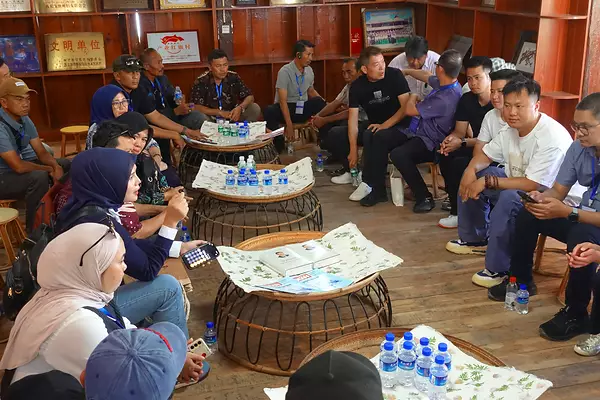
On September 13, grassroots officials from China and Indonesia engaged in a dialogue at the village library in Manzhao Village Group, Menghai County, Yunnan Province. There, the Chinese hosts presented the Indonesian guests with books as study materials, including the English edition of Xi Jinping: The Governance of China (Volume V) and Up and Out of Poverty.
Through this program, the two sides hope to deepen experience-sharing in rural development, strengthen market connectivity, and advance coordinated capacity-building. In doing so, they aim to inject fresh momentum into rural cooperation under the China-Indonesia comprehensive strategic partnership.
** This press release is distributed by PR Newswire through automated distribution system, for which the client assumes full responsibility. **
Hearts Meet Along a Shared Path: Indonesian Rural Officials Explore Rural Revitalization in Yunnan