A senior UN official on Thursday condemned Israel's ongoing military presence and operations in southern Syria as near-daily violations of the 1974 Disengagement Agreement and Syrian sovereignty.
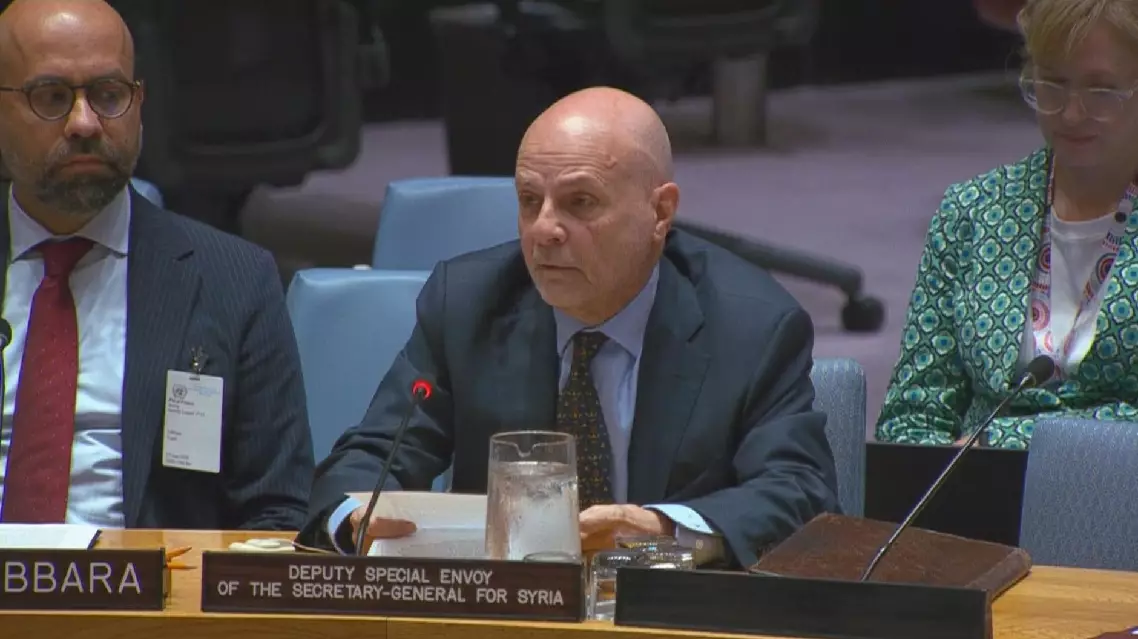
At a UN Security Council meeting on the Syrian crisis, Claudio Cordone, the UN Deputy Special Envoy for Syria, warned that Israel's continued military activities in southern Syria violate the 1974 Disengagement of Forces Agreement between Israeli and Syrian forces, monitored by the UN Disengagement Observer Force (UNDOF).
"Israeli presence and military activity in southern Syria has continued in violation of the 1974 Disengagement of Forces Agreement, with near-daily incursions, temporary checkpoints, searches of homes and artillery fire, particularly in Quneitra and western Daraa. Two Syrians who were taken to Israel and held there were returned home, but others remain in Israeli custody. On September 9, Israeli Prime Minister Netanyahu visited Israeli forces on Jabal al-Sheikh/Mount Hermon, reiterating that Israel would not permit hostile forces to establish themselves along its border," said Cordone.
Cordone's remarks came after Israeli Prime Minister Benjamin Netanyahu visited Mount Hermon in the Israeli-occupied Golan Heights, where he said Israel would not withdraw its troops from Syria, a position that has drawn widespread condemnation. UN Secretary-General Antonio Guterres has repeatedly demanded that Israel stop violating Syria's sovereignty and territorial integrity.
Israel persistently violates Syrian sovereignty: UN official
A former U.S. Marine has highlighted a poignant chapter of World War II history, recounting how Chinese civilians risked and gave their lives to save downed American airmen following the 1942 Doolittle Raid against Japanese aggression.
Born in the 1960s, Jeffrey Greene is a former U.S. Marine Corps pilot who later entered the film and television industry as a military advisor.
He made a documentary about China and the U.S. fighting side by side during WWII, which helped prompt then U.S. president Bill Clinton to express gratitude for China's assistance to American pilots trapped behind enemy lines.
In a recent interview, Greene recounted the history surrounding the famous Doolittle Raid. In April 1942, 16 U.S. bombers launched from the aircraft carrier USS Hornet to strike Tokyo and several other Japanese cities. It was the first U.S. air attack on the Japanese homelands, forcing Japan to recall troops for home defense and significantly shifting the momentum of the Pacific theater.
Prior to the mission, the U.S. planned for the bombers to land at airfields along China's eastern coast. To prepare for their arrival, China mobilized half a million civilian laborers who worked day and night for two months to expand an airfield in Quzhou City of Zhejiang Province.
However, on the day of the raid, the mission took an unexpected turn when a Japanese warship spotted the American carrier. The pilots decided to take off ahead of schedule, at a much greater distance from Japan than planned.
They accomplished their mission. But with fuel running out and communications disrupted, they were forced to bail out of the aircraft or make emergency landings across the Chinese provinces of Zhejiang, Anhui, Fujian, and Jiangxi.
Starving and injured, the airmen were rescued by Chinese soldiers and civilians, who bandaged their wounds and shared the very food they had saved for their own families.
"The Doolittle Raid, they had a jump in the middle of the night into a very dark China. There were no lights in the countryside. They were all gathered by the Chinese people, normal people -- soldiers, doctors, merchant men, farmers, kids, children," said Greene.
In one harrowing instance, three pilots landed in a Japanese-occupied zone. To save them, more than a dozen Chinese civilians formed a human wall, using their own bodies to shield the airmen from Japanese assaults, successfully escorting them to safety.
However, these acts of heroism triggered a brutal and devastating retaliation. Less than a month later, Japanese forces launched a military campaign in east China's Zhejiang Province and Jiangxi Province.
A newspaper at the time depicted the horrors of the invasion: "There is no sign of life in the fields, only cries of grief at midnight; there is nothing on the roads, but coffins being carried".
During the offensive, members of the notorious Unit 731 of the Japanese army even deployed biological weapons.
"The Japanese soldiers went berserk, and in the next three months, they killed at least 250,000 Chinese men, women and children -- anyone they suspected of giving aid and comfort to the American pilots. They used rifles and bayonets and bombs and grenades. They also used bacteriological weapons. We see a holocaust," said Greene.
The Doolittle Raid solidified the U.S. resolve to fight alongside China. Of the rescued airmen, 28 chose to stay in the China-Burma-India (CBI) theater to continue the fight.
Some joined the famed "Flying Tigers", led by General Claire Lee Chennault, and flew the treacherous "Hump" route to transport vital supplies into China.
"I don't know where in history any nation, any group, any country would risk so much for a group of people who had come from a distance to fight for them. It's not in Europe, it's not in Central or South America history. It's only here in China, and it's only between the Chinese people and the American pilots. It's the ultimate display of humanity," said Greene.
Greene later founded the Sino-American Aviation Heritage Foundation, aiming to preserve the historical legacy of the Flying Tigers and promote U.S.-China youth and cultural exchanges.
For the past 30 years, he has traveled back and forth between the two nations to ensure younger generations in the U.S. understand this shared history.
Looking ahead, Greene expressed hope that the two countries can draw upon this historical bond to tackle modern global challenges together.
"Our two countries are the two most powerful countries on the planet. If China and the United States do not cooperate, it's a very iffy situation looking at the future," said the veteran.
The Chinese people have never forgotten that part of history. In July this year, a dialogue marking the 85th anniversary of the Flying Tigers' support for China during World War II was held in Liuzhou City, south China's Guangxi Zhuang Autonomous Region.
The event brought Chinese and American youth together at the Liuzhou Military Museum, where they learned about the Flying Tigers' legacy and vowed to promote friendship between the two peoples.
Jackson Parker Long, a student from Pequea Valley School and the great-grandson of a Flying Tiger pilot, also attended the event.
"Well my great grandfather, the most impressive story that he told me was that during his missions, his 104 missions, he got shot down twice and was able to walk away and get rescued by the Chinese," he said.
"I love seeing the camaraderie between the pilots and the Chinese people. It's a great story that should be told," said John Martin Feister, another student from Pequea Valley School.

Former US marine highlights heroic rescue of American airmen by Chinese civilians during WWII

Former US marine highlights heroic rescue of American airmen by Chinese civilians during WWII