Shenzhen City in south China's Guangdong Province has seen record levels of both cargo and foreign passenger traffic from other Asia-Pacific Economic Cooperation (APEC) economies for the same period as of early September.
In the first eight months of this year, Shenzhen airport handled 450,000 tons of imports and exports with other APEC economies, up 6.3 percent year on year. By early September, the airport's inbound and outbound foreign passengers from APEC member economies exceeded 1 million, a year-on-year increase of 31.1 percent. Both figures mark new highs for the same period in history.
To facilitate passenger and cargo flows between Shenzhen and other APEC economies, Shenzhen airport has worked with airlines and launched or increased the frequency of 10 international routes to APEC member economies including Indonesia, Malaysia, the Republic of Korea and Singapore.
"Next, Shenzhen airport will continue to collaborate with airlines -- taking into account market demand and available capacity -- to launch and increase the frequency of more direct passenger routes between Shenzhen and other APEC economies," said Wei Zixiao, manager of the marketing development department at Shenzhen Airport.
The airport has also established a round-the-clock green channel for departure tax refunds and improved its international language support, so as to further enhance international service quality.
This year marks the APEC "China Year," with the theme of "Building an Asia-Pacific Community to Prosper Together." China will host the 33rd APEC Economic Leaders' Meeting in November.
APEC is the highest-level economic cooperation mechanism that enjoys the broadest scope and the most significant influence in the Asia-Pacific region, and this year is China's third time hosting APEC meeting.
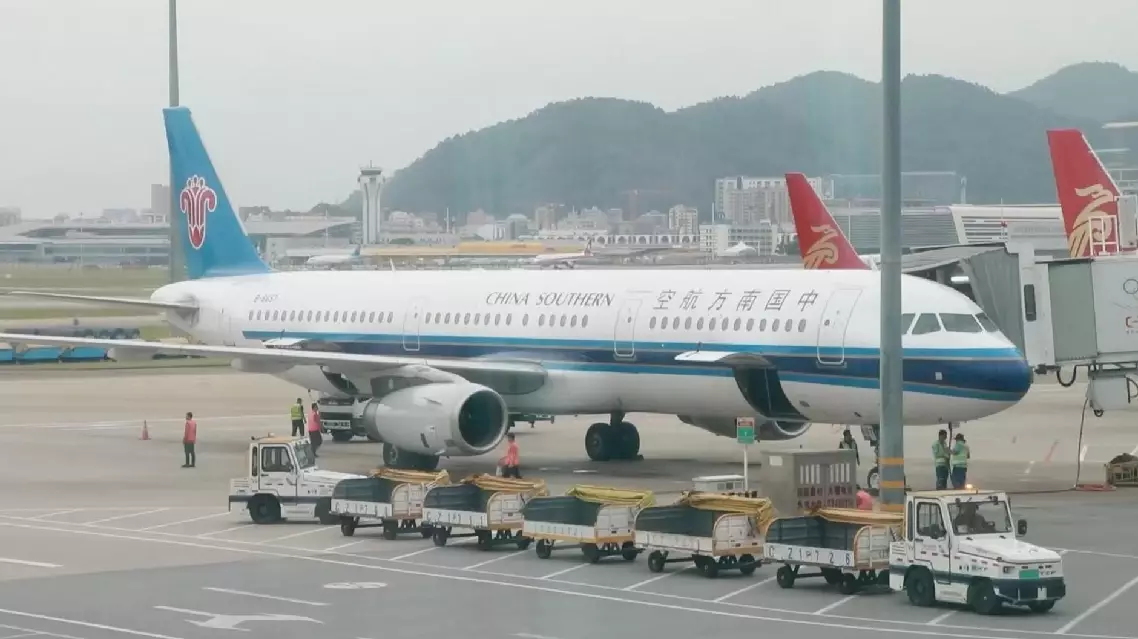
Shenzhen airport sees record cargo, passenger traffic to APEC economies this year
Twenty crested ibises are set to be released into the wild in Tianshui, northwest China's Gansu Province on Sunday, and preparations at their breeding base are in their final stage on Saturday.
The birds currently live at the Longmen Forest Farm of the Xiaolong Mountain Forestry Protection Center, the country's third relocation and rewilding site for the species. The crested ibises were introduced from Yangxian County in northwest China's Shaanxi Province, and the towering steel mesh cage that serves as their home stands about 10 stories high.
The cage covers an area of 5,024 square meters, with a rise of 35 meters and a diameter of 80 meters, making it one of the highest-standard wild-training enclosures in China.
Its circular design gives the birds a continuous flight path, allowing them to fly in loops to build endurance and muscle strength. Thanks to the favorable climate and environment, a complete ecosystem has taken shape around the site — which has also attracted natural predators of the ibises, making the multi-layered protection essential.
Inside the cage, a fully simulated natural environment includes lawn, wetland and forest.
The two wetland areas cover one-third of the enclosure, with shallows and deep-water zones where keepers release loaches for the ibises to practice wading and foraging with their long beaks.
A feeding shed is fitted with a heated water trough to keep the surface from freezing in winter, while a shelter shed provides refuge for young birds during extreme weather such as blizzards and hail.
Various trees are distributed throughout, as crested ibises are particular about nesting sites, generally choosing tall broad-crowned trees with abundant lateral branches, such as oaks and oil pines.
A bird-watching platform allows keepers to record the birds' feeding, flight and roosting daily, data that complements footage from 16 high-definition monitoring systems to form detailed monitoring logs.
Next to the main cage stand two smaller enclosures with distinct functions. A chick-rearing cage of about 230 square meters currently houses 10 young birds, which will stay for roughly a year until they learn to forage independently and fly short distances, before moving into the main cage for the next stage of training.
A separate rescue cage provides treatment and recovery space for injured birds — for instance, during breeding season, crested ibises may abandon their nests when frightened or disturbed, requiring timely human intervention to save the chicks.
These carefully designed facilities have allowed the ibises to grow up healthy, laying a solid foundation for their return to the wild.
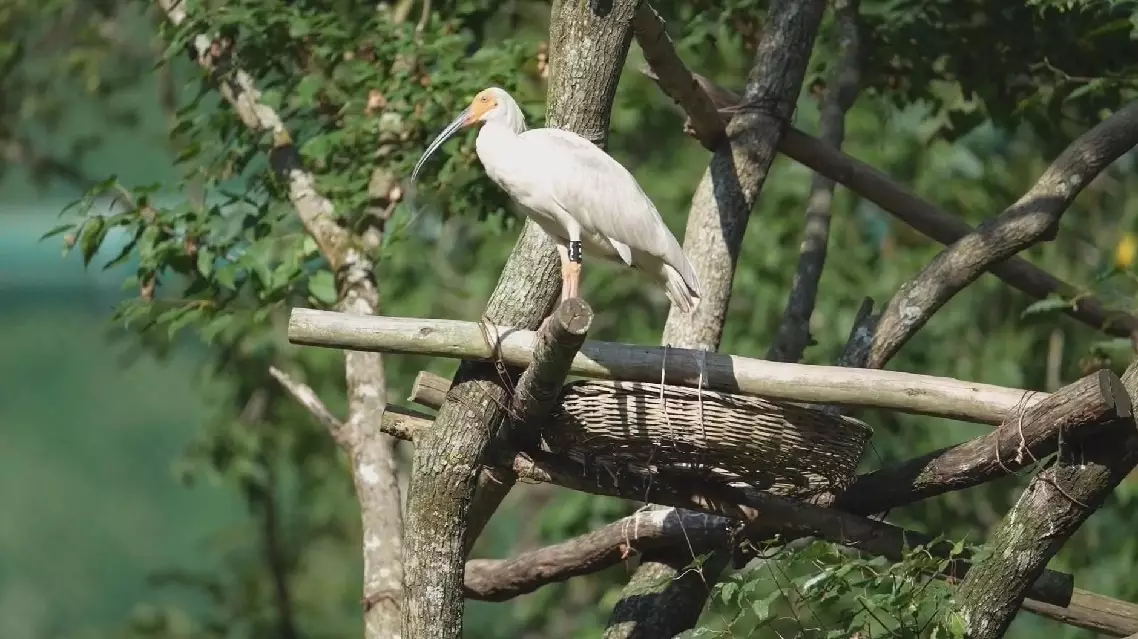
20 crested ibises to be released into wild in Gansu