LONDON (AP) — A technical issue afflicted the U.K.'s national air traffic controller on Monday, the second in two weeks, causing more disruption for travelers and prompting renewed calls for the organization's chief to quit.
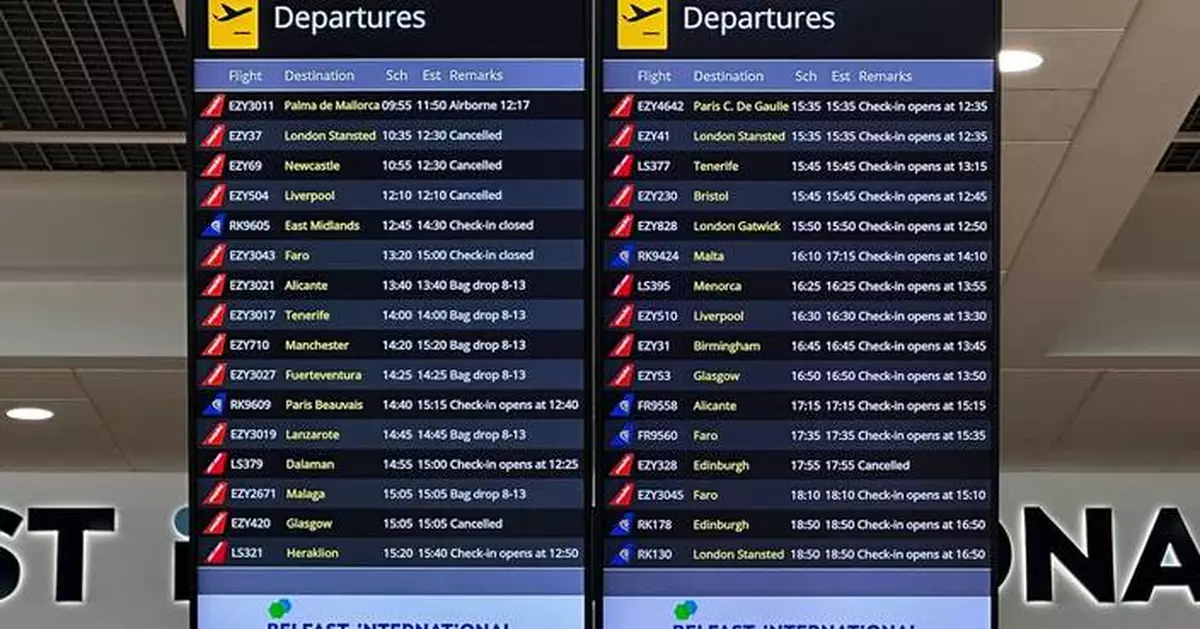
Although NATS, formerly known as National Air Traffic Services, said the issue at its Prestwick center in Scotland has been fixed, the repercussions will likely continue through the day at the very least, with flights in and out of Scotland, Northern Ireland and the north of England canceled or delayed.
“We are working with airports and airlines to safely lift air traffic regulations as quickly as we can to minimize any further disruption,” it said in a statement. “We apologize for the disruption.”
Nikki Ferguson and her husband were taking their two daughters to Disneyland Paris, but had their morning EasyJet flight from Glasgow canceled. The Aberdeen family were rebooked to leave in the evening from Edinburgh but were anxious about whether that would happen.
“My youngest daughter was crying, thinking we were not going to get to go,” Ferguson said. “We’re still feeling stressed, not sure if we’re actually going to get there today or not. We booked the holiday a year ago. It was the girls’ big Christmas present."
NATS said the disruption is unconnected with the software glitch that led to the cancellation of over 2,000 flights in and out of the United Kingdom two weeks ago. The chaos prompted mounting calls for its chief executive Martin Rolfe to stand down.
In a report on the outage published on Friday, NATS said a software defect in the National Airspace System, which allocates codes so air traffic controllers can identify flights on radar, was behind the decision to ax the flights.
Unlike that national disruption, NATS said airports south of Manchester, including those in and out of London, are “broadly unaffected."
Manchester, Belfast International, Edinburgh and George Best Belfast City airports have seen the most disruption, according to aviation analytics company Cirium.
Airlines and airports were aghast at the latest technical problem involving air traffic control over the U.K. and demanded urgent action. Ryanair was particularly vociferous in its response, saying more than 25,000 of its passengers are expected to face disruption as a result of the latest problem and said the company's CEO should stand down immediately or be sacked by Transport Secretary Heidi Alexander.
“Martin Rolfe has presided over repeated system failures, repeated passenger disruption and repeated failures to deliver an effective back-up system,” its chief operations officer Neal McMahon said. "Enough is enough. Martin Rolfe should resign today.”
EasyJet said the latest flight disruption “once again, calls into question the resilience of NATS’ systems and demonstrates the need for firm actions to prevent these repeated failures."
And British Airways said it is “disappointing” that some customers may experience disruption after “yet another technical fault" involving NATS.
The U.K. government owns 49% of NATS, making it the largest shareholder and giving it an effective veto over key decisions. Airlines, airports, investors and employees own the remaining shares in the public-private partnership.
“I know this will be deeply frustrating for passengers after the previous issue,” Transport Secretary Alexander said.
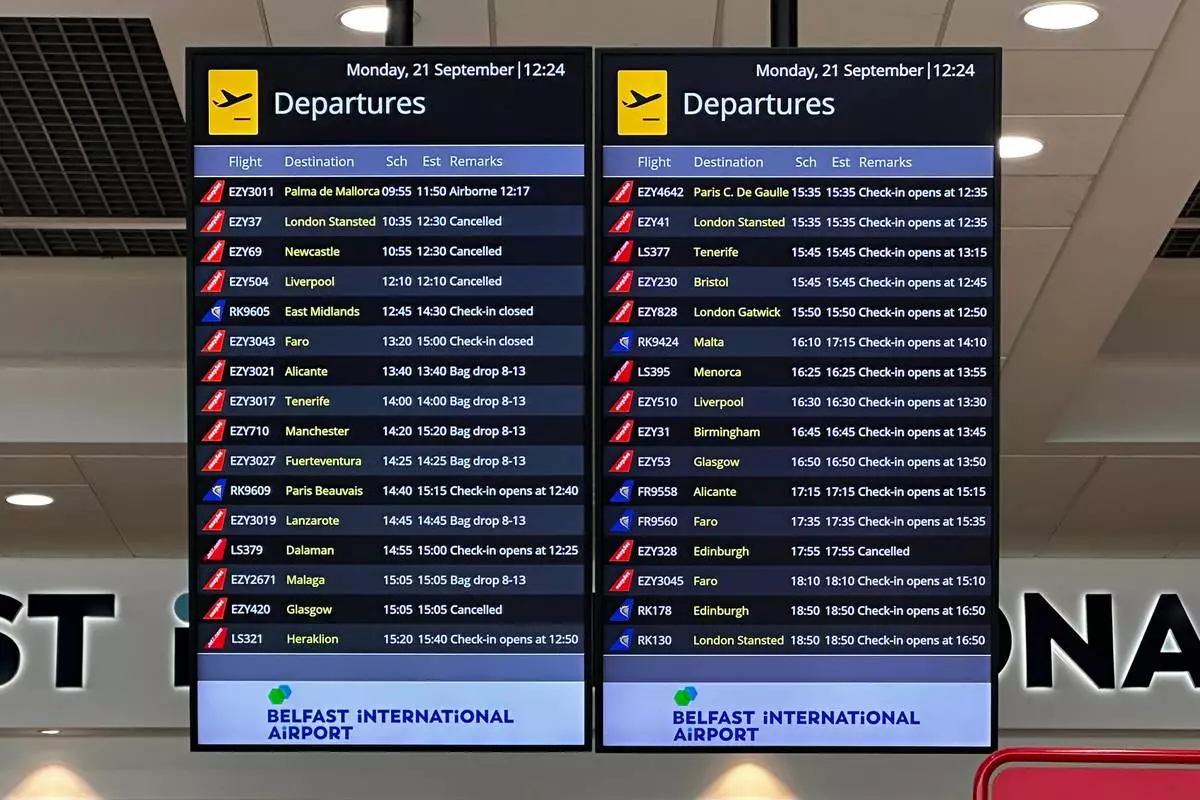
A departures board at Belfast International Airport, Co Antrim, following disruption to flights due to a "technical issue" at an air traffic control centre in Scotland, Monday Sept. 21, 2026. (Liam McBurney/PA via AP)
The main Kremlin party retained its majority in Russia’s parliament, election officials said Monday, after three days of carefully orchestrated balloting that excluded most opposition candidates and helped President Vladimir Putin maintain his tight grip on power.
Preliminary results indicated that United Russia would get 355 out of 450 seats in the State Duma, the lower chamber of parliament, the Central Election Commission said, which would be a record high for the party if confirmed.
Results from over 95% of the polling stations gave United Russia just under 58% of the vote for the 225 seats apportioned by parties, according to commission chair Ella Pamfilova. Another 225 lawmakers were chosen to represent individual constituencies, and the results showed United Russia candidates leading in 208 of those races.
Winning seats alongside United Russia were several other parties that almost always vote for Kremlin initiatives. A handful of seats will go to candidates who ran without a party affiliation in single-seat races, according to preliminary results.
It was the first parliamentary election since Putin launched the full-scale invasion of Ukraine in 2022, and the first to include residents of four regions of that country that were seized and illegally annexed by Moscow later that year. At a polling station in the Russian-held part of the Donetsk region, voters dropped their ballots in a box under the gaze of an armed Russian soldier.
Voting also was held in Crimea, which was illegally annexed by Russia in 2014. Kyiv denounced the voting in those regions as illegal.
The government was “able to carry out the campaign and the voting the way it wanted, with the most optimal output,” said Tatyana Stanovaya of the Carnegie Russia Eurasia Center, in an online commentary.
The Kremlin tightened its crackdown on opposition before the election, including barring Russia’s only liberal, anti-war party from the ballot and allowing it to compete only in single-constituency races.
The Kremlin has sought the parliamentary election to showcase popular support for the war, and strove to avoid political risks by stamping out any dissent.
A massive state media campaign and tight control over the election in the absence of genuine opposition left little doubt that the Kremlin will keep tight control of Russian politics as economic costs rise and Ukrainian drone attacks increase deep inside the country.
Electronic balloting was available in many regions and encouraged by authorities. Critics said it made it easier for the government to control the outcome of the vote.
Pamfilova said turnout was just over 59% — the most for a parliamentary election in over a decade. The final results will be announced Friday, she said.
The liberal Yabloko party, the only registered political entity that dared to publicly criticize the war, was removed from the ballot last month by Russia’s Supreme Court, and only has a few dozen candidates in the single-constituency races. Additionally, some anti-war politicians were imprisoned or forced to flee abroad ahead of the campaign.
Yabloko and the Communist Party, which has criticized some aspects of government policy but carefully avoided any criticism of Putin, said many of their observers were turned away from polling stations.
Russia didn’t invite observers from the Organization for Security and Cooperation in Europe, with the Foreign Ministry accusing the group of “double standards” for its criticism of the country. OSCE Parliamentary Assembly President Pere Joan Pons said the decision was a breach of Russia’s commitments as a member state of the organization.
The election took place against the backdrop of incessant Ukrainian drone attacks. On Sunday, Russia's Defense Ministry reported that it downed 1,110 Ukrainian drones overnight.
Moscow Mayor Sergei Sobyanin said hundreds of drones targeted the capital and described it as “the largest ever” attack on the city. The Moscow Oil Refinery was hit, he said, and so was another building.
Three people were killed in the wider Moscow region, Gov. Andrei Vorobyov said. A total of 38 others were injured and received medical treatment, according to the Health Ministry.
Ukraine’s long-range drone strikes over the summer pounded oil refineries, triggering a widespread fuel crisis, and set ablaze sprawling warehouses of online retailers Wildberries and Ozon, bringing the war home for millions of Russians like never before.
“Putin, of course, will interpret United Russia's results as confirmation of the (public) support of the war, even though it is not the case: the overall demand for ending the war is growing,” said Stanovaya of the Carnegie Russia Eurasia Center.
“The main question is: what now? There are great concerns about mobilization, new repressions, harsher measures, and escalation," she wrote.
“I partially agree that Putin may perceive the election results as a green light for ‘anything for the victory,' but I think the role of the elections here is greatly exaggerated," she added. "Everything depends much more on the military situation, the American factor (I don’t believe new negotiations will work out), and the overall picture, where everyone is escalating.”
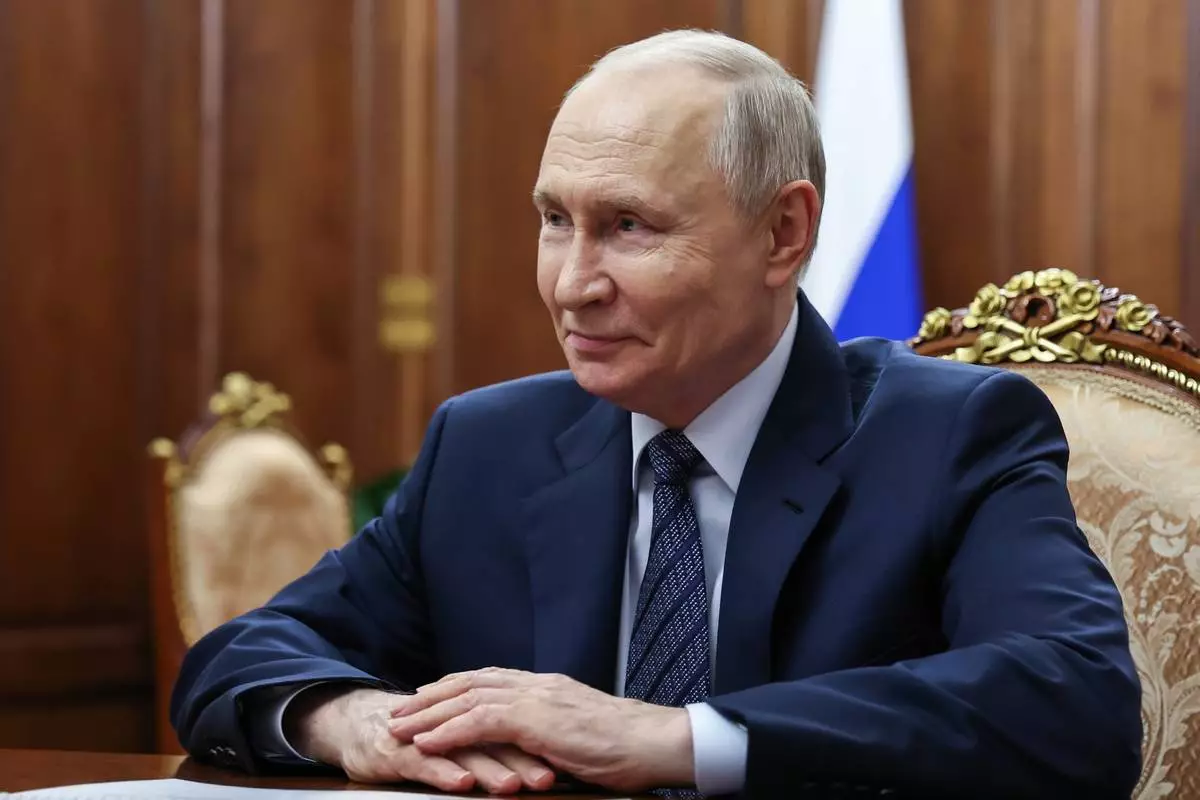
Russian President Vladimir Putin meets with Russian Federal Customs Service Valery Pikalev in Moscow, Monday, Sept. 21, 2026. (Vyacheslav Prokofyev, Sputnik, Kremlin Pool Photo via AP)
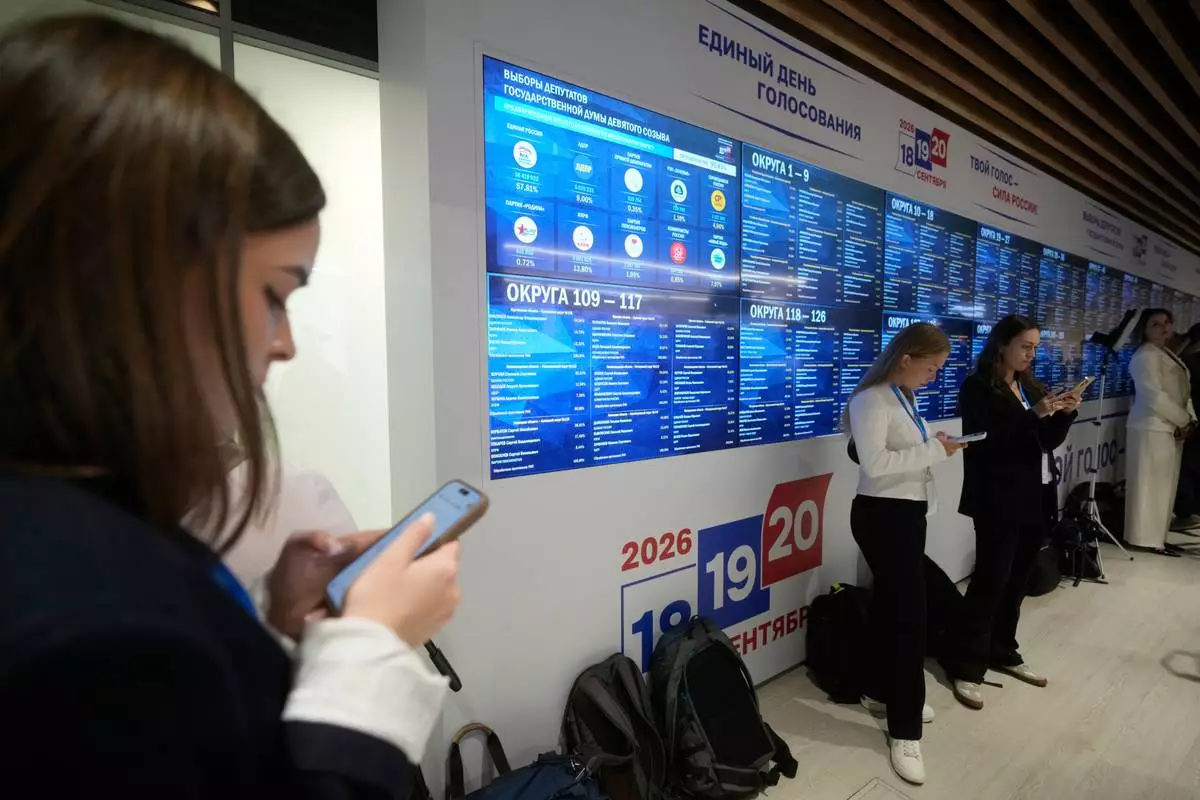
Journalists stand next to video screens sowing preliminary voting results for Russian parliamentary elections at Russia's Central Election Committee headquarters, in Moscow, Russia, Monday, Sept. 21, 2026. (AP Photo/Pavel Bednyakov)
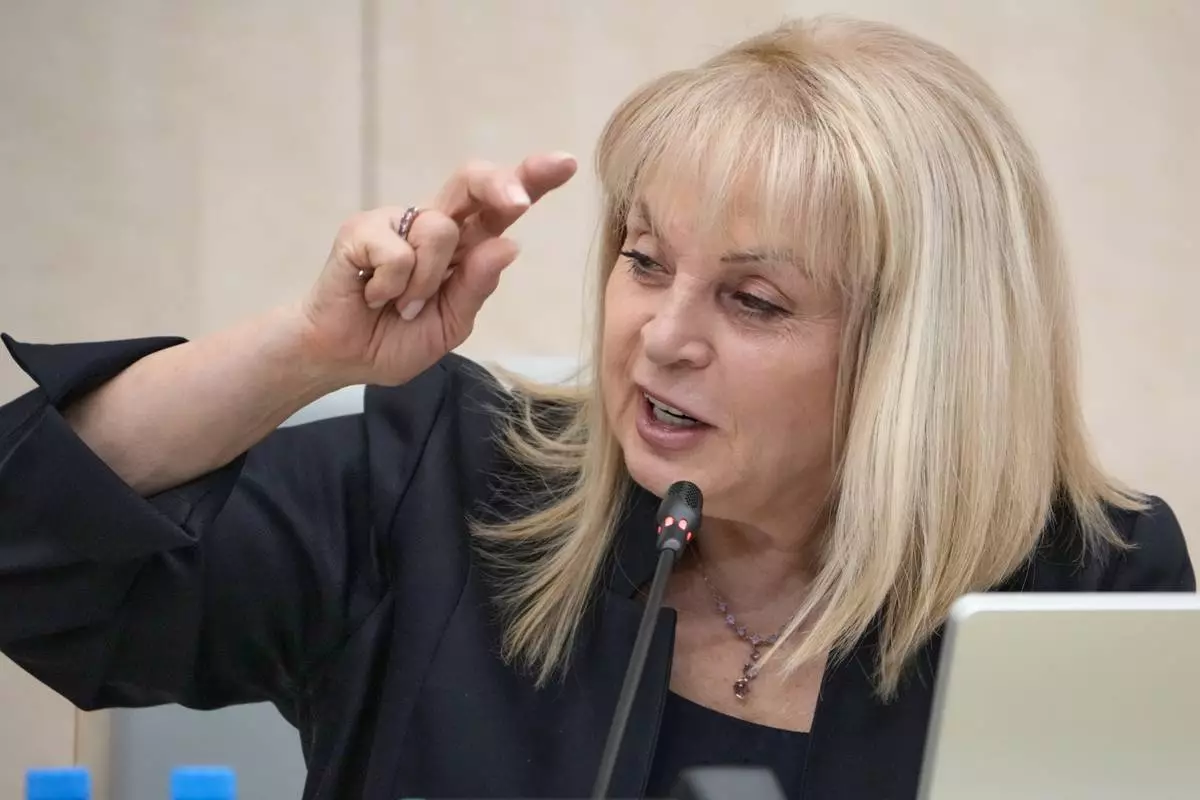
Ella Pamfilova, the head of Russian Central Election Commission, speaks during a news conference following parliamentary elections, in Moscow, Russia, Monday, Sept. 21, 2026. (AP Photo/Pavel Bednyakov)
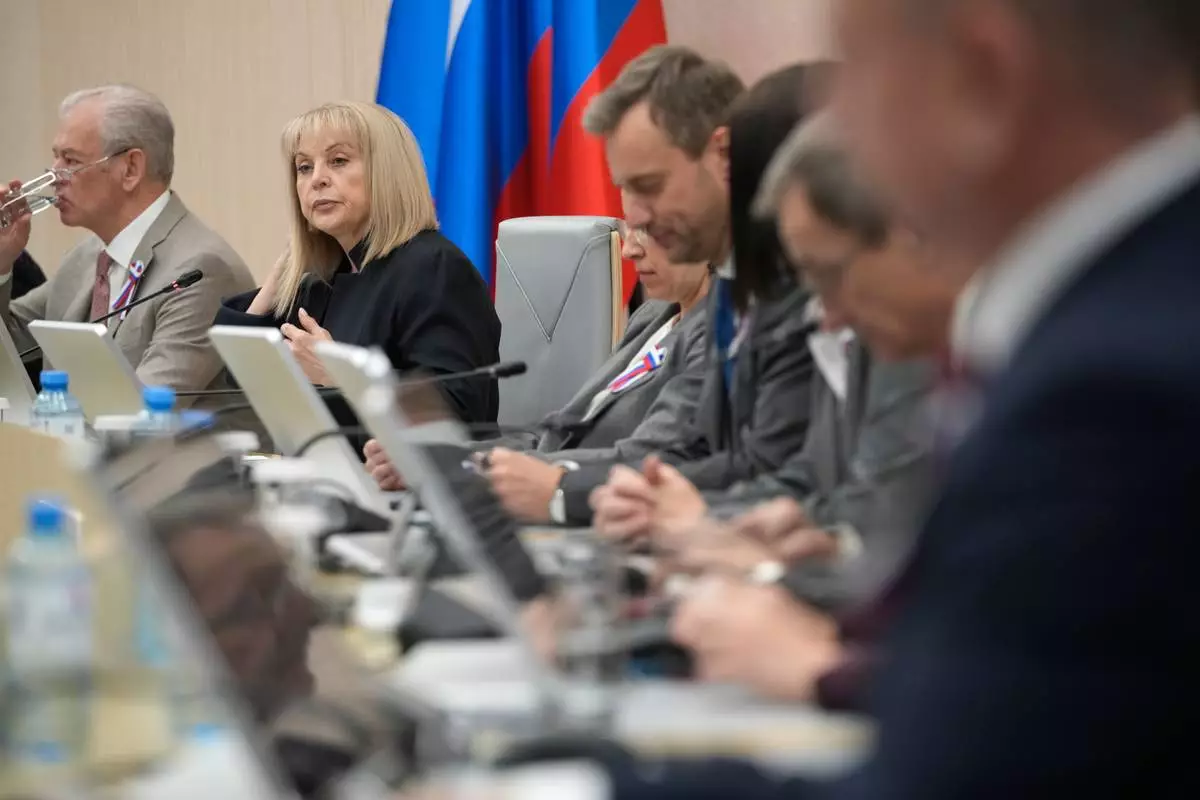
Ella Pamfilova, the head of Russian Central Election Commission, 2nd left, and other members of the Commission attend a news conference following parliamentary elections, in Moscow, Russia, Monday, Sept. 21, 2026. (AP Photo/Pavel Bednyakov)
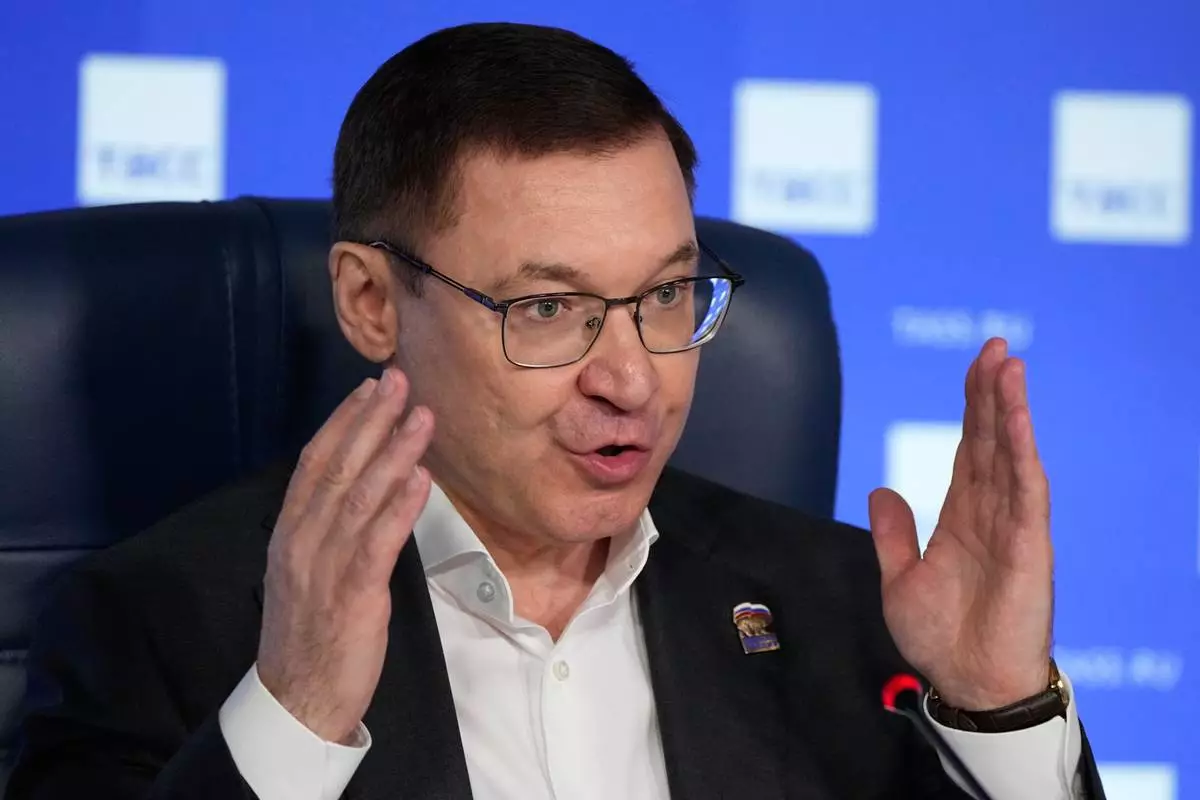
Vladimir Yakushev, a secretary of the General Council of the United Russia party, speaks during a news conference following parliamentary elections, in Moscow, Russia, Monday, Sept. 21, 2026. (AP Photo/Alexander Zemlianichenko)
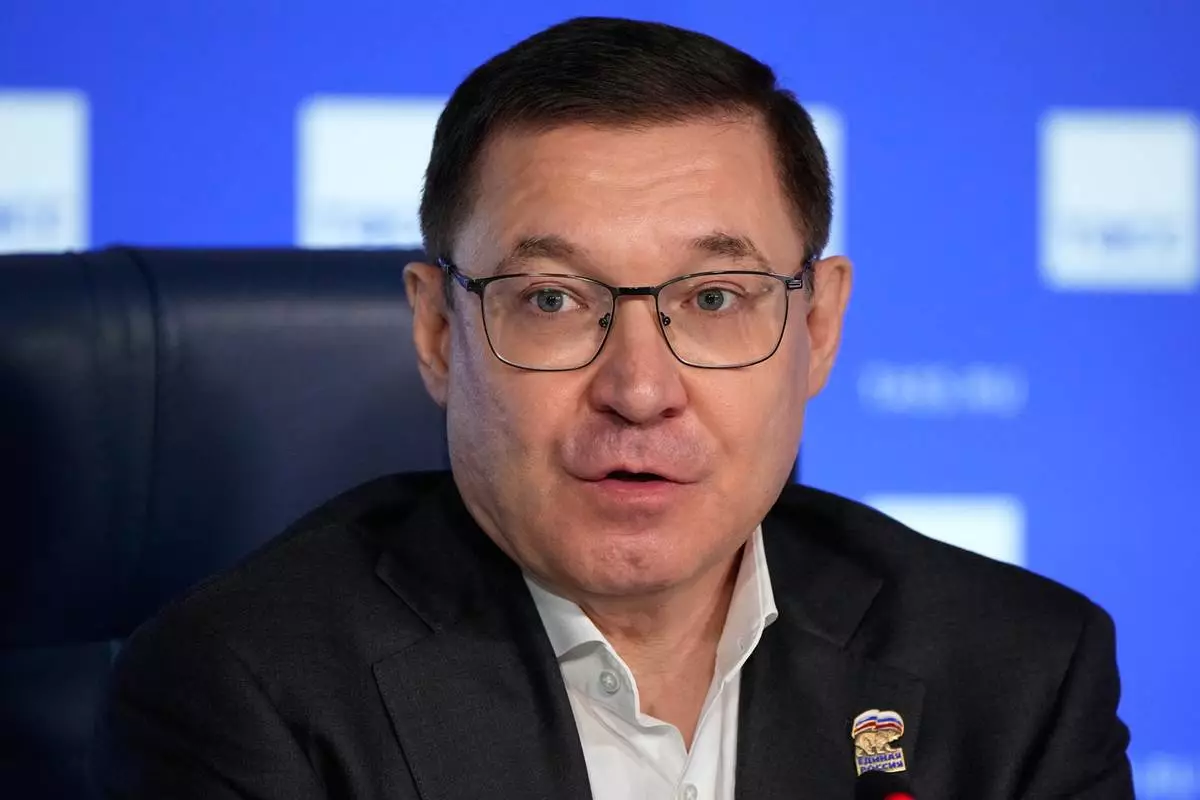
Vladimir Yakushev, a secretary of the General Council of the United Russia party, speaks during a news conference following parliamentary elections, in Moscow, Russia, Monday, Sept. 21, 2026. (AP Photo/Alexander Zemlianichenko)
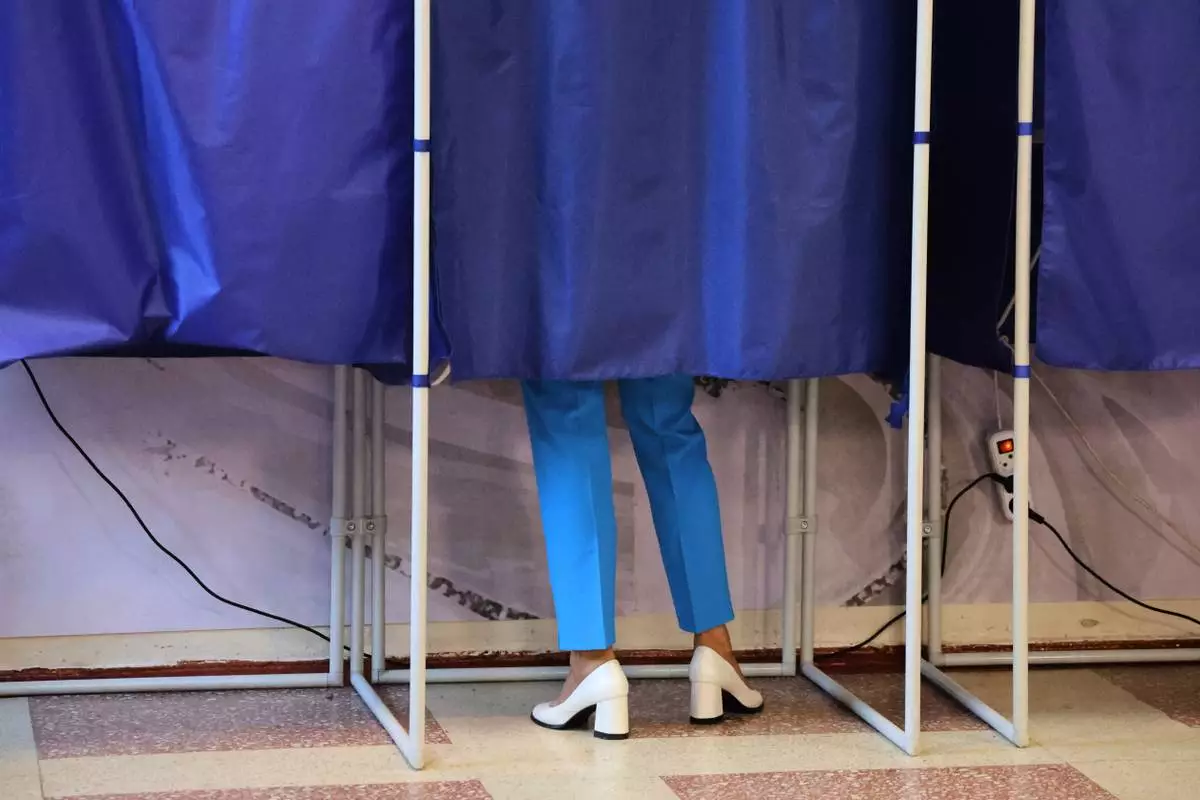
A voter fills-in a ballot during Russia's parliamentary election in Donetsk, in the Russian-controlled part of the Donetsk region, Ukraine, Friday, Sept. 18, 2026. (AP Photo)