Iran's Islamic Revolution Guard Corps (IRGC) said in a statement on Monday that it has prepared itself for a long-term conflict with the United States and its allies.
The statement quoted IRGC spokesman Hossein Mohebbi as saying that if it comes under another "invasion", Iran will introduce new weapons with new capabilities into the fray, in addition to expanding the scope of conflict.
Mohebbi stressed that Iran's policy is to maintain good-neighborly and friendly relations with countries in the region. Iran's missile strikes target only U.S. military equipment and bases, and pose no threat to neighboring countries.
On Feb. 28, Israel and the United States launched joint attacks on Iran's capital Tehran and other cities. Iran has since tightened its grip on the Strait of Hormuz.
On June 18, the United States and Iran signed a memorandum of understanding (MoU) on ending the war in the region on all fronts, including Lebanon.
Under the MoU, they were scheduled to hold negotiations within 60 days, a deadline that expired on Aug. 17, to reach a final agreement, but the talks' fate remains unclear amid recent escalations.

Iran's IRGC prepares itself for long-term conflict with US

Iran's IRGC prepares itself for long-term conflict with US
NIO's manufacturing base in Hefei, east China's Anhui Province, the country’s leading new energy vehicle startup brand, showcases advanced intelligent manufacturing with a highly flexible assembly line that breaks the limitations of traditional fixed-mode production, boosting production flexibility, operational efficiency, and product quality.
At NIO's Second Advanced Manufacturing Base, vehicles with entirely different models and designs are assembled alternately on the same line. This flexible system supports millions of personalized configuration combinations, spanning a wide range of interiors and accessories to precisely meet the growing demand for customization among global EV consumers.
Besides flexible production, the plant's original zero-kilometer logistics model achieves a major breakthrough in supply chain efficiency. A dedicated connecting corridor links the vehicle assembly workshop directly to supporting component suppliers. Core auto parts such as vehicle seats are delivered to the assembly line in real time via conveyor belts, completely replacing traditional truck transportation. The innovative model substantially cuts intermediate logistics costs and greatly improves overall production efficiency and stability.
"Our automated and digital capabilities enable the plant to roll out one finished vehicle every minute. The workshop is equipped with 1,015 intelligent robots, and all our connections are 100 percent automated, effectively ensuring the safety of our vehicles and the quality of our products," said Yin Liang, a production supervisor.
In addition, AI-driven quality inspection acts as the final and critical safeguard for vehicle quality. The plant's inspection workshop deploys an unmanned detection system integrated with cloud computing, vehicle-mounted AI agents, and 5G technology.
Without human intervention or exposed detection devices, the intelligent system autonomously completes over 1,000 professional inspection items in just three minutes, including door actuation tests, air conditioning and seat functionality checks, and lighting system calibration.
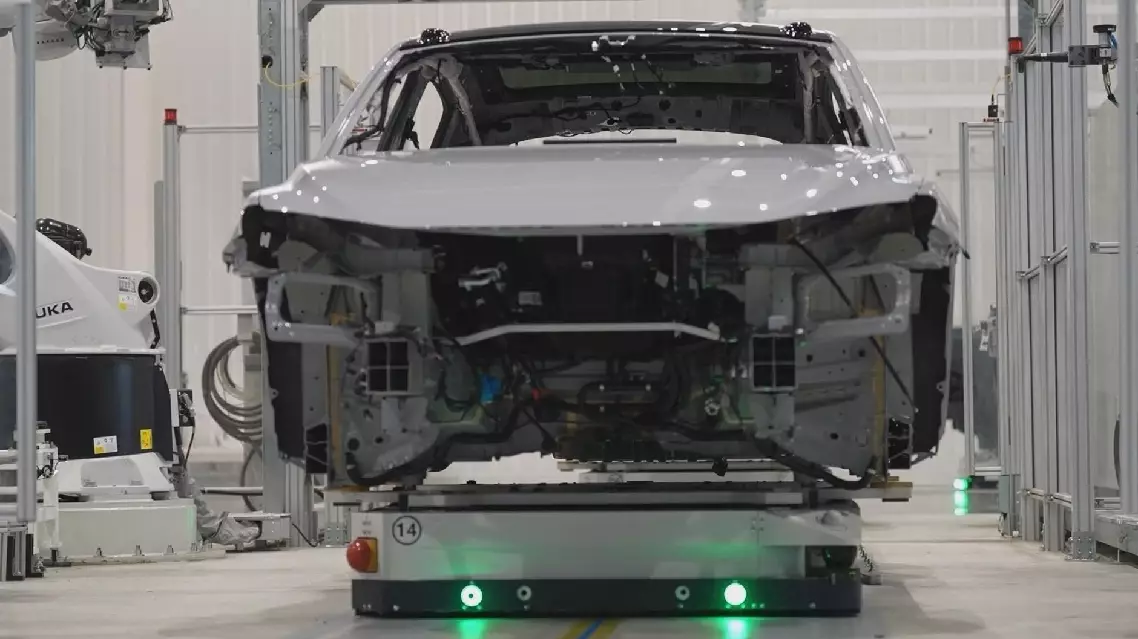
NIO’s Hefei plant highlights advanced, flexible assembly line