NEW YORK (AP) — The Gates Foundation is convening Anthropic, Google, OpenAI Foundation and dozens of other organizations to help make artificial intelligence more accessible in underrepresented languages.
The partners — 60 in total, according to Monday's announcement — include frontier AI labs, corporations, philanthropies and others already working to expand the number of languages available in AI tools that the Gates Foundation believes could combat global inequality. The coalition aims to reach more than 3 billion people over five years by better coordinating existing efforts.
It's work that must continue “full speed ahead," according to Gates Foundation CEO Mark Suzman, even as some of the largest AI companies urge their industry to slow down development of advanced models. Governments must regulate the impacts on cybersecurity or children's development, he said, while they extend AI's humanitarian applications to poor communities currently “shut out” from the technology.
“Even if AI was frozen right now — which I don’t expect and I am not calling for — we would want to be building these language sets and making them usable with the tools that we have available right now,” Suzman told The Associated Press.
The collaboration follows last week's Goalkeepers report, where the foundation committed $1 billion toward AI-focused efforts to improve health outcomes, upgrade educational tools and inform small farmers' practices around the world. Unrepresentative language data could lead a model to mistranslate a pregnant Malawi woman saying her “water has broken” into the direct English that she'd “thrown away water," the report warned.
The “original sin” is that many AI tools were trained on language data scraped from the internet, according to Mozilla Data Collective CEO E.M. Lewis-Jong, whose company was incubated by the Mozilla Foundation and is now a subsidiary of the not-for-profit Mozilla.org. The data-sharing platform seeks to help communities upload cultural and linguistic data sets on their own terms rather than have that data taken from the web without their explicit consent.
“The internet is not a representative space,” she said. “Why would you think that you were going to get a culturally diverse and representative system out of something that was predominantly trained on Reddit?”
Details such as the coalition’s governance are still getting hammered out, according to Suzman. A secretariat will track each signatory’s commitments and the Gates Foundation may nudge partners to fill larger gaps when necessary.
Google, a member of the coalition, has been funding an effort to collect more than 150,000 hours of audio across every district in India. Known as Project Vaani, the push underscores the need to gather speech data on dialects within languages, according to Google senior vice president James Manyika. To get there, he said, Google is working with local partners to record speech in the field.
Anthropic, whose CEO published an essay calling for industrywide cooperation on decelerating advancements, was already working with the foundation to speed up vaccine developments and bolster its chatbot’s data set of local crops. Elizabeth Kelly, the head of beneficial deployments at Anthropic, acknowledged the company's products “lag in many African languages in particular."
“We’re acutely aware that we can’t achieve any of the benefits we want to see in terms of improving patient outcomes or improving literacy and numeracy for students across the globe unless we actually get this language piece right," she said.
Associated Press coverage of philanthropy and nonprofits receives support through the AP’s collaboration with The Conversation US, with funding from Lilly Endowment Inc. The AP is solely responsible for this content. For all of AP’s philanthropy coverage, visit https://apnews.com/hub/philanthropy.
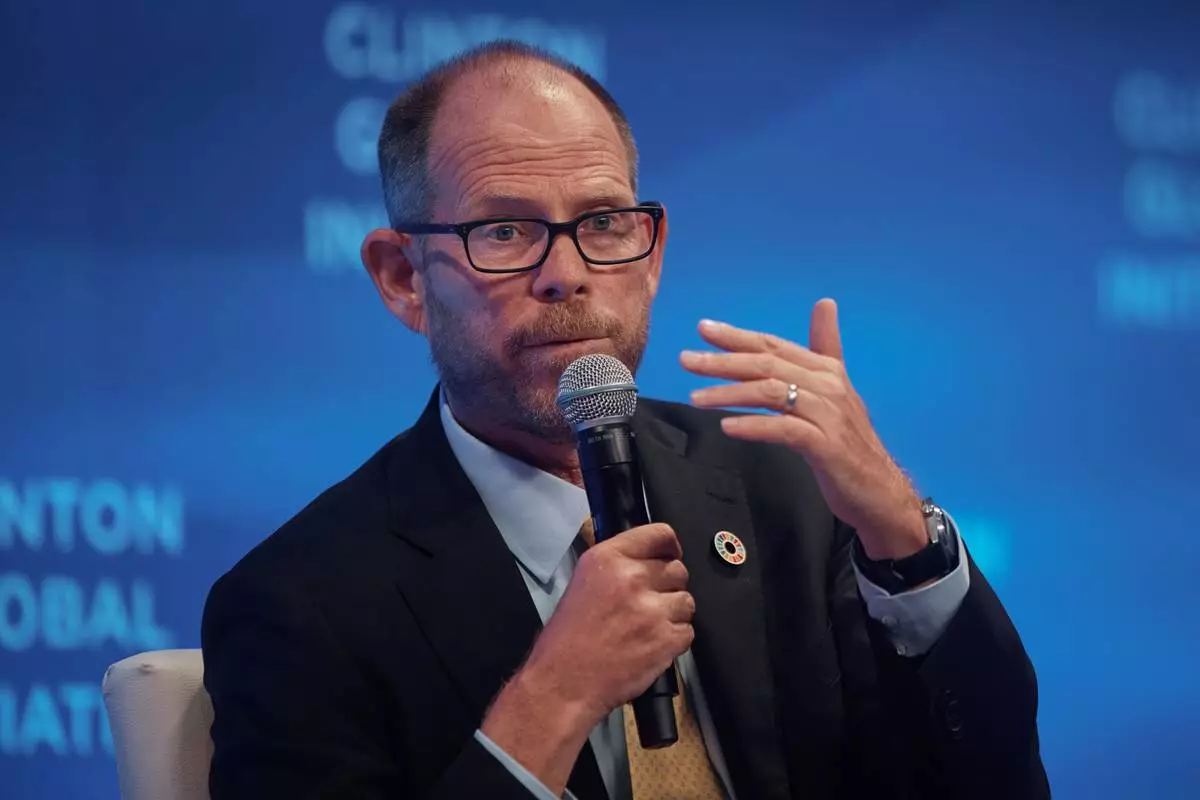
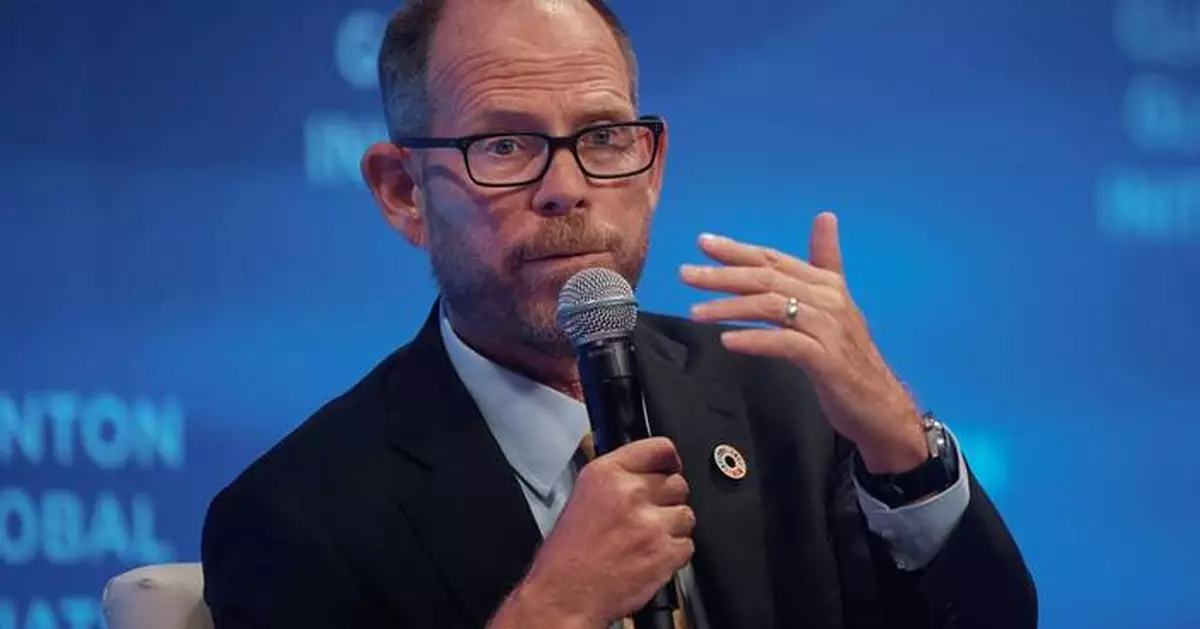
FILE - Mark Suzman, CEO and Board Member of the Gates Foundation speaks during the Clinton Global Initiative, on Sept. 24, 2025, in New York. (AP Photo/Andres Kudacki, File)
NEW YORK (AP) — U.S. stocks are climbing with markets worldwide on Monday after oil prices and yields in the bond market gave back some of their jumps from last week.
The S&P 500 rose 1% and pulled within 0.9% of its all-time high set last month. The Dow Jones Industrial Average was up 193 points, or 0.4%, as of 11:30 a.m. Eastern time, and the Nasdaq composite was 1.6% higher.
They got help from the price for a barrel of Brent oil falling 3.4% to $100.29. While that’s still much higher than its roughly $72 price from earlier this summer, it’s down from the nearly $110 it touched last week.
Oil prices are swinging up and down as some crude from the Middle East is able to sail through the Strait of Hormuz, though nowhere nearly as much as the industry and customers would like because of the war with Iran. Morgan Stanley’s Michael Wilson said another leg higher in prices for oil, gasoline and other refined products is the main risk he sees in the near term that could keep the U.S. stock market from rising to his forecasted target for the year’s end.
The average price for a gallon of regular gasoline across the United States has already climbed to nearly $4.48, according to AAA. That's up from less than $4.32 just a week earlier and from $3.18 a year ago.
Monday’s pullback in oil prices helped lower the pressure coming from the bond market. The yield on the 10-year Treasury eased to 4.96% from 5.01% late Friday after it crossed above the 5% threshold last week for the first time in three years.
Yields have been on the rise because of worries about inflation, big debt loads for governments worldwide and other factors. That hurts the economy because high yields make it more expensive not only for the U.S. government to borrow money to pay its bills but also for households and businesses.
Worries remain about how much oil is available for customers worldwide, ING commodities strategists Ewa Manthey and Warren Patterson wrote in a commentary on Monday. However, they said profit-taking by investors after the recent jump in oil prices, together with hopes for constructive discussions at this week’s U.N. General Assembly and at a meeting between China’s and the United States’ leaders, helped improve optimism.
U.S. Treasury Secretary Scott Bessent told reporters following talks Sunday with Chinese Vice Premier He Lifeng in New York that the U.S. had “a very successful engagement” with the Chinese side. Bessent said talks with China touched on trade and AI. China and the United States have been discussing reciprocal tariff reductions on $30 billion worth of goods from each side.
In Beijing, China’s Foreign Ministry on Monday confirmed that Xi Jinping will pay a state visit to the United States between Sept. 23 and 25. Experts and policymakers believe trade, tariffs, and AI safety are likely among the topics to be on the agenda. The war in Iran and developments in the Middle East and ties between China and Iran could also be discussed.
On Wall Street, stocks in the artificial-intelligence industry continued to stabilize following their worldwide slide at the start of last week. Leaders of the AI industry have recently warned a slowdown is needed in the industry’s development for the safety of humanity.
Advanced Micro Devices rallied 9.4% and could finish the day with a total market value above $1 trillion, while Nvidia added 1.2%.
Stocks enmeshed in the cryptocurrency industry, meanwhile, rallied after bitcoin's price rose back above $85,000 and returned to where it was in January. Coinbase Global jumped 5.2%, and Robinhood Markets rose 3.2%.
Stock indexes around the world also climbed thanks to the easing of oil prices and bond yields. Indexes gained 1.1% in France, 1.2% in Hong Kong and 1.6% in South Korea.
AP Business Writers Chan Ho-him and Michelle Chapman contributed to this report.
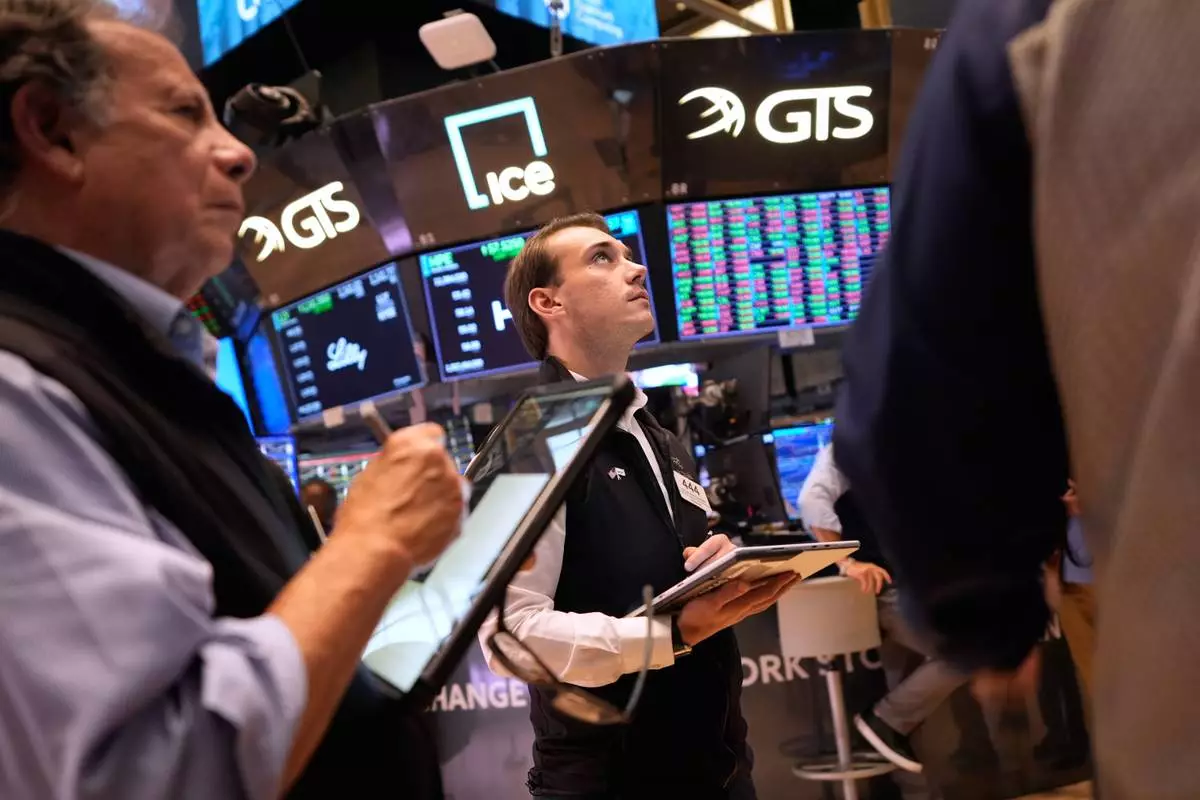
Traders work on the floor at the New York Stock Exchange in New York, Wednesday, Sept. 16, 2026. (AP Photo/Seth Wenig)
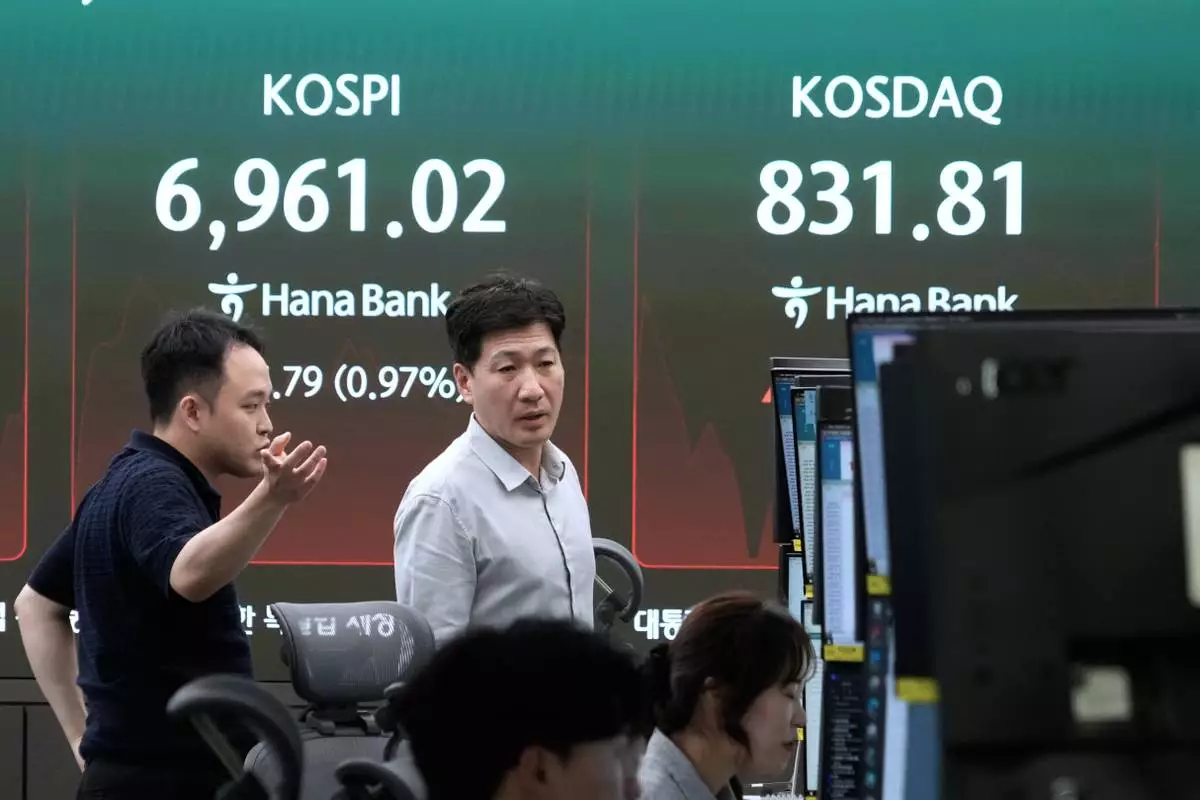
Currency traders work near a screen showing the Korea Composite Stock Price Index (KOSPI) in the foreign exchange dealing room at the Hana Bank headquarters in Seoul, South Korea, Monday, Sept. 21, 2026. (AP Photo/Ahn Young-joon)
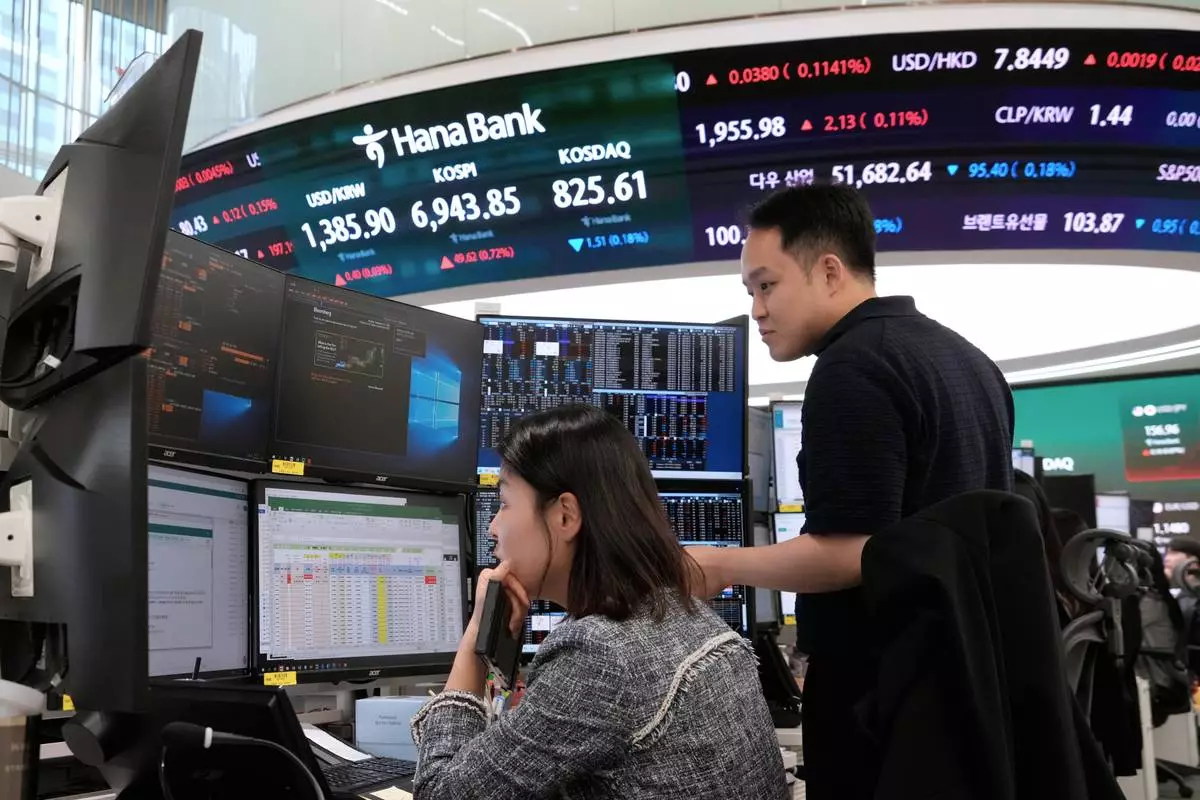
Currency traders work in the foreign exchange dealing room at the Hana Bank headquarters in Seoul, South Korea, Monday, Sept. 21, 2026. (AP Photo/Ahn Young-joon)
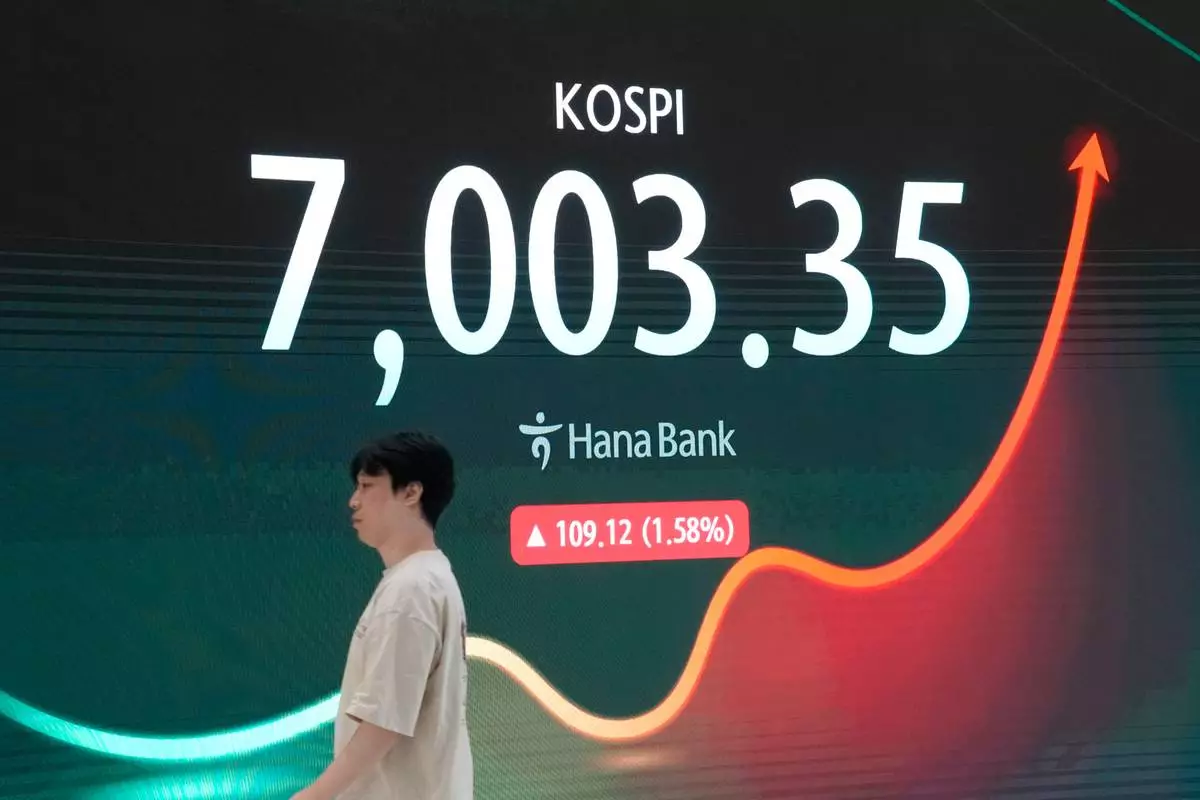
A screen shows the Korea Composite Stock Price Index (KOSPI) in the foreign exchange dealing room at the Hana Bank headquarters in Seoul, South Korea, Monday, Sept. 21, 2026. (AP Photo/Ahn Young-joon)