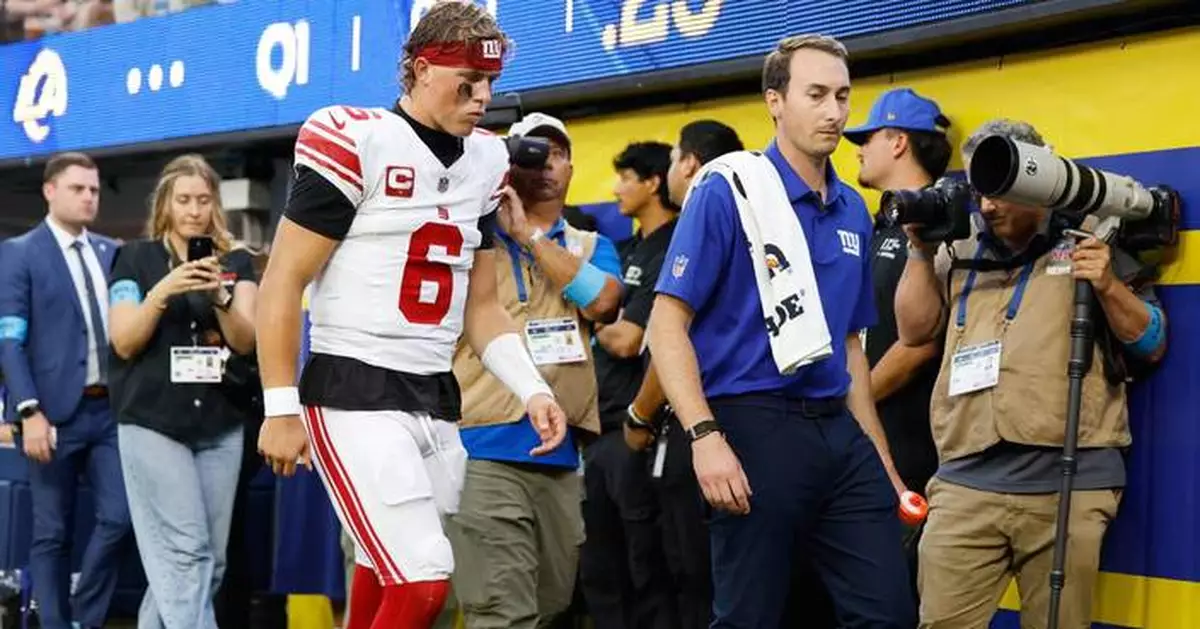
INGLEWOOD, Calif. (AP) — New York Giants quarterback Jaxson Dart and wide receiver Malik Nabers sustained injuries in the first quarter against the Los Angeles Rams on Monday night.
Dart sustained a knee injury during his team's first series, while Nabers hurt his right shoulder on the second-to-last play of the quarter.
Dart was hurt while being pressured on third-and-8. Rams linebacker Byron Young hit Dart from the quarterback's right side, sending him into linebacker Josaiah Stewart, who undercut Dart's legs, resulting in a hard fall onto the turf. Dart was eventually able to walk gingerly to the sideline under his own power, and he went straight into the medical tent for further evaluation.
Dart, who was 3-of-5 passing for 20 yards, then walked to the locker room. The Giants said his return was questionable.
Jameis Winston replaced Dart on the ensuing Giants drive.
Nabers was injured jockeying with Rams cornerback Trent McDuffie when he was targeted on a first-down pass. Nabers immediately grabbed his right shoulder and ran to the sideline, where he was clearly in pain as he was examined by multiple trainers.
Nabers remained on the bench, working with a trainer and lifting and flexing his right arm as the Giants prepared for their ensuing offensive possession after falling behind 14-0, but he was able to return to the game.
Dart played in 14 games and made 12 starts as a rookie after being drafted 25th overall in 2025, sustaining a concussion in a Week 10 game against the Bears. He threw for 2,272 yards with 15 touchdowns and five interceptions and rushed for 487 yards and nine touchdowns.
Dart's second season began with the most productive game of his young career. He threw for three touchdowns without an interception in a 28-20 win over the Cowboys.
Winston started two games and appeared in three for the Giants in 2025, throwing for 567 yards with two touchdowns and two interceptions. The 11-year veteran was drafted first overall in 2015, and has also played for the Buccaneers, Saints and Browns.
See AP’s full NFL coverage here

New York Giants quarterback Jaxson Dart (6) walks off the field with an injury during the first half of an NFL football game against the Los Angeles Rams in Inglewood, Calif., Monday, Sept. 21, 2026. (AP Photo/Caroline Brehman)

New York Giants quarterback Jaxson Dart (6) throws under pressure from Los Angeles Rams linebacker Byron Young during the first half of an NFL football game in Inglewood, Calif., Monday, Sept. 21, 2026. (AP Photo/Katie Chin)

New York Giants quarterback Jaxson Dart (6) walks off the field with an injury during the first half of an NFL football game against the Los Angeles Rams in Inglewood, Calif., Monday, Sept. 21, 2026. (AP Photo/Caroline Brehman)
TOKYO (AP) — Ikebana, the Japanese art of arranging flowers, is a form of expression that dates back more than 500 years. It continues to blossom, quietly, not only with traditionalists but also with newcomers who find its blend of creativity and mindfulness to be restorative.
Ikebana can be a bit like solving a puzzle, except there’s no fixed answer. Because each flower, and human individual, is different, there are multiple solutions.
“There’s a ‘detox’ purifying factor, and a healing,” says Hiroyuki Okada, 40, who began taking lessons in ikebana about seven years ago. He now teaches Ikenobo, the oldest of three major ikebana schools.
Okada, who also teaches backflips to anyone who wants to learn, usually wears silver chains and jeans, but he wears a nice kimono when he formally demonstrates his arrangements. He considers himself typical of those drawn to ikebana today, people looking for joy, purpose, or solace from the daily grind or pain of modern life.
“In arranging (flowers), you are dealing with the life that is there, the beauty, of course, but you find what’s in your heart,” said Okada. “You come face to face with yourself.”
The Kyoto-based Ikenobo school, which is rooted in Buddhism, now has chapters around the world.
Okada's previous job at a nonprofit involved talking to people from around the world, and he realized how different — and alike — people were. When he switched to his current job, at a flower shop, he decided to take up a pursuit that was Japanese, so he could explore that aspect of himself, and one that could be done for a long time, alone.
Ikebana involves interacting with nature, although on a small scale — usually in a little vase.
“It is about the relationship of the creator with the flowers,” said Senko Ikenobo, headmaster-designate of the Ikenobo school.
Her family dates back generations to the originators of the art. Her father is the current headmaster.
Jeannette Haviland-Jones, professor of social psychology at Rutgers University, says studies have shown “that flowers and even flower scents promote happiness in people. We suggested a coevolutionary theory for this in which flowers became the ‘pets’ of the plant world.”
Besides a flower's beauty and fragrance, the feel of its petals and leaves to the touch is crucial, like petting a kitten or a puppy, according to Okada.
There are toddlers who do Ikenobo, copying their moms, and there are devoted centenarians. The headmaster-designate says she has seen ikebana help women who are juggling work and motherhood, or taking care of aging parents.
Ikebana has a healing effect similar to that of yoga, meditation or play, says Mayu Shimizu, who works for an online educational service and has been taking lessons from Okada for about three years.
“I like this moment of nothingness when you are concentrating on the flowers before you,” she says. “My mind feels clearer. I feel more at peace, and gentle.”
One traditional Ikenobo arrangement is shoka shofutai, which attempts to arrange the flowers, leaves and branches as they might look in nature, reaching toward sunlight or bending in the wind. The vase, sometimes crafted from wood or pottery, also becomes part of the arrangement's vision.
Yet the overall look is pure and simple, expressing the life cycle of flowers — from blossoming through withering — through three main elements:
— Shin, the tallest element, is arranged first, representing one's core, reaching up toward the sky.
— Soe, which is trimmed to about two-thirds the height of the shin and is placed at the side, expresses the flower’s individuality. The leaves might be slightly faded, representing the later stages of life.
— Tai, the third element, is the future. Choose a blossom or fresh small leaves — things that are being born.
There are also freer, spinoff styles that look more like casual, Western-style bouquets than the stoic, textbook-oriented shoka shofutai. That may feel easier, and more fun, for beginners.
Just as ikebana connects a person with flowers, those who practice the art say it’s also about the passing of the art over generations, connecting people.
Yuri Kageyama is on Threads: https://www.threads.com/@yurikageyama
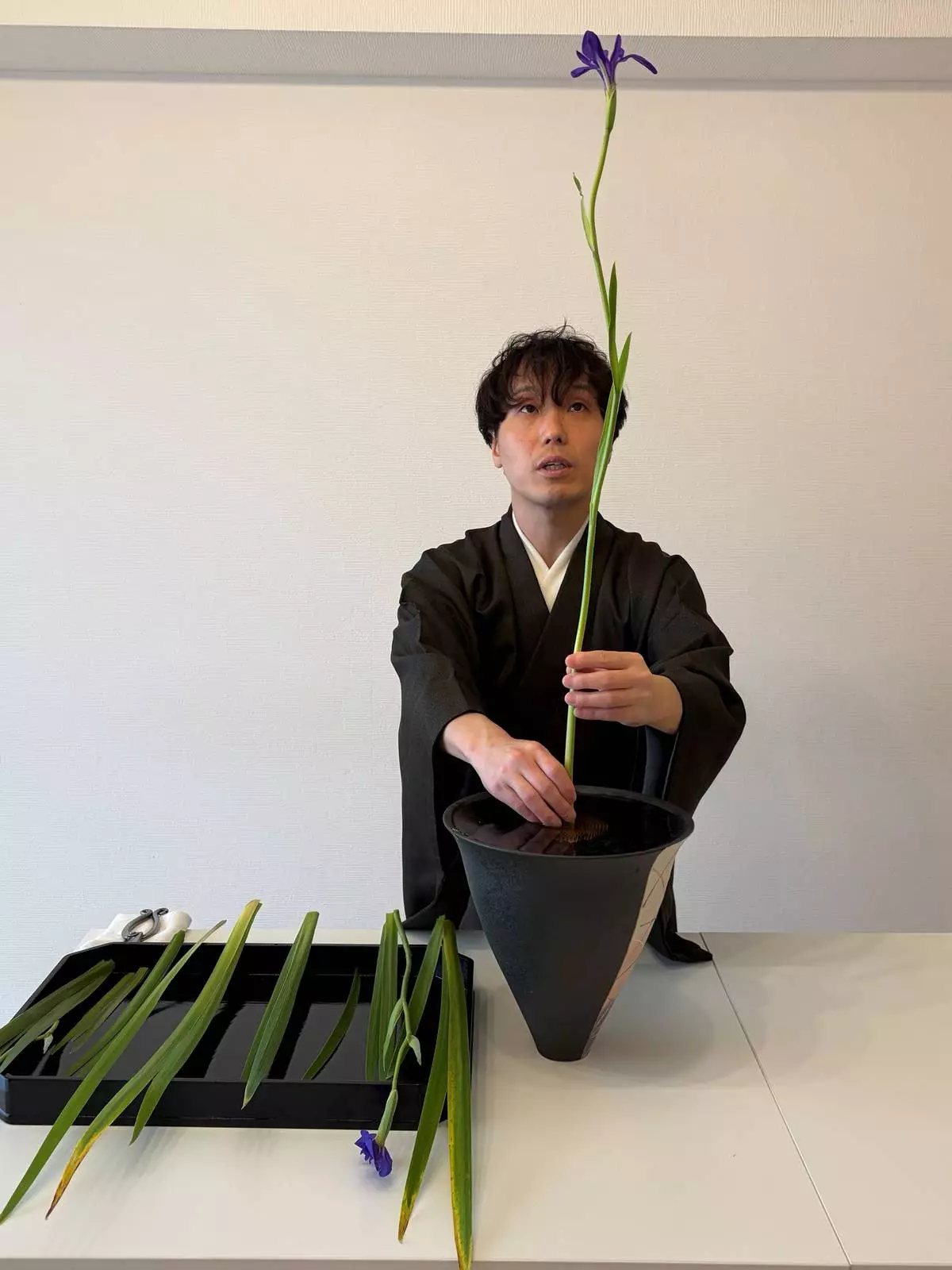
Ikenobo ikebana instructor Hiroyuki Okada demonstrates a basic flower arrangement style called “Shoka Shofutai” at a studio in Tokyo on Aug. 11, 2026. (AP Photo/Yuri Kageyama)
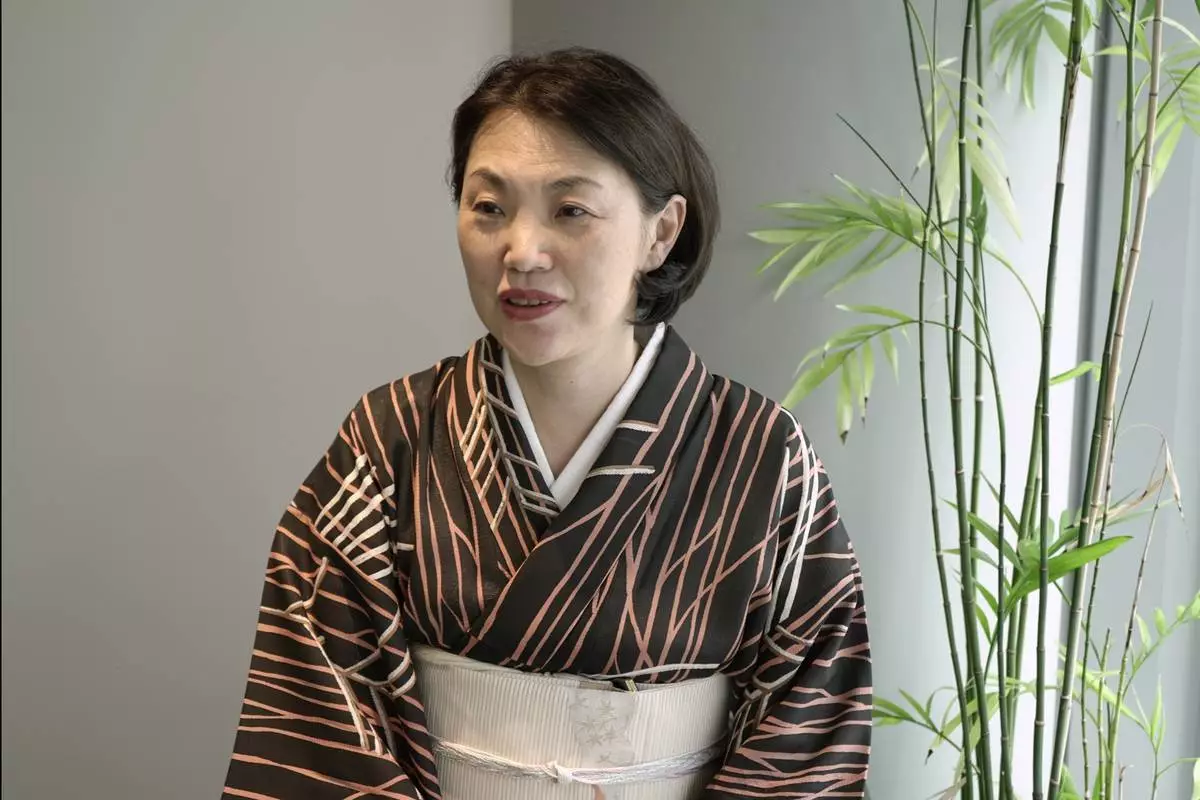
Ikenobo headmaster designate Senko Ikenobo speaks during an interview in Tokyo, on July 17, 2026. (AP Photo/Mayuko Ono)