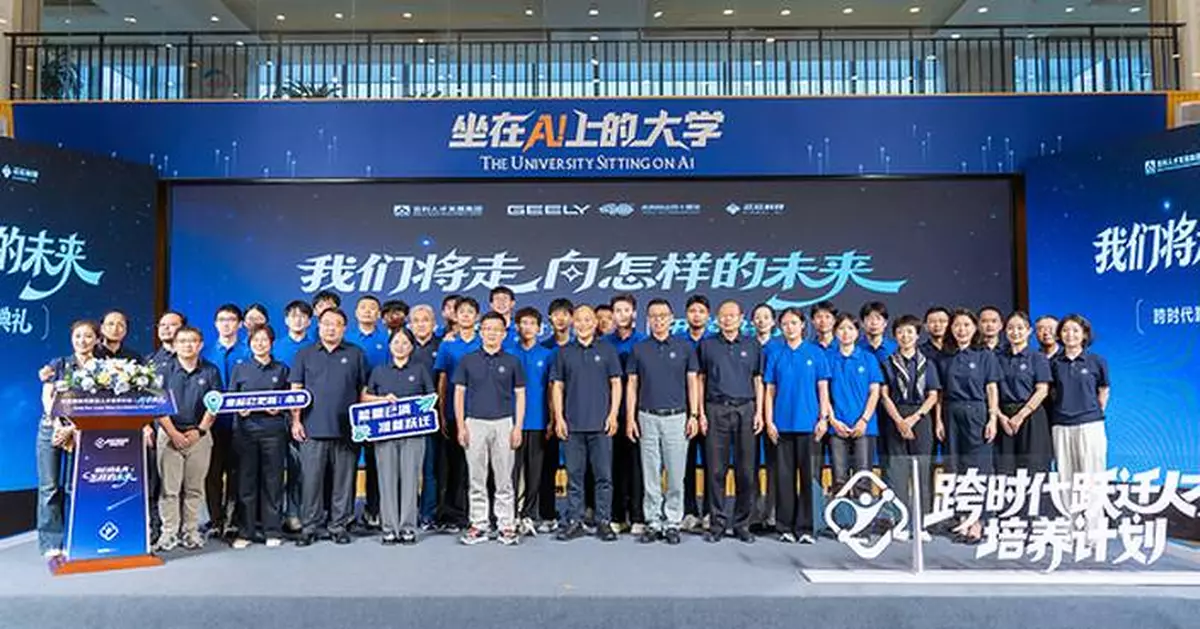
SANYA, China, Sept. 22, 2026 /PRNewswire/ -- As artificial intelligence (AI) reshapes higher education, institutions and industry are exploring new approaches to identifying and developing talent. On Sept. 16, the Cross-Era Leap Talent Development Program ("Leap Program") held an opening ceremony for its inaugural class. Developed by Xinwei Education to prepare emerging leaders for the industries of the future, the flagship program introduces an educational model grounded in real-world industry settings and designed to identify and cultivate exceptional young talent. The ceremony marked the formal launch of a program that encompasses both the early identification of promising students and their long-term growth.
Chairman of Geely Holding Group, Li Shufu (Eric Li); Lu Dan, CEO of Geely Talent Development Group and Chairman and Global CEO of Xinwei-AI; and Pan Leifang (Tony Pan), Senior Vice President and Chief Human Resources Officer of Geely Holding Group, joined industry mentors, education experts and 19 incoming students selected from tens of thousands of applicants. Participants discussed the future of emerging industries and approaches to preparing the next generation of leaders.
Looking Beyond Grades to Identify Potential Earlier
AI is reshaping industries as well as the ways in which talent is developed and assessed.
Chairman Li Shufu discussed the relationship between industry competitiveness and talent development. Every sector, he noted, faces continuing competition, with talent ultimately serving as one of the principal determinants of success. Companies may hire experienced professionals or invest in training recent graduates. Using Geely's longstanding metaphor of cultivating a "talent forest," Li said the Leap Program begins at an earlier stage: rather than selecting "saplings," it seeks to identify promising "seeds."
At this earlier stage, the program focuses on advanced technologies and emerging industries in the AI era, seeking out recent high school graduates who demonstrate sustained commitment and exceptional potential in particular fields. Students will study and undertake practical work in four areas—electric vehicles, AI, low-altitude aviation and low-Earth-orbit satellites—through an intensive curriculum that combines academic study with substantive industry experience.
In its selection process, the Leap Program looks beyond test scores alone. Xinwei-AI and Xinwei Education partner with companies, universities and research institutions to evaluate candidates in four areas: passion and ambition, critical thinking and vision, grit and resilience, and empathy and teamwork. A structured assessment framework and a rigorous six-stage selection process are intended to ensure that candidates are evaluated fairly and comprehensively.
Dr. Lu Dan said the approach reflects a fundamental reconsideration of how people develop and acquire capabilities. In addition to academic performance, the qualities increasingly required of future leaders include sustained intellectual curiosity, the ability to learn across disciplines, a willingness to engage with complex problems and the capacity to translate an interest into sustained action. He said educational assessment must move beyond selection based principally on scores toward a more comprehensive process of identifying and developing talent. The approach is intended to create an educational environment in which universities and industry share responsibility for students' growth, with AI supporting collaboration between faculty members and students.
The inaugural class brings a range of strengths: some have a particular interest in robotics programming; others have extensive experience in model aircraft competitions, sustained engagement in independent research or demonstrated strengths in collaborative work. They are united by a willingness to pursue their interests over time and explore them independently.
By identifying talent earlier, the Leap Program also seeks to establish a coherent pathway from discovery to development. Its objective is not simply to select promising students, but to give them opportunities to strengthen and apply their abilities in real-world settings.
From Acquiring Knowledge to Developing Potential
Unlike traditional programs centered primarily on classroom instruction and coursework, the Leap Program places sustained emphasis on helping each student realize their potential.
Pan Leifang urged students to "work on real problems and engage with them deeply." One of the program's principal advantages, he said, is that students engage directly with industry challenges from the beginning of their studies. Students will work with code used in real-world applications, gain experience on production lines and contribute to active research projects.
Ding Renzhong, chair of the academic committee at Geely University of China and former president of Sichuan Normal University, said the value of higher education in the future will lie not only in helping students acquire knowledge, but also in preparing them to identify, formulate and investigate problems. Industry settings provide opportunities for applied learning while exposing students to complex questions for which there may be no established answers.
The Leap Program does not prescribe a single developmental path. Instead, each student's experience reflects the individual's interests, strengths and potential, with academic preparation, industry exposure and practical challenges integrated throughout the program. Under a three-mentor model, students will receive guidance as they encounter unfamiliar problems, work in new environments and undertake increasingly complex assignments. In doing so, they will build knowledge and capabilities through sustained engagement with real-world questions.
Xinwei Bee Line, an AI-enabled academic training platform developed by Xinwei-AI, will support students in strengthening their capacity for independent thought and sound judgment. Rather than concentrating solely on finding established answers, students will learn to analyze, test and address real problems. Through this process, students will develop a deeper understanding of how technology operates in different industry contexts while drawing on multiple disciplines and perspectives. The aim is to help students progress from acquiring specialized knowledge to applying it to complex challenges.
The program therefore approaches education not simply as the accumulation of knowledge and skills, but as an ongoing process of identifying, cultivating and applying each student's potential.
From Selection to Shaping the Future
At an opening ceremony themed "What Kind of Future Will We Build?", students received a letter framed as a message from 2030 and viewed a dynamic map illustrating possible future pathways for the 19 members of the inaugural class. These elements invited students to consider the relationship between their personal development and the industries they may one day help shape. Academic and industry mentors were formally appointed, while an AI mentor named "Xinwei Liangzai" (means cool boy) was introduced as part of the program's collaborative support structure.
Students also spoke with Li Shufu, other senior leaders, experts and mentors about emerging areas of industry, choosing fields of study, interdisciplinary learning and the translation of research into practical applications. Whereas many university opening ceremonies focus primarily on campus life, the students' questions centered largely on industry developments and future careers, reflecting the program's emphasis on applied learning.
Chairman Li Shufu emphasized that changes in how knowledge is acquired in the AI era require universities to reconsider the objectives of higher education. There is no shortcut to personal development or achievement, he said: students must understand the world around them while retaining the ability to think independently. Learning in the AI era, he added, should progress beyond acquiring knowledge for its own sake to learning how to innovate and prepare for the future.
Dr. Lu Dan said the AI era provides students with access to a broader range of resources and greater scope for exploration, while also amplifying capabilities developed through sustained effort. He encouraged "AI natives" to think ambitiously and explore actively, while recognizing that ideas must ultimately be translated into sustained innovation and action.
As the discussion concluded, Chairman Li Shufu offered his best wishes to the inaugural class: "May you make a successful leap and see your aspirations and dreams fulfilled."
Rapid advances in technology, continuing industrial transformation and changes in the ways people access knowledge are prompting higher education institutions to reconsider how talent is identified, developed and assessed. They also underscore the need for closer connections among education, workforce development and industry.
The Cross-Era Leap Talent Development Program represents Xinwei Education's response to these questions. Bringing together universities, companies and technology platforms, the program expands the assessment of candidates beyond examination results to include a broader evaluation of their potential for growth. By connecting early talent identification with individual growth, practical skills and industry experience, the initiative is intended to inform new approaches to identifying and educating promising innovators in the AI era.
** This press release is distributed by PR Newswire through automated distribution system, for which the client assumes full responsibility. **
Geely and Xinwei-Backed Cross-Era Leap Talent Development Program Welcomes Inaugural Class of "AI Natives"