German Chancellor and Christian Democratic Union (CDU) leader Friedrich Merz on Monday called his party's state election defeat in Mecklenburg-Vorpommern a "heavy blow," while ruling out any internal leadership challenge.
Speaking at a press conference in Berlin, Merz admitted that the CDU failed to provide satisfactory answers to public concerns.
However, he dismissed allegations of an internal rebellion, stressing that there had been "no personnel debate" regarding his leadership.
On Sunday, the CDU secured only 4.9 percent of the vote in the Mecklenburg-Vorpommern election, failing to enter the state parliament for the first time. Meanwhile, the far-right Alternative for Germany (AfD) won the state election with 38.2 percent of the vote, followed by the Social Democratic Party (SPD) with 35.5 percent.
Noting the center-left SPD's intention to stick with the coalition in Berlin, Merz said his party also fully supported the federal governing coalition.
The two parties would discuss the path forward for their cooperation, Merz said, adding that he would also hold talks with federal state leaders in the near future.
The German Bundestag has a total of 630 seats. Following the 2025 German federal election, the CDU/CSU alliance won 208 seats and subsequently formed a coalition government with the SPD, which holds 120 seats and is the third-largest party in parliament, making Merz German chancellor.
It is worth noting that, since all major German parties currently rule out the possibility of forming a coalition government with the far-right AfD, the party, which holds 150 seats and is the second-largest party in parliament, serves as the largest opposition party in the Bundestag.

Merz vows coalition stability after state election defeat
China's industrial sales revenue grew steadily in the first eight months of this year, with equipment manufacturing and high-tech industries posting notable growth as new quality productive forces are cultivated at a faster pace, revealed the country's latest tax data released on Monday.
From January to August, the industrial economy maintained steady progress, with industrial sales revenue rising 7.3 percent year on year, according to the State Taxation Administration (STA).
Sales revenue in mining, manufacturing, and the production and supply of electricity, heat, gas and water grew 8.3 percent, 7.5 percent and five percent respectively, all maintaining relatively fast growth.
Equipment manufacturing continued to play a stabilizing role, with sales revenue up 10.1 percent year on year. In particular, sales revenue in computer and communication equipment manufacturing, electrical machinery and equipment manufacturing, and instruments and meters manufacturing grew 18.8 percent, 14 percent and 14.1 percent respectively.
Meanwhile, new quality productive forces were cultivated at a faster pace. In the first eight months, sales revenue of high-tech industries rose 15.7 percent year on year.
Among them, high-tech manufacturing sales revenue grew 18.9 percent, with AI-related sectors such as integrated circuits and intelligent vehicle-mounted devices up 67.7 percent and 38.8 percent respectively, the data showed.
In addition, the integration of the digital and real economies continued to deepen. From January to August, sales revenue of core industries of the digital economy grew 9 percent year on year, according to STA.
Sales revenue of digital product manufacturing and digital product services grew 16.6 percent and 11.1 percent respectively, reflecting the continuous improvement of digital industrialization.
Nationwide, corporate procurement of digital technology rose 8.6 percent year on year. In particular, the manufacturing sector increased investment in digital transformation, with its procurement of digital technology also growing from a year earlier.
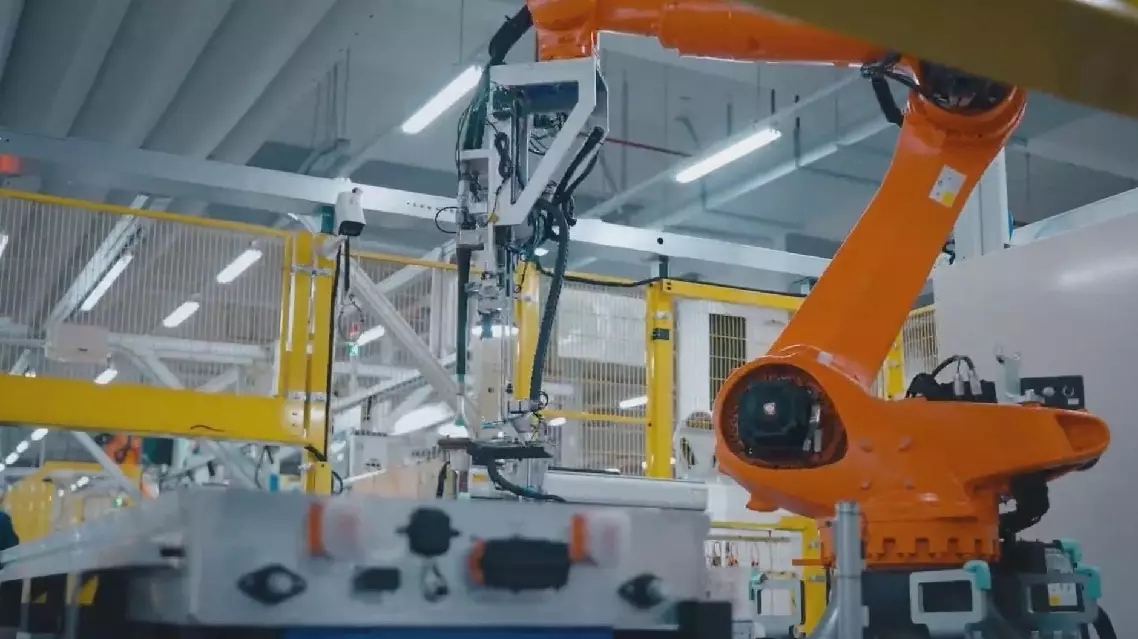
China's industrial economy grows steadily in first eight months