DES MOINES, Iowa (AP) — A judge on Wednesday dismissed Donald Trump’s lawsuit accusing The Des Moines Register and its former pollster of misrepresenting the state of the 2024 presidential race, rejecting the president’s claim that the newspaper’s poll coverage violated Iowa’s consumer fraud law.
Calling the case extraordinary, Iowa District Judge Scott J. Beattie said that allowing the lawsuit and its “faulty” claims to proceed could have a chilling effect that “can discourage others from reporting on and debating public affairs.” He sided with pollster J. Ann Selzer and the newspaper, who described the lawsuit as a conspiracy theory and an affront to free speech protections.
The ruling Wednesday came hours after a judge heard arguments but did not rule from the bench in a case on Trump’s ban of CNN, MS NOW and Politico from White House grounds. Trump banned the three outlets beginning Friday, assailing what he called “fake news.”
Trump filed the lawsuit against Selzer, The Des Moines Register and the newspaper’s parent company in December 2024, accusing them of fraudulently publishing inaccurate poll results to damage him and help Democrats, saying coverage of polls is not protected speech.
Trump and his team have filed several lawsuits against media organizations accusing them of bias, calling into question the boundaries of free speech protections, particularly for press. Some of those lawsuits have ended in settlements.
In dismissing the case in Iowa state court, Beattie wrote that Trump’s suit sought to “stretch both Iowa statutory and common law beyond their current bounds, turning speech that enjoys the highest category of First Amendment protection into a liability.” After hearing the arguments, the judge concluded the constitutional protection “is too great and the reach is too far. The case must therefore be dismissed.”
Beattie said the case would have to be dismissed even if, solely for the purpose of deciding the motions, he accepted the Trump team’s allegations that the poll was intentionally skewed and its results fabricated. “Even with this assumption, each of the three counts still fails,” the judge wrote, because the lawsuit did not meet the legal requirements for fraud or consumer deception. He made clear that the poll and coverage of it are constitutionally protected political speech and not a commercial product.
The White House referred questions to the president's personal lawyers, who did not immediately respond to messages.
Selzer's case was taken up by the free speech advocacy group Foundation for Individual Rights and Expression. She said Wednesday she was grateful for the ruling, which “reaffirms the fundamental freedom to pursue and publish the truth without political interference.”
“Polling is a social science, not clairvoyance, and no responsible pollster can guarantee an election outcome,” Selzer said in a statement.
U.S. Rep. Mariannette Miller-Meeks and former Iowa state Sen. Brad Zaun, both Republicans, joined the lawsuit. Selzer and her co-defendants wanted the case moved to federal court but, after a year of legal proceedings, the first hearing took place this year in state court.
The poll, conducted by Selzer’s company in the final days of October and released just days before Election Day 2024, showed then-Vice President Kamala Harris, the Democrats’ presidential nominee, capturing 47% of Iowa likely voters, to Trump’s 44%.
Trump ultimately won the support of 56% of the nearly 2 million Iowans who voted.
Trump, Miller-Meeks and Zaun alleged the misleading coverage diminished their reputations, valuable time in the final days of the campaign, and campaign funds and resources.

President Donald Trump and New York City Mayor Zohran Mamdani speak to reporters at Gracie Mansion, Monday, Sept. 21, 2026, in New York. (AP Photo/Julia Demaree Nikhinson)

President Donald Trump speaks to the United Nations General Assembly, Tuesday, Sept. 22, 2026, at the UN headquarters. (AP Photo/Julia Demaree Nikhinson)
McDonald’s said Wednesday it will spend $8.5 billion over the next decade to modernize its restaurants globally.
Fast-food traffic in many markets, including the U.S., is flat, so for McDonald’s to continue to grow it has to grab share from competitors and improve restaurant productivity, McDonald’s Chairman and CEO Chris Kempczinski said at a meeting with investors at the company’s Chicago headquarters. McDonald's wants to automate more tasks, like inventory and scheduling, and improve kitchen operations.
“The winners will be the companies that create more demand and deliver it more efficiently,” Kempczinski said.
McDonald's shares fell nearly 5% Wednesday, their largest percentage drop since April 2025, as investors shuddered at the eye-popping price of improving McDonald's 46,000 global stores.
On the product side, McDonald's said hand-breaded chicken, which has rolled out at 10,000 restaurants in Asia and a handful of restaurants near Chicago, has boosted sales and quality ratings. Many of McDonald's competitors, like Chick-fil-A and KFC, offer hand-breaded chicken. The company plans to expand its testing to more markets in the U.S. and Ireland next year.
McDonald's also plans to introduce grilled chicken sandwiches and wraps in the U.S. and other markets and experiment with products like egg bites and bowls to meet the needs of customers who are seeking more protein and varied portion sizes.
Skye Anderson, the president of McDonald’s USA, said approximately 30 million Americans are now using GLP-1 weight loss drugs, and they’re seeking smaller, more protein-packed meals as a result. But the company’s research indicates that 60 million Americans are actively seeking more protein in their diet.
“This is an opportunity. We need to keep giving them more reasons to make McDonald’s their first choice,” Anderson said at McDonald’s investor day.
McDonald’s said the restaurant modernizations include lockers to handle delivery orders, more visible coffee preparation areas to enhance quality perceptions, bigger play areas and improved kitchen layouts. Scales to help ensure order accuracy – which are already in use at 10,000 restaurants globally – will be in 20,000 restaurants by 2028, McDonald’s said.
The company is deploying its ArchIQ system, developed with Google, that improves order accuracy with artificial intelligence and automates tasks like inventory management and scheduling. Archy, the company's AI-enabled drive-thru ordering system, is now capable of taking orders in Spanish and English with a 90% accuracy rate.
Archy could eventually reduce at least 50 labor hours per week in a typical McDonald's, Chief Financial Officer Ian Borden said. But he said the intention is not to reduce staffing. Instead, employees can focus more on hospitality or on tasks like hand-breading chicken.
Kempczinski said customers have responded positively to Archy in testing because it helps make their orders more accurate.
“It's not AI is bad or AI is good. We try to be really thoughtful about how we use it,” he said.
McDonald's is also rolling out new employee training that will focus on hospitality and food quality, said Tiffanie Boyd, McDonald's chief people officer. The training will be more experience-based, showing employees what a perfectly cooked Big Mac tastes like, for example, and will encourage more pleasant interactions with customers.
At the same time, McDonald's is still focused on value. Kempczinski said low-income consumers, defined as U.S. households making $45,000 or less, continue to go out for fast food but not as often as they used to. McDonald's has done a good job with meal bundles, like its $5 meal deal, he said. But the company is exploring ways to offer entry-level prices on a basic menu of items in the U.S., as it does in Europe and other markets.
“This is the environment that we’re in right now. You have to be on your game and deliver that value,” Kempczinski said. “The pressure around cost of living isn't going away.”
McDonald’s U.S. franchisees typically spend up to $450,000 per decade to on required store remodels. Under the company’s new plan, they will have to spend an additional $800,000 over time, but McDonald’s will pay a portion of that cost in the form of rent relief and capital support.
Borden said the investments will be phased in over time when markets and individual franchisees are ready for them. Once the investments are made, the efficiency improvements will deliver roughly $100,000 in annual cash flow benefits to the average U.S. restaurant, some of which can be reinvested in the restaurant, Borden said.
“We'd love to see it going into hospitality to elevate the experience with our customers,” Borden said.
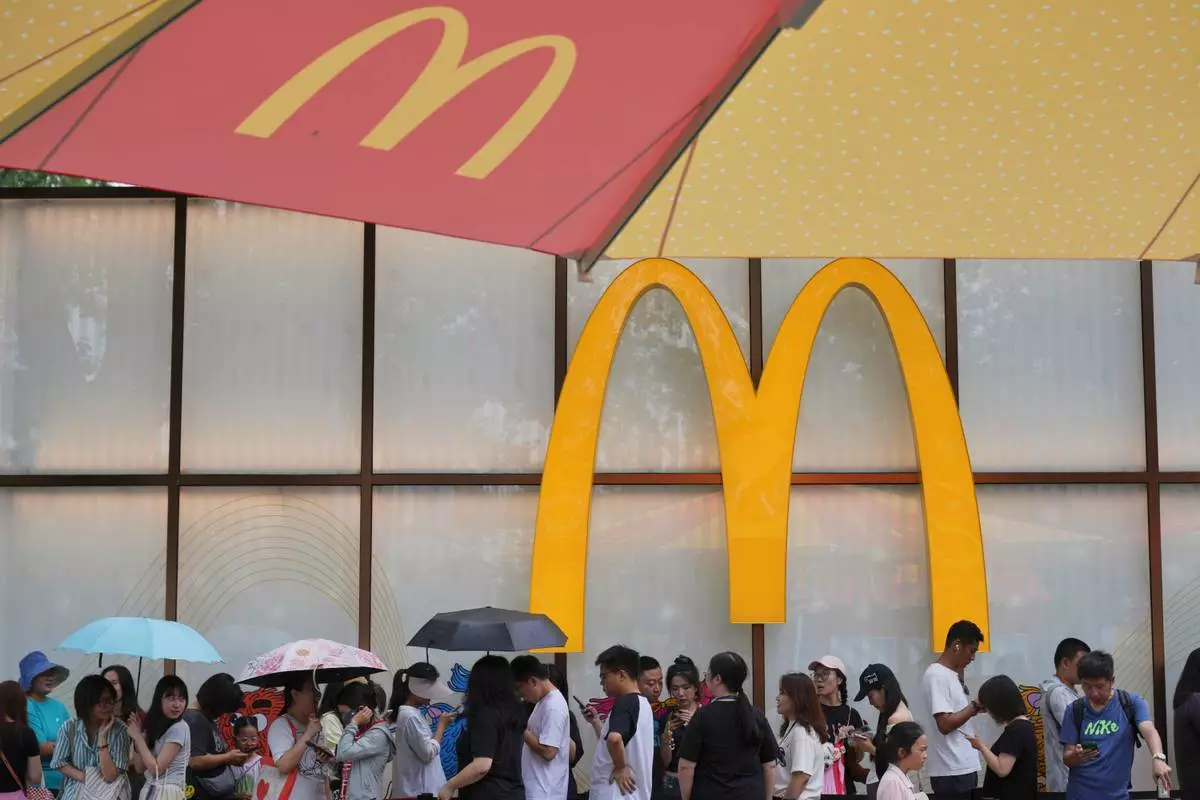
FILE - People line up to enter a McDonald's restaurant in Beijing on Aug. 20, 2025. (AP Photo/Andy Wong, File)