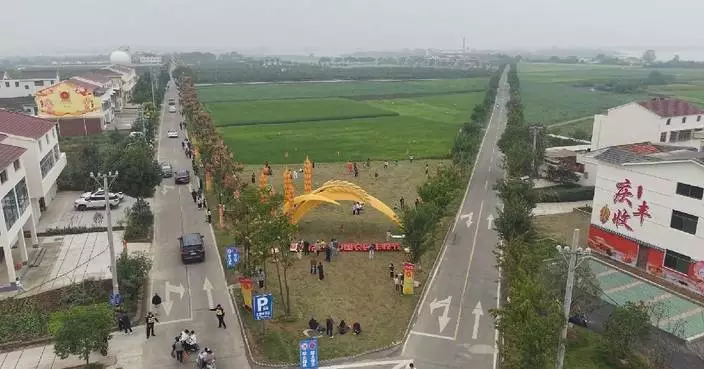
Farmers across China are busy harvesting autumn crops as the various grain-producing regions leverage modern technology and agricultural machinery to boost efficiency, with the Ministry of Agriculture and Rural Affairs forecasting yet another bumper yield this year.
Data from the Ministry show that the nationwide autumn grain acreage remains stable with a slight increase, notably in high-yield corn.
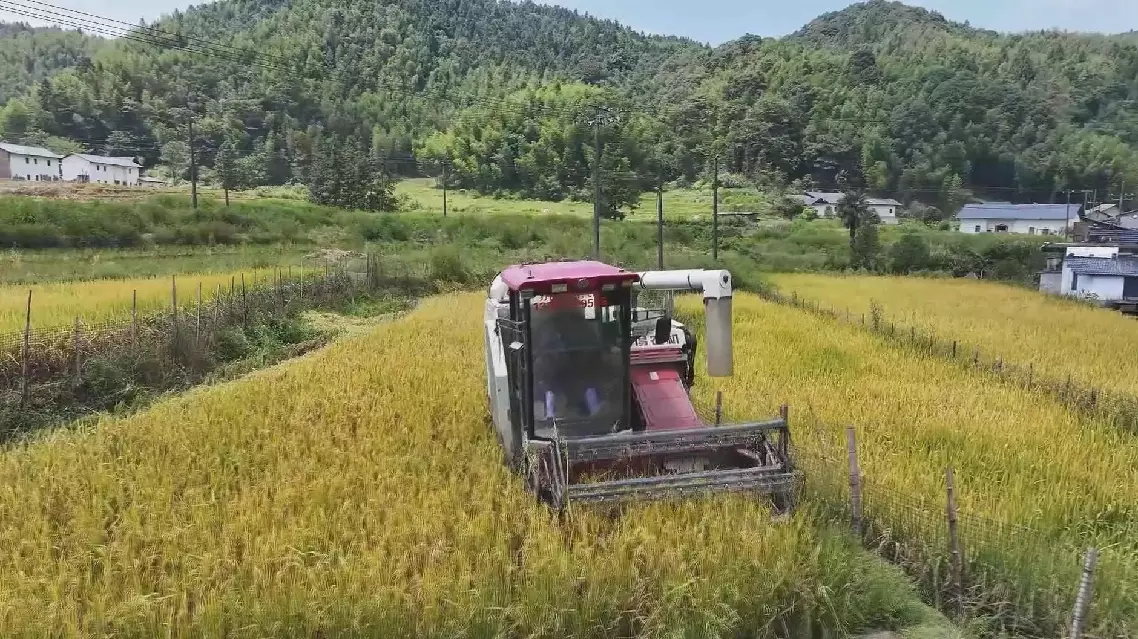
So far, most autumn grain crops have been growing well. Southwest China is currently at the peak of its rice harvest, while rice harvesting in the colder northeast is also underway. With corn maturing in the Yellow River-Huaihe River-Haihe River region, the country is on track for another robust autumn harvest. In Xunwu County of east China's Jiangxi Province, harvesting is fully mechanized across hilly terraced fields. Located along the foothills of the Wuyi Mountains, much of the county's farmland is distributed on mountain slopes.
In recent years, local authorities have introduced new crop varieties and compact harvesters specifically adapted for hilly terrain. This has significantly boosted harvesting efficiency and farm profitability.
In Funing County of southwest China's Yunnan Province, new technology is helping streamline the harvest across more than 660 hectares of terraced paddy rice fields in a village named Naye.
So far this year, the village has deployed five agricultural drones to transport harvested grain between the fields and drying grounds, with a single transport run completed in just two to three minutes. Assisted by drone logistics, the village expects to finish its entire rice harvest by early October.
In Fuyuan City, northeast China's Heilongjiang Province, growers are employing a specialized "wet harvesting" technique for cranberries.
Before getting in the matured fruit, workers will flood the fields with water to create shallow ponds and operate beating machines to detach ripe cranberries from the vines. Farmers will then use floating nets to gather the floating harvest and load the harvested berries onto trucks via conveyor belts.
This technique preserves the original taste and quality of the fruit while substantially increasing harvest efficiency.
In Jize County of north China's Hebei Province, harvesting is underway across more than 4,000 hectares of chili pepper fields.
Known for its "goat-horn" chili peppers -- so named for their distinctive shape and historically served as an imperial tribute during the Ming and Qing Dynasties (1368-1911) -- the county now supplies over 20 percent of China's domestic chopped chili market, with products exported to more than 10 other countries and regions, including Japan, South Korea and Southeast Asia.
Technology powers China's autumn harvest as bumper yield expected
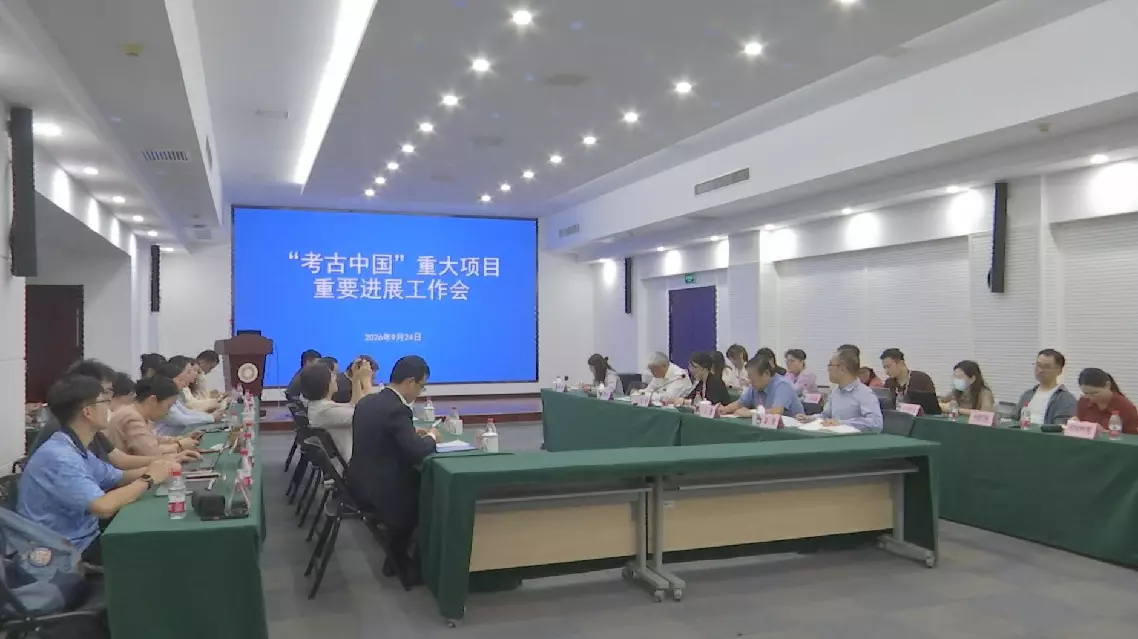
The National Cultural Heritage Administration (NCHA) held a meeting on major progress in the "Archaeology China" program in Beijing on Thursday, releasing the latest results of three joint archaeological projects in Kyrgyzstan, Egypt and Tunisia.
In Kyrgyzstan, archaeologists from northwest China's Shaanxi Province have joined in local institutions' archaeological surveys and excavations at Krasnaya Rechka, a large city site dating from the sixth century to the early 13th century.
Located in Kyrgyzstan's Chui Region, the Krasnaya Rechka site covers an area of approximately 20 square kilometers. It's known as New City as recorded in medieval Chinese and foreign documents.
Frequently mentioned in Chinese literature, the New City, along with the cities of Suyab and Talas, are all related to the Chu river valley in Kyrgyzstan.
Since 2018, the China-Kyrgyz joint archaeological team has unearthed more than 100 artifacts, including everyday pottery, bricks and coins.
They have also carried out systematic surveys of city ruins in the Chu river valley, identifying 24 sites.
These new discoveries reveal the historical process of urban system development in the region during the medieval period and present a vivid picture of exchanges and mutual learning among civilizations along the Silk Road.
In Egypt, the Institute of Archaeology at the Chinese Academy of Social Sciences launched a joint archaeological mission with Egyptian institutions in 2018 for studies at the Temple of Montu in the Karnak Temple Complex in Luxor, a city renowned for its rich monuments in southern Egypt.
They have uncovered a previously unknown second "sacred lake" at the site, which is an ancient man-made water reservoir covering more than 50 square meters.
The new discovery, termed as the Southern Sacred Lake, combines with the known Northern Sacred Lake to form a unique two-lake layout, marking the first time two sacred lakes are found in the same temple precinct. In Tunisia, a joint archaeological team, comprising Chinese and Tunisian professionals, has discovered remains of architectural complexes, water storage facilities, ash pits, and kilns dating from the Punic (3rd-1st centuries BC) to Roman (1st-5th centuries) periods at the Ben Arous Forest site since 2023.
They have identified functional areas such as temple areas, residential areas, private bath areas, and artisan areas at the site, refining the archaeological chronological framework for the transition from Carthaginian to Roman civilization in the western coastal region of North Africa.
Based on the findings at the site, they have also built a small urban heritage park, becoming a cultural landmark for China-Tunisia people-to-people and cultural exchanges and effectively promoting mutual understanding between the two peoples.
"China has practical, replicable and promotable experience in large-site heritage protection. Following the concepts and methods of China's large-site protection and using visual simulation, we have built a heritage park to show the Tunisian public that we can not only successfully excavate the site and do careful studies of the findings, but also display these findings," said Tong Wei, deputy director of the National Archaeological Research Center of the National Cultural Heritage Administration.
Chinese archaeologists release latest findings from overseas sites