Entering its prime viewing period with the highest waves of the year, the tidal bore on the Qiantang River in east China has drawn thousands of Chinese tourists during the three-day Mid-Autumn Festival from Friday to Sunday.
The Qiantang River stretches more than 500 kilometers in Zhejiang, passing through the provincial capital Hangzhou before flowing into the East China Sea.
Home to the world's largest tidal bore, a natural phenomenon caused by the gravitational pull from the Moon, the river features four common types of phenomenon: criss-cross, one-line, back-flow, and fish-scale tides.
For centuries, this natural wonder has been a famous tourist attraction, amazing countless visitors every year when the tidal bore reaches its peak between the 15th and 18th day of the eighth month on the Chinese lunar calendar.
The Mid-Autumn Festival, celebrated annually on the 15th day of the eighth month on the Chinese lunar calendar, fell on Sept 25 this year. Traditional celebrations usually feature mooncakes, whose round shape stands for reunion, and lanterns resembling or bearing images of a rabbit, the auspicious animal that accompanies Chang'e, the moon goddess in a Chinese fairy tale.
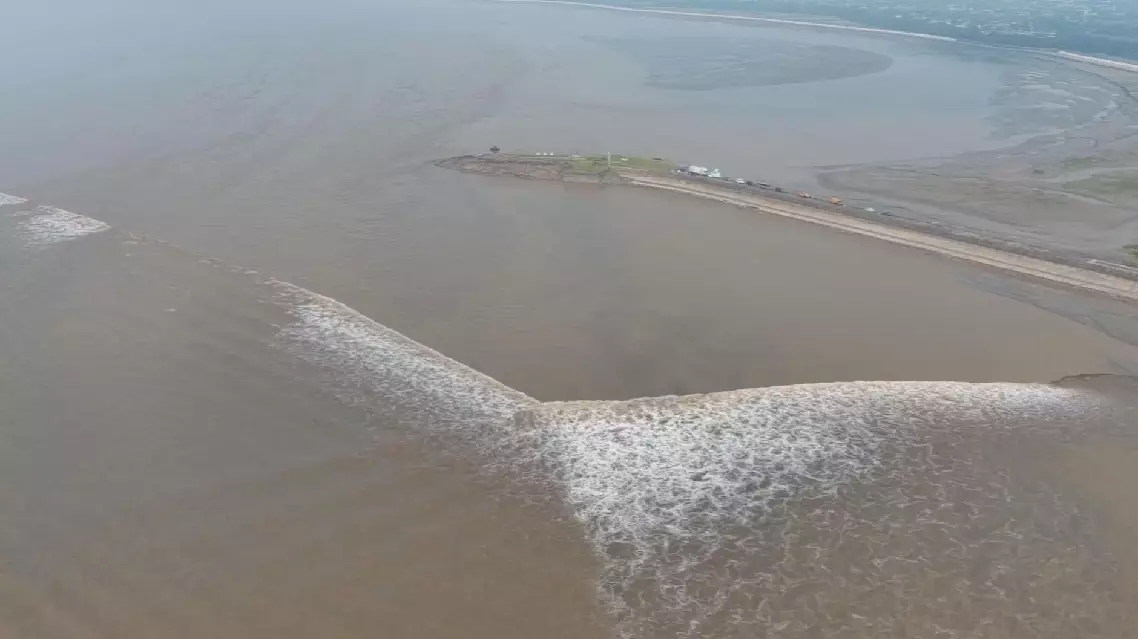
Spectacular tidal bore on Qiantang River wows viewers
People-to-people exchanges between China and the United States can make a significant contribution to mutual understanding, said a former U.S. diplomat, noting that there is a lot of room for subnational engagement between the two countries.
While attending a welcome ceremony held by U.S. President Donald Trump at the White House on Thursday morning, President Xi Jinping pledged to invite 100,000 young Americans to visit China for exchanges and study over the next five years.
During an interview with China Global Television Network (CGTN), David Firestein, president and CEO of the George H. W. Bush Foundation for U.S.-China Relations and a former diplomat, lauded President Xi's invitation, calling for more such exchanges in both directions.
"As the Chinese saying goes, hearing 100 times is not as good as seeing once. And I think it's really important that people have the opportunity to see for themselves what's happening, by the way, in both directions. But the work that China has done to catalyze and facilitate greater numbers of young Americans getting to China, I think, is laudable. And I think it's a significant contribution to mutual understanding and certainly to U.S. understanding of China. And by the same token, the Chinese in China who interact with those Americans no doubt learn quite a bit about the United States as well. So that's very positive. I think we need to do a lot more of that in both directions," Firestein said.
Beyond exchanges at national level, the expert stressed that there is more room for subnational engagement between China and the United States.
"It's not just the federal government in the United States or the central government in China that is involved in facilitating or catalyzing these exchanges. But just as you've said, it's cities, it's states, it's universities, non-profits, individual actors, there's a lot of room for what we might call subnational engagement, and it takes everyone kind of rowing in the same direction, to use that metaphor, to really make a difference and to have an impact when you're dealing with countries of this scale," Firestein said.
He said that there are signs of changing attitudes in the United States, as more people come to see that their country must take a "more pragmatic and results-oriented" approach to China.
"I do think that we are starting to see a change in the mindset in the United States. I think people are starting to realize we need to be more pragmatic and results-oriented in dealing with China because provocative, politicized, incendiary rhetoric isn't solving anybody's problems. And ultimately, the bottom line metric is solving problems and making people's lives better. I think we're starting to see a bit of a shift and a bit of a rethink in the United States, and I think that's healthy, and it'll be very interesting to see how that unfolds," said Firestein.
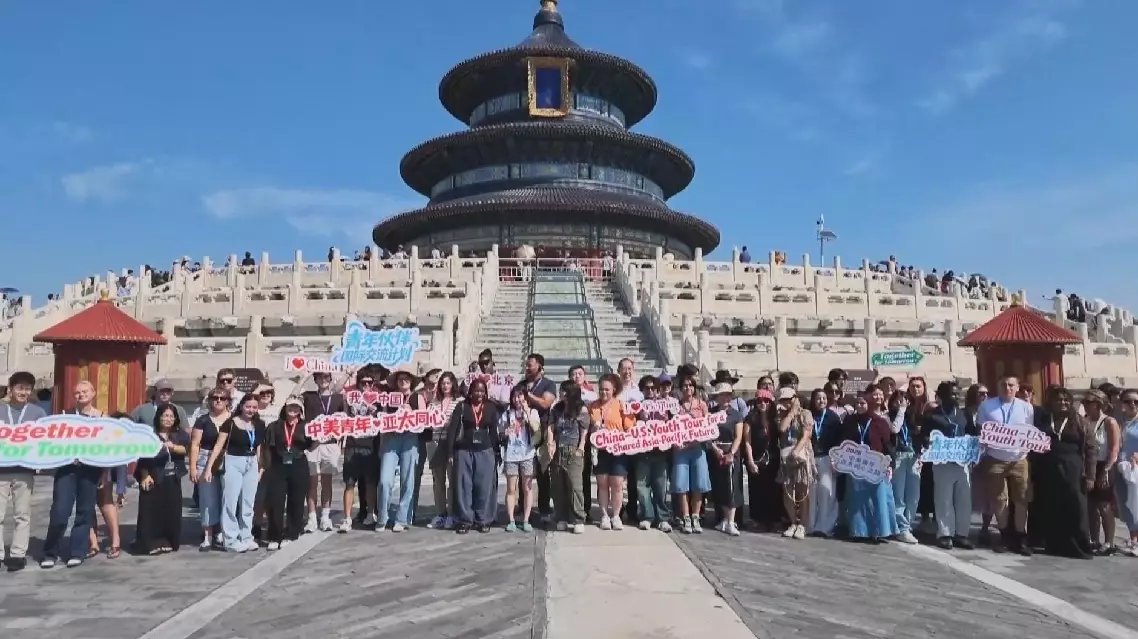
China-US people-to-people exchanges contribute to mutual understanding: former diplomat