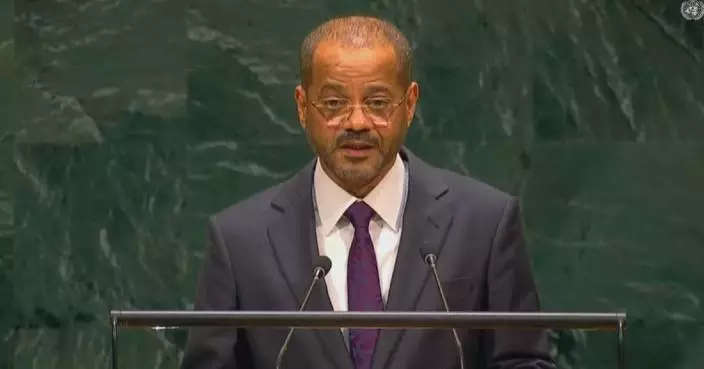
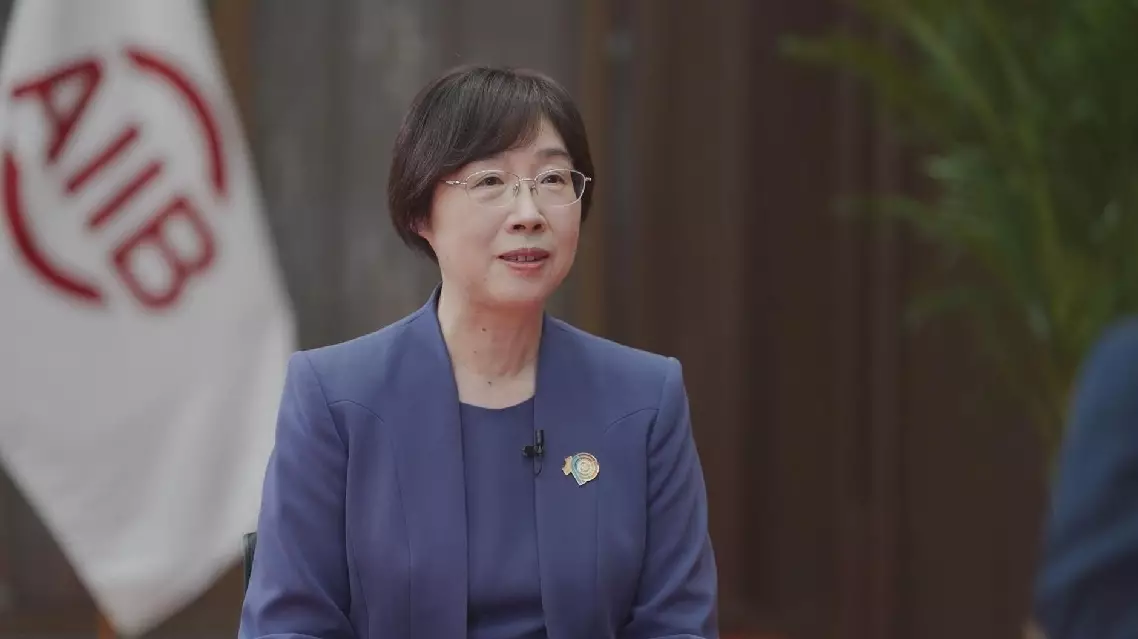
Asian Infrastructure Investment Bank (AIIB) President Zou Jiayi said she hopes the lender's annual meeting in Doha, Qatar, will deepen international partnerships and strengthen cooperation on infrastructure as countries confront development challenges they cannot solve alone.
The 11th annual meeting of the AIIB's Board of Governors is scheduled for Monday and Tuesday. It will be the bank's first since entering its second decade, with discussions set to cover its strategic direction and investment priorities.
"We want to do more to better advance infrastructure development and regional cooperation in Asia, and to further strengthen Asia's links with the rest of the world. We want to provide a platform for deeper international cooperation and partnerships, so the AIIB can work more closely with our members and development partners," Zou said in an interview with China Central Television (CCTV).
The bank, which began operations in 2016, now has 111 approved members. Its recent work includes a loan of 500 million U.S. dollars for urban services in South Africa, its first investment in the country, and a partial debt guarantee supporting Pakistan's first yuan-denominated panda bond.
Zou said the case for cooperation extended to economies at every stage of development.
"Development is not only for developing countries. It matters to every country, including developed economies. Countries do not develop in isolation. Global trade, international investment and industrial chains connect global economies, expand markets and give every country involved in that cooperation more room to grow," she said.
Zou said no economy could address today's overlapping development challenges alone. Countries needed to pool expertise and resources to support sustainable development, with infrastructure providing a practical basis for that cooperation.
"Infrastructure is collaborative by nature. It provides a physical foundation for cooperation within countries and between them. The AIIB is a platform committed to multilateralism. Our borrowing members come from different regions and are at different stages of development, but they all share our mission: to develop infrastructure and promote cooperation within and across regions. That shared vision brings us together. We believe cooperation will create more development opportunities for every country," she said.
AIIB chief seeks stronger infrastructure partnerships ahead of Doha meeting
Retired American teacher Ronald Sakolsky said on Friday that he expects his decades-long bond with China stemming from his generous contribution to the fight against desertification in north China to serve as a starting point for further expansion of exchanges between the two countries' younger generations.
Sakolsky made the expectation in an interview with China Media Group (CMG) one day after Chinese President Xi Jinping announced an invitation for 100,000 young Americans to visit China for exchanges and study in the coming five years at a welcome ceremony held by U.S. President Trump at the White House.
The announcement was made during Xi's three-day state visit to the United States running from Sept 23 to 25.
The story of Sakolsky, who more than two decades ago gave Chinese desert-control pioneer Yin Yuzhen financial support in her desert-control efforts in China, was mentioned by Xi in his remarks at a welcome banquet held by Trump at the White House on Sept 24.
"I could not believe that the President of China actually mentioned my name. [President Xi] didn't just refer to me as an American teacher but called me by my name. I'm still going crazy over it," said Sakolsky.
Sakolsky said based on his own experience, he believes that friendly exchanges between the U.S. and China are necessary and have the potential to change the world for the better. He said he believes Xi's invitation will help expand the friendship between the two countries.
"Our story is the seed. In 1999 [and] 2000, we planted the seeds. They have now grown into a 50,000-tree forest. In 2026, our story has now planted the seed, showing that the two cultures can work together and be successful in making a better world for the future. President Xi's initiative of [inviting] 100,000 American students [to visit China] will spark the seed to grow into a much better project," he said.
Sakolsky believes that the U.S. and China can be more closely connected by common grounds in spite of a great number of differences, and for younger generations, they will hopefully embrace a brighter future for bilateral exchanges.
"Though we speak a different language, though we look differently, though we eat differently, we still bleed red blood and we still have kindness in our heart. And the younger generation, I believe, is ready to step into a brighter future by expanding this relationship," he said.
The story of Sakolsky and Yin began in 1999 when Sakolsky taught English at a school in central China's Henan Province under a teachers' exchange program between the two countries. After watching a television news report featuring Yin's tireless work, he was deeply moved and raised 5,000 U.S. dollars to help Yin and her husband in their afforestation efforts against desertification.
Months later, at the invitation of local officials, Sakolsky traveled to the desert to meet Yin in person.
Yin kept one dollar as a souvenir and bought 50,000 saplings with the rest.
The saplings have now grown into thriving forests and become a symbol of friendly exchanges between the U.S. and China.
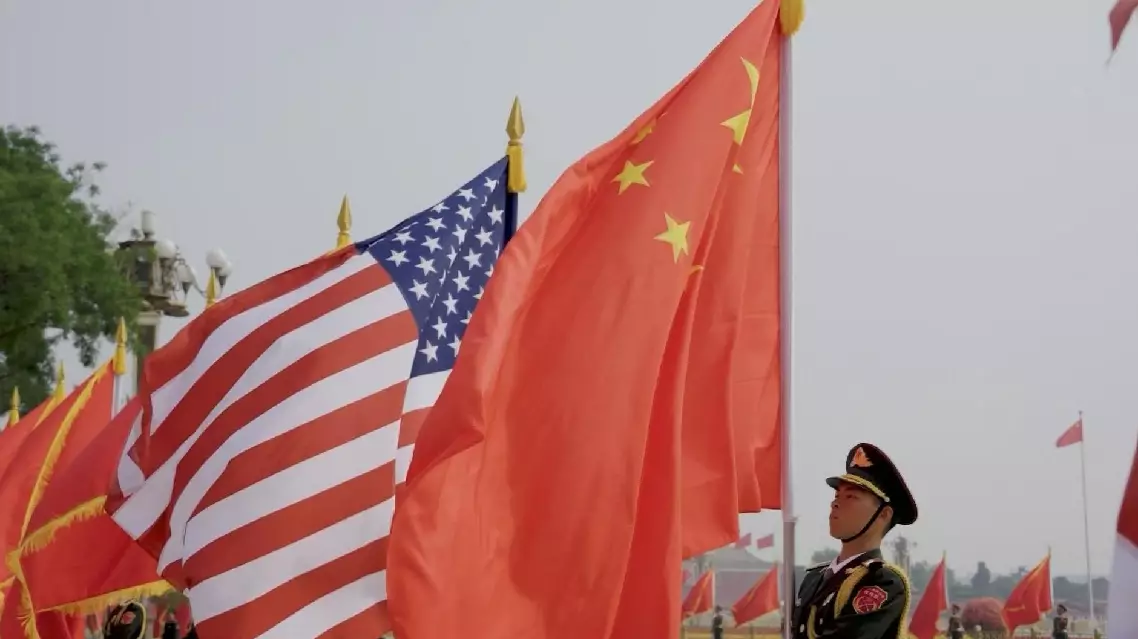
Retired U.S. teacher expects his bonds with China to be expanded