Northwest China's Xinjiang Uygur Autonomous Region and Shaanxi Province have presented a variety of festive activities with strong local cultural characteristics during the three-day Mid-Autumn Festival ending on Sunday, attracting large crowds of residents and tourists.
The ancient city of Kashgar in Xinjiang has rolled out a series of festive events, including various time-honored craftsmanship.
In the bustling alleys, the air is filled with the aroma of freshly baked naan, a type of leavened flatbread and a staple food for people of ethnic groups in the region.
Visitors wearing ethnic costumes throng through the ancient city, taking photos to capture the memorable moments.
The Tuancheng old town of Hotan Prefecture has also organized a range of festival-themed cultural and tourism activities, giving visitors a chance to fully experience local distinctive appeal.
In the downtown area, a mooncake-making experience zone has been set up, letting visitors take part in the complete process, from wrapping the filling and pressing the dough into the mold to baking the finished treats.
Crowds are also drawn to other hands-on activities such as paper-cutting and painting colorful masks, learning about traditional culture through immersive participation. The celebrations also include Meshrep dance, a traditional cultural practice among the ethnic Uygur communities in Xinjiang. Professional performers, local residents and visitors dance together, adding to the joyous holiday atmosphere.
In Yulin City of Shaanxi Province, lively Yangge dancing -- a national-level intangible cultural heritage item -- kicked off along a local landmark street to celebrate the festival, immersing visitors in the festive atmosphere.
Mid-Autumn Festival, one of China's most treasured traditional festivals, falls on the 15th day of the eighth month in the Chinese lunar calendar. Traditional celebrations usually feature mooncakes, whose round shape stands for reunion, and lanterns resembling or bearing images of a rabbit, the auspicious animal that accompanies Chang'e, the moon goddess in a Chinese fairy tale.
This year's festival fell on Sept 25.
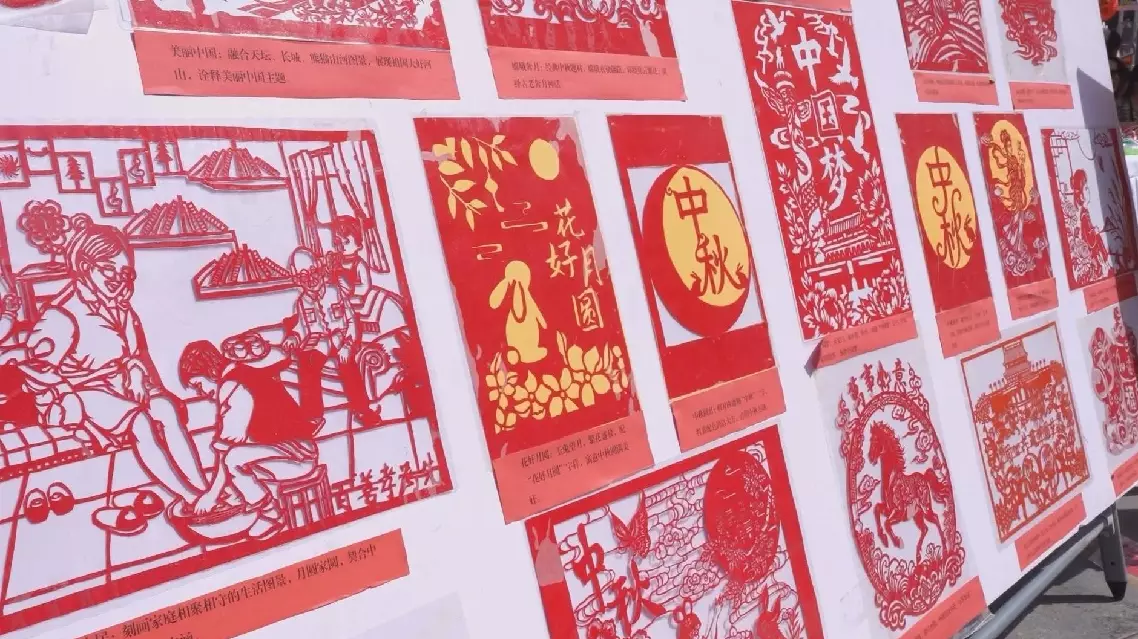
Northwest China regions present colorful activities during Mid-Autumn Festival
Retired American teacher Ronald Sakolsky said on Friday that he expects his decades-long bond with China stemming from his generous contribution to the fight against desertification in north China to serve as a starting point for further expansion of exchanges between the two countries' younger generations.
Sakolsky made the expectation in an interview with China Media Group (CMG) one day after Chinese President Xi Jinping announced an invitation for 100,000 young Americans to visit China for exchanges and study in the coming five years at a welcome ceremony held by U.S. President Trump at the White House.
The announcement was made during Xi's three-day state visit to the United States running from Sept 23 to 25.
The story of Sakolsky, who more than two decades ago gave Chinese desert-control pioneer Yin Yuzhen financial support in her desert-control efforts in China, was mentioned by Xi in his remarks at a welcome banquet held by Trump at the White House on Sept 24.
"I could not believe that the President of China actually mentioned my name. [President Xi] didn't just refer to me as an American teacher but called me by my name. I'm still going crazy over it," said Sakolsky.
Sakolsky said based on his own experience, he believes that friendly exchanges between the U.S. and China are necessary and have the potential to change the world for the better. He said he believes Xi's invitation will help expand the friendship between the two countries.
"Our story is the seed. In 1999 [and] 2000, we planted the seeds. They have now grown into a 50,000-tree forest. In 2026, our story has now planted the seed, showing that the two cultures can work together and be successful in making a better world for the future. President Xi's initiative of [inviting] 100,000 American students [to visit China] will spark the seed to grow into a much better project," he said.
Sakolsky believes that the U.S. and China can be more closely connected by common grounds in spite of a great number of differences, and for younger generations, they will hopefully embrace a brighter future for bilateral exchanges.
"Though we speak a different language, though we look differently, though we eat differently, we still bleed red blood and we still have kindness in our heart. And the younger generation, I believe, is ready to step into a brighter future by expanding this relationship," he said.
The story of Sakolsky and Yin began in 1999 when Sakolsky taught English at a school in central China's Henan Province under a teachers' exchange program between the two countries. After watching a television news report featuring Yin's tireless work, he was deeply moved and raised 5,000 U.S. dollars to help Yin and her husband in their afforestation efforts against desertification.
Months later, at the invitation of local officials, Sakolsky traveled to the desert to meet Yin in person.
Yin kept one dollar as a souvenir and bought 50,000 saplings with the rest.
The saplings have now grown into thriving forests and become a symbol of friendly exchanges between the U.S. and China.

Retired U.S. teacher expects his bonds with China to be expanded