WASHINGTON (AP) — The Federal Reserve’s internal watchdog said Wednesday that the central bank has broadly mismanaged an expansive building renovation project but did not find any criminal violations, as alleged by Trump administration prosecutors.
A variety of missteps by the Fed's Board of Governors and staff inflated the cost of the $2.4 billion renovation, the Fed’s inspector general said. The board did not secure a comprehensive cost estimate at the beginning of the project, nor did it nail down a maximum overall cost, a step that could have forced the building contractor to absorb the impact of inflation, the IG said in a 120-page report. Prices spiked after construction began in 2022.
Click to Gallery
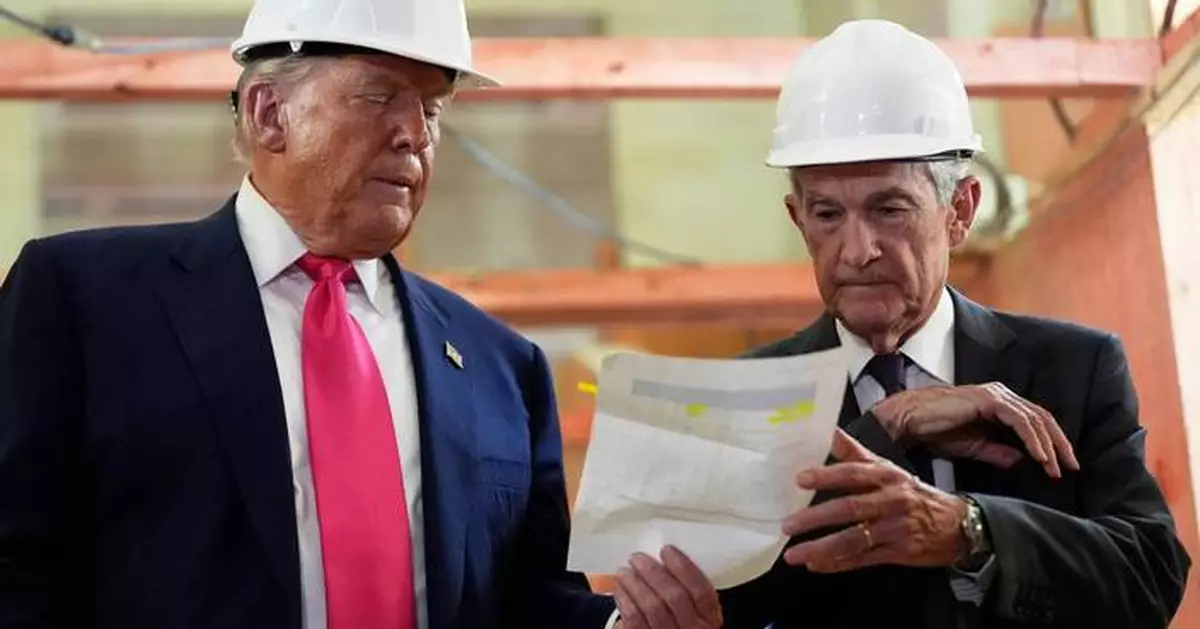
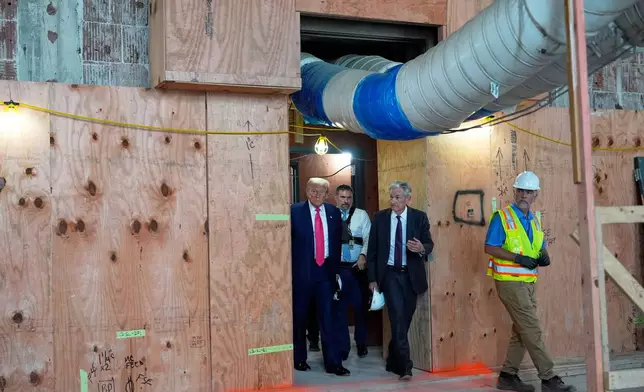
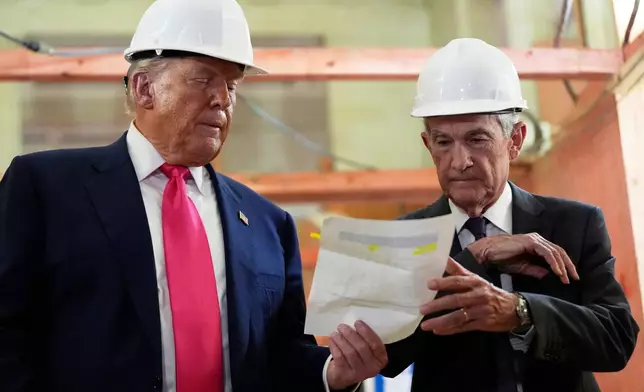
FILE- Federal Reserve Chairman Jerome Powell, from second left, President Donald Trump and Sen. Tim Scott, R-S.C., visit the Federal Reserve, Thursday, July 24, 2025, in Washington. (AP Photo/Julia Demaree Nikhinson, File)
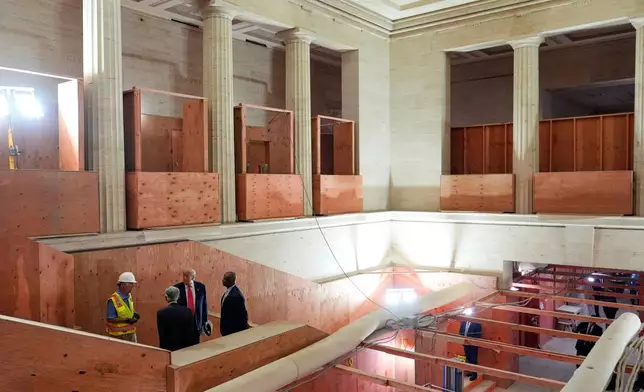
FILE- President Donald Trump, left, and Federal Reserve Chairman Jerome Powell, second right, visit the Federal Reserve, Thursday, July 24, 2025, in Washington. (AP Photo/Julia Demaree Nikhinson, File)
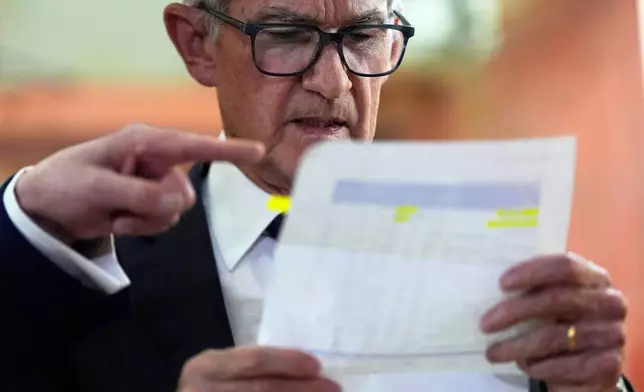
FILE- Federal Reserve Chairman Jerome Powell looks over a document of cost figures as President Donald Trump points during a visit to the Federal Reserve, Thursday, July 24, 2025, in Washington. (AP Photo/Julia Demaree Nikhinson, File)
FILE- FILE - Federal Reserve Chairman Jerome Powell, right, and President Donald Trump look over a document of cost figures during a visit to the Federal Reserve, Thursday, July 24, 2025, in Washington. (AP Photo/Julia Demaree Nikhinson, File)
“Our review found that the Board has not effectively managed and executed its ... contract and repeatedly deviated from its cost-management provisions,” the report said.
The building project became a high-profile flashpoint in the Trump administration’s efforts to pressure the Fed into cutting its key interest rate. President Donald Trump even visited the construction site last July, when then-Chairman Jerome Powell corrected Trump’s estimate of the project’s expected costs as the two stood in hard hats before TV cameras.
Criticism of the project also mounted in Congress, leading Powell to request in July 2025 that the inspector general, Michael Horowitz, investigate the renovation.
The building project then became the focus of a criminal investigation by Trump’s Justice Department, specifically into whether Powell had committed perjury during brief testimony about the renovation before a Senate committee. That investigation was dropped in April after a judge quashed subpoenas issued by Jeanine Pirro, the U.S. attorney for the District of Columbia. Pirro said then she would await the outcome of the inspector general’s investigation before deciding whether to take any further action.
“At no point during our evaluation did we find reasonable grounds to believe that a violation of federal criminal law had occurred requiring a referral to the U.S. Attorney General,” the IG’s report said.
Tim Lauer, a spokesperson for Pirro's office, said the report is under review.
Powell's term as chair ended in May, but he took the highly unusual step of remaining on the board as one of seven governors. His term as a governor lasts until January 2028. Powell said earlier this year he would remain on the board at least until he is convinced that Pirro's investigation is done. By keeping his seat, Powell has also prevented the Trump administration from filling another spot on the board.
Massachusetts Sen. Elizabeth Warren, the top Democrat on the Senate Banking Committee and a frequent critic of Powell's, said the report “confirmed that Trump lapdogs U.S. Attorney Jeanine Pirro and Attorney General Todd Blanche have no basis to restart the President’s witch hunt against former Fed Chair Jerome Powell.”
Current Fed chairman Kevin Warsh, who took office last May, welcomed the IG’s findings in a letter and said the General Services Administration, a federal agency that oversees most government buildings, would take over the management of the project.
He also said the Fed would engage an independent auditor to evaluate the building project and all its costs. The Fed, with the GSA, will review all the project's contracts and “pursue appropriate remedies,” including seeking reimbursement for any work paid for but not performed.
The report said that the construction costs to renovate two Fed buildings more than doubled from an original estimate of $921 million in February 2020 to $2.018 billion by December 2024. Construction is expected to last until December 2027, long past its originally slated completion date of mid-2024.
Some aspects of the project that were criticized by the Trump administration and Republican members of Congress for being luxurious — water fountains, private elevators and marble facades — were not significant drivers of the excessive costs of the project.
Instead, the IG said that a design change by the Fed in 2023 from a mostly open workspace to one with mostly closed office space caused a significant delay in the project's design. It also delayed the Fed from seeking a maximum cost ceiling for the project at that time.
The Fed has long blamed a range of factors for the cost overruns, including a spike in inflation that occurred as the economy emerged from the COVID-19 pandemic, unexpected expenses such as asbestos remediation, and additional demands from review agencies. For example, Trump appointees to a planning commission from his first term pushed the Fed to add more marble to the exterior of the renovated buildings, in keeping with Trump's preference for classical architecture.
The report said those factors all played a role, but added that they “do not account for the effect of key project management and contract execution decisions” that effectively transformed the contract to "a cost-plus reimbursement contract with a pay-as-you-go approach.”
“Inflation does not change the Fed’s responsibility to manage its resources prudently and be accountable to Congress,” Sen. Tim Scott, chairman of the Senate Banking Committee and a South Carolina Republican, said.
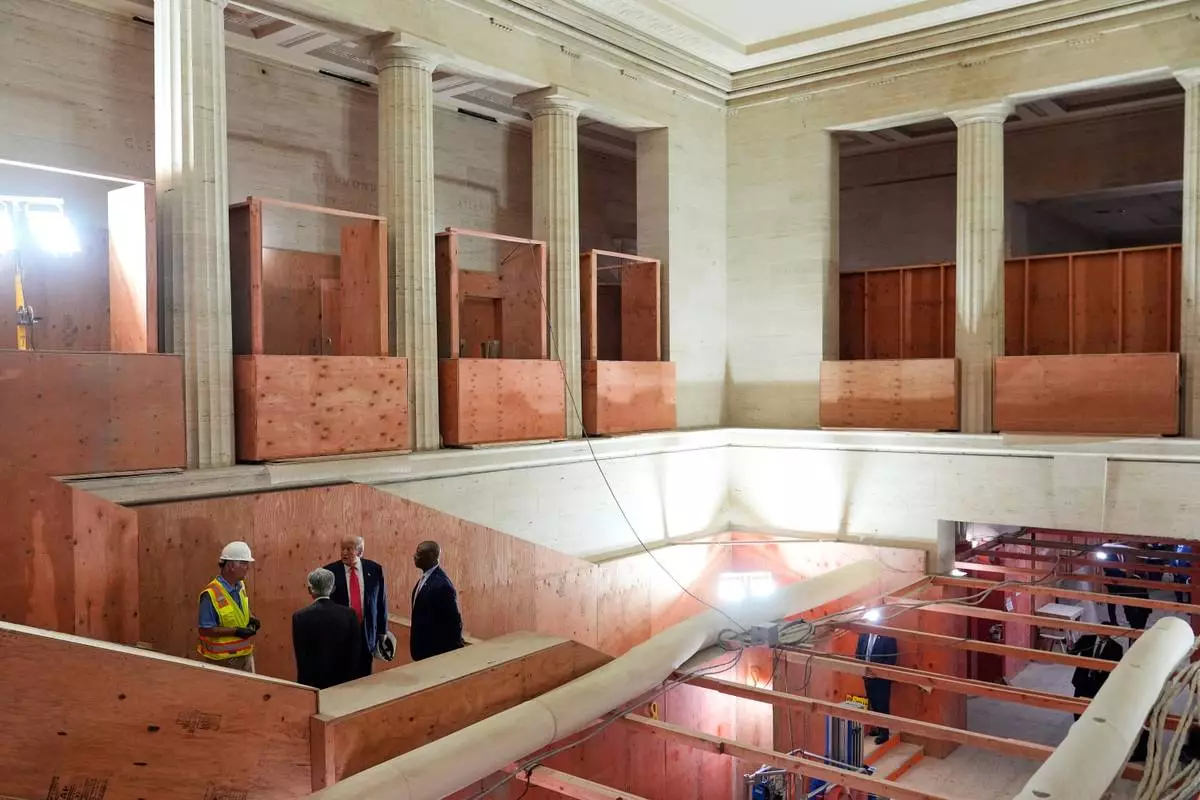
FILE- Federal Reserve Chairman Jerome Powell, from second left, President Donald Trump and Sen. Tim Scott, R-S.C., visit the Federal Reserve, Thursday, July 24, 2025, in Washington. (AP Photo/Julia Demaree Nikhinson, File)
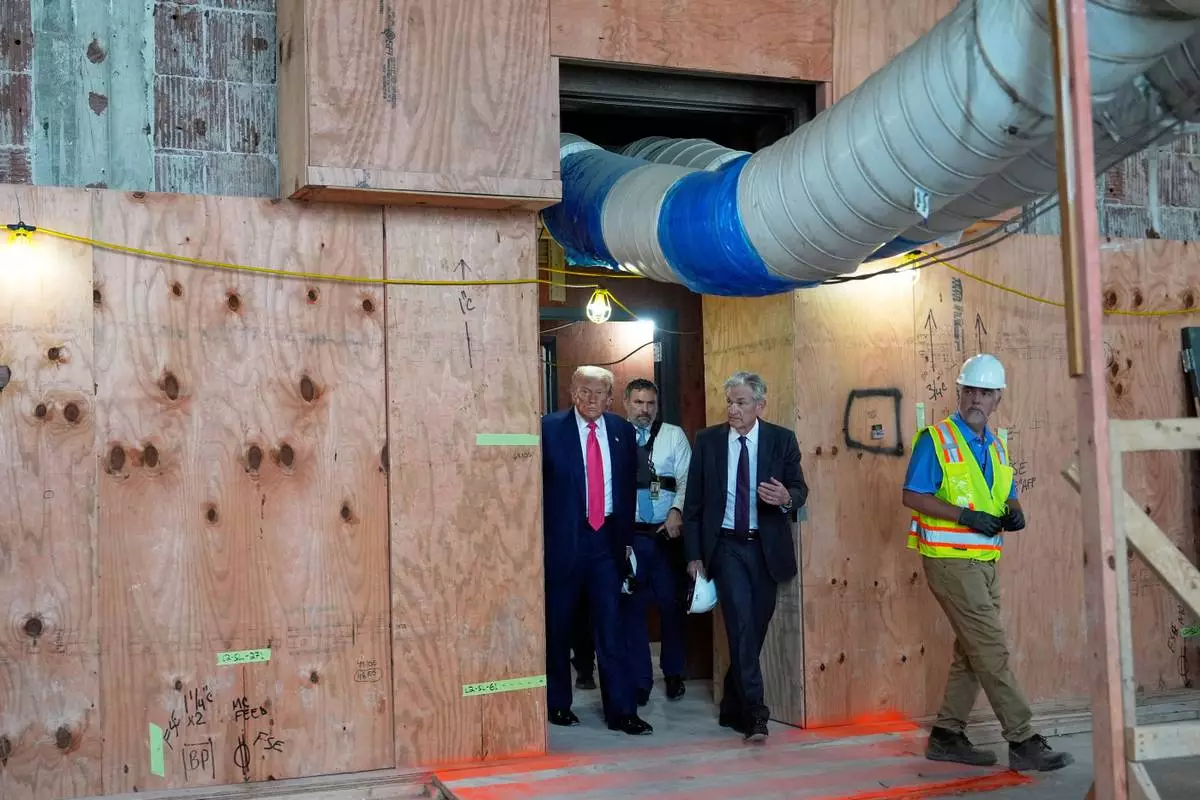
FILE- President Donald Trump, left, and Federal Reserve Chairman Jerome Powell, second right, visit the Federal Reserve, Thursday, July 24, 2025, in Washington. (AP Photo/Julia Demaree Nikhinson, File)
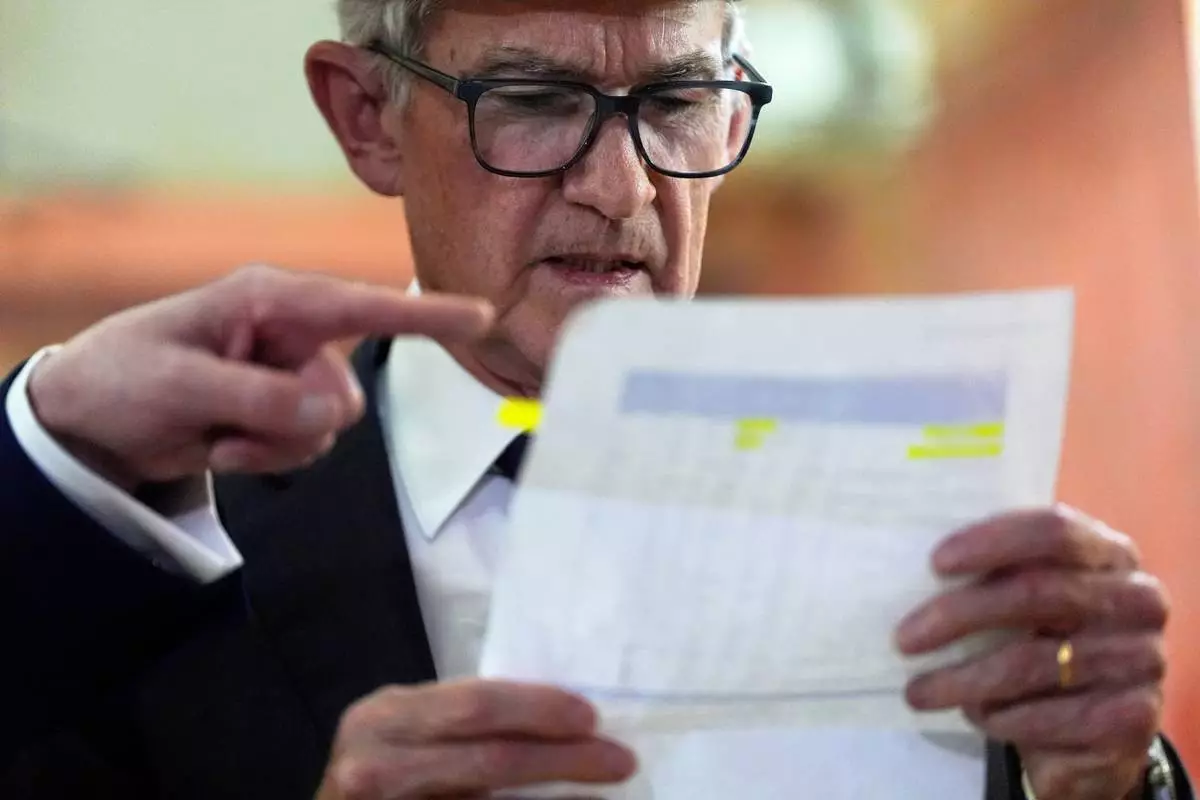
FILE- Federal Reserve Chairman Jerome Powell looks over a document of cost figures as President Donald Trump points during a visit to the Federal Reserve, Thursday, July 24, 2025, in Washington. (AP Photo/Julia Demaree Nikhinson, File)
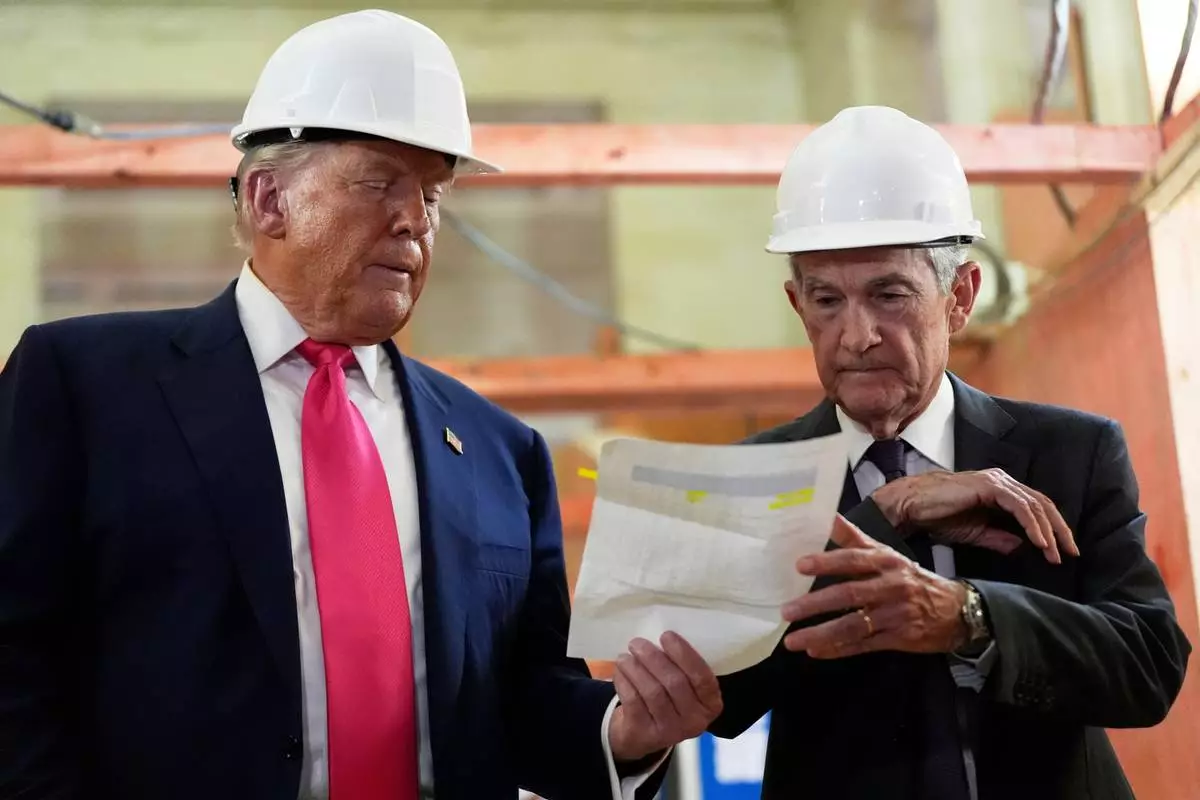
FILE- FILE - Federal Reserve Chairman Jerome Powell, right, and President Donald Trump look over a document of cost figures during a visit to the Federal Reserve, Thursday, July 24, 2025, in Washington. (AP Photo/Julia Demaree Nikhinson, File)
BAGHDAD (AP) — The U.S. military announced Wednesday that it completed the withdrawal of all American troops from Iraq, ending a 12-year mission to fight the Islamic State group and prompting President Donald Trump to hail the conclusion of "a very expensive excursion into Hell.”
The last U.S. troops left an air base in northern Iraq under a deal between Baghdad and Washington.
Trump, in a social media post, described the withdrawal by a Sept. 30 deadline as “orderly." Appearing soon after at a White House event celebrating Hispanics, he spoke at length about the withdrawal and said, “It’s been a long time with very bad decision making that got us involved in this quagmire in the first place. It was a quagmire. For many, many years it lasted. But soon that part of history will be over.”
He said the shift was a victory for the U.S., Iraq and a sign of victory over the Islamic State group.
The withdrawal, agreed on two years ago, comes against the backdrop of the ongoing war between the United States and Iran that has also sometimes spilled over into Iraq, with Iran-backed militias firing on U.S. troops and the U.S. striking the groups' strongholds.
Trump’s comments came as his own decision earlier this year to launch the war with Iran has been compared to the Iraq war for its undefined mission as it nears its seventh month.
Appearing at the White House, Trump made that comparison, arguing both that his one-day military action in Venezuela earlier this year to capture now former President Nicolás Maduro and the Iran war compared favorably, taking far less time and with fewer deaths of U.S. troops.
In recent years, Washington has sought to shift its focus from the Middle East toward Asia, but that shift has been inconsistent, with the Pentagon alternating between reducing its Mideast presence and then finding itself engaging in new conflicts — including the ongoing war in Iran.
Baghdad touted the end of the U.S. mission as a sign of the country's increasing strength and sovereignty.
The withdrawal was also celebrated by Iran-backed groups but raised concerns among some other Iraqis, particularly in the Kurdish region, where many fear a resurgence of the Islamic State group as well as more attacks by Iran-linked groups, possibly emboldened by the departure of U.S. forces.
Meanwhile, questions loom around the future of the Iraqi militias, which the Baghdad government has sought to disarm, with little success so far.
Pentagon spokesperson Sean Parnell said in a statement that U.S. troops and equipment had completed an “orderly departure” from the air base in Irbil, in northern Iraq's semi-autonomous Kurdish region.
“This milestone reflects the success of a 12-year campaign that defeated ISIS as an organized military threat in Iraq and across the region,” he said. “It also marks a transition from a wartime coalition mission to an Iraqi-led security effort supported by a more normal bilateral security relationship.”
He added that the U.S. military “will continue to provide targeted training and intelligence support to our Iraqi partners.”
Iraqi Prime Minister Ali al-Zaidi presided over the handover ceremony and described the U.S. withdrawal as the beginning of a “new phase, one defined by Iraq’s sovereignty, the strength of its institutions, the readiness of its forces, the unity of its decision-making, and balanced partnerships with its friends.”
He said Iraqi security forces will continue the fight against IS and the government will ensure that non-state groups no longer hold weapons.
Trump in his remarks on Wednesday lavished praise on al-Zaidi, calling him “outstanding,” a “fantastic guy, friend of mine,” and someone who “will hopefully be able to handle things very well.” He also appeared to try to take credit for al-Zaidi's leadership, saying that the Iraqi leader was “running for election” and “wasn’t given even a chance and I endorsed him and politicked for him a little bit, and he ended up winning in a virtual landslide.”
Al-Zaidi was not on the ballot but was selected as prime minister when Iraq’s dominant parliamentary bloc nominated him after weeks of internal debate among its member parties and Trump publicly announcing his opposition to the coalition's previous choice.
U.S. troops invaded Iraq in 2003 to topple Saddam Hussein. They departed in 2011, but three years later, Iraqi authorities invited a smaller U.S.-led mission to fight the Islamic State group, which had rampaged across Iraq, seizing large swaths of territory.
With the extremist group reduced to scattered sleeper cells, Washington and Baghdad agreed in 2024 to wind the mission down.
U.S. troops pulled out of bases in most areas of Iraq last year but maintained a small presence of hundreds of troops in the semiautonomous northern Kurdish region. Bases there have regularly come under attack since the U.S. and Israel launched their war against Iran on Feb. 28. Iran-backed Iraqi militias also have coordinated with Yemen’s Houthi rebels to attack Saudi Arabia.
The Iraqi government initially linked the Sept. 30 deadline for U.S. withdrawal to the disarmament of non-state armed groups by that date.
While a handful of less-influential militias have agreed to turn over their weapons, powerful groups close to Iran rejected the prospect or set conditions for disarming that the government would be unlikely to meet.
Al-Zaidi has since walked back the deadline. He told The New York Times earlier this month that the deadline for militia disarmament has been pushed to June 2027.
The effects of the U.S. withdrawal may not be immediately visible, particularly since the U.S. military presence had already been scaled down. But officials in Iraq's Kurdish region have expressed anxiety about the departure and particularly about the removal of U.S. air defense systems.
The Kurdish regional government's Peshmerga Ministry said the Kurdish region had faced more than 1,000 drone and ballistic-missile attacks during the recent U.S.-Iran conflict.
“The departure of the United States from the Kurdistan Region under these complex regional circumstances, without the provision of a defense system, is a matter of concern,” the statement said.
Iran-allied groups in Iraq, meanwhile, have celebrated the U.S. withdrawal.
“The expulsion of the occupation forces, defeated, from the land of Iraq is the beginning of full sovereignty,” Abu Mujahid al-Assaf, a security official with the powerful Kataib Hezbollah militia, said in a statement.
He added a warning to al-Zaidi and his government not to carry out American plans, threatening that “any government that does not work for the benefit of the people will be overthrown by all means.”
The Islamic Resistance in Iraq, an umbrella group of Iran-backed militias, said in a statement that negotiations with the government over the regulation of weapons have not resulted in an agreement and that it was “not bound by any timeline or agreement” announced by the government or political entity. The group said it is open to “any dialogue that guarantees Iraq’s sovereignty and dignity.”
Price reported from Washington. Associated Press writer Abby Sewell in Istanbul contributed to this report.
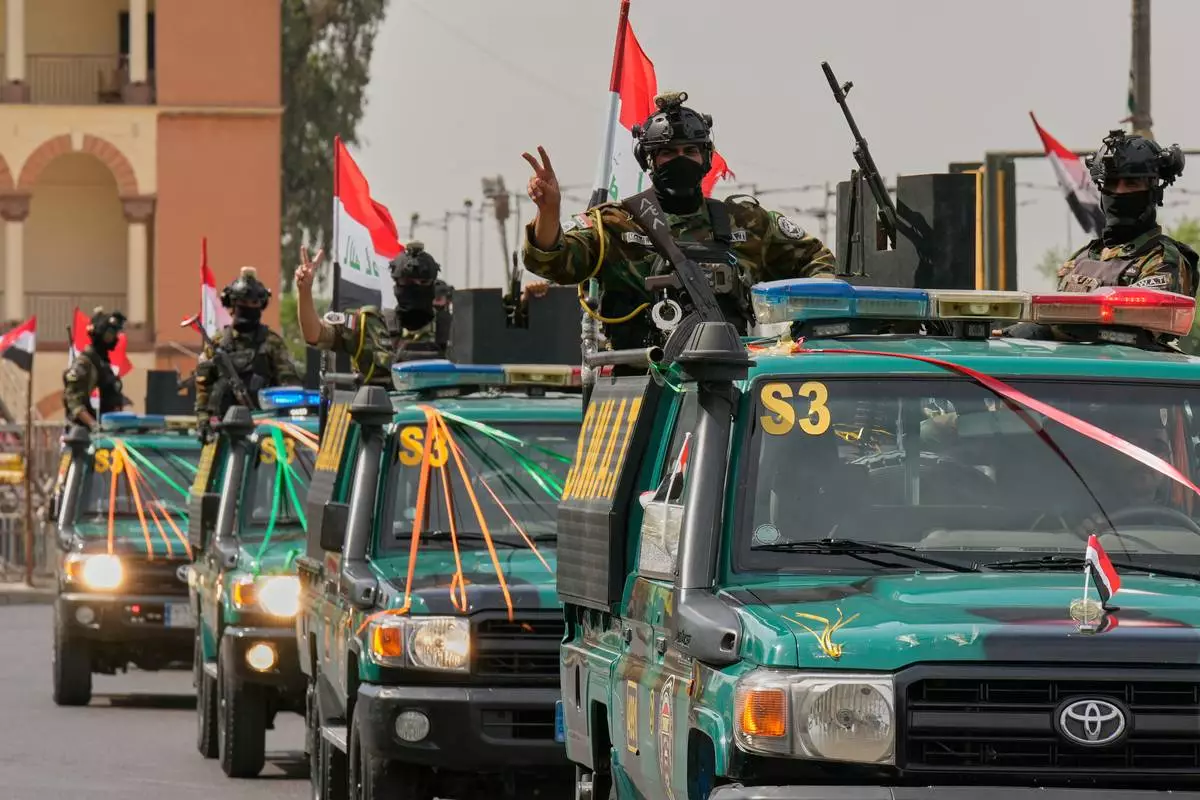
Iraqi security officers flash victory signs as they ride on vehicles decorated with national flags and ribbons during a convoy celebrating the complete withdrawal of U.S. troops from Iraq, in Baghdad, Iraq, Wednesday, Sept. 30, 2026. (AP Photo/Hadi Mizban)
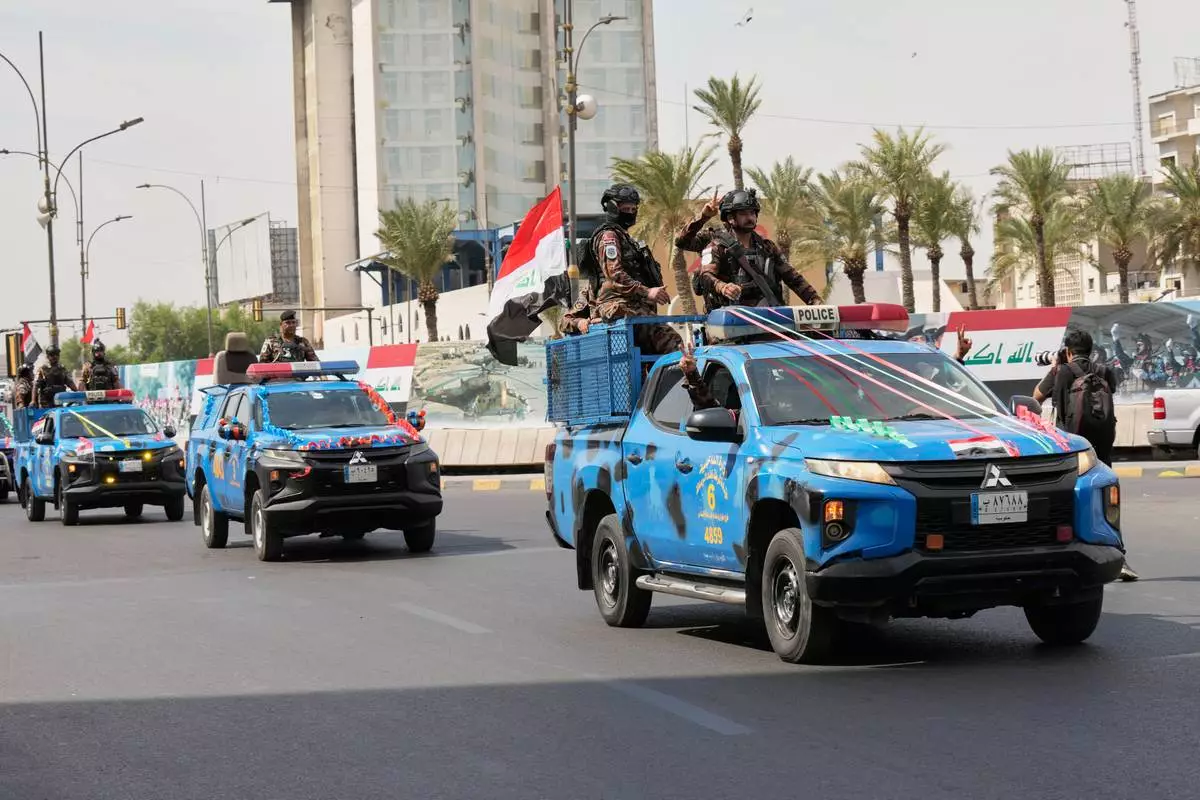
Iraqi police vehicles decorated with national flags and ribbons drive in a convoy as officers flash victory signs while celebrating the complete withdrawal of U.S. troops from Iraq, in Baghdad, Iraq, Wednesday, Sept. 30, 2026. (AP Photo/Hadi Mizban)
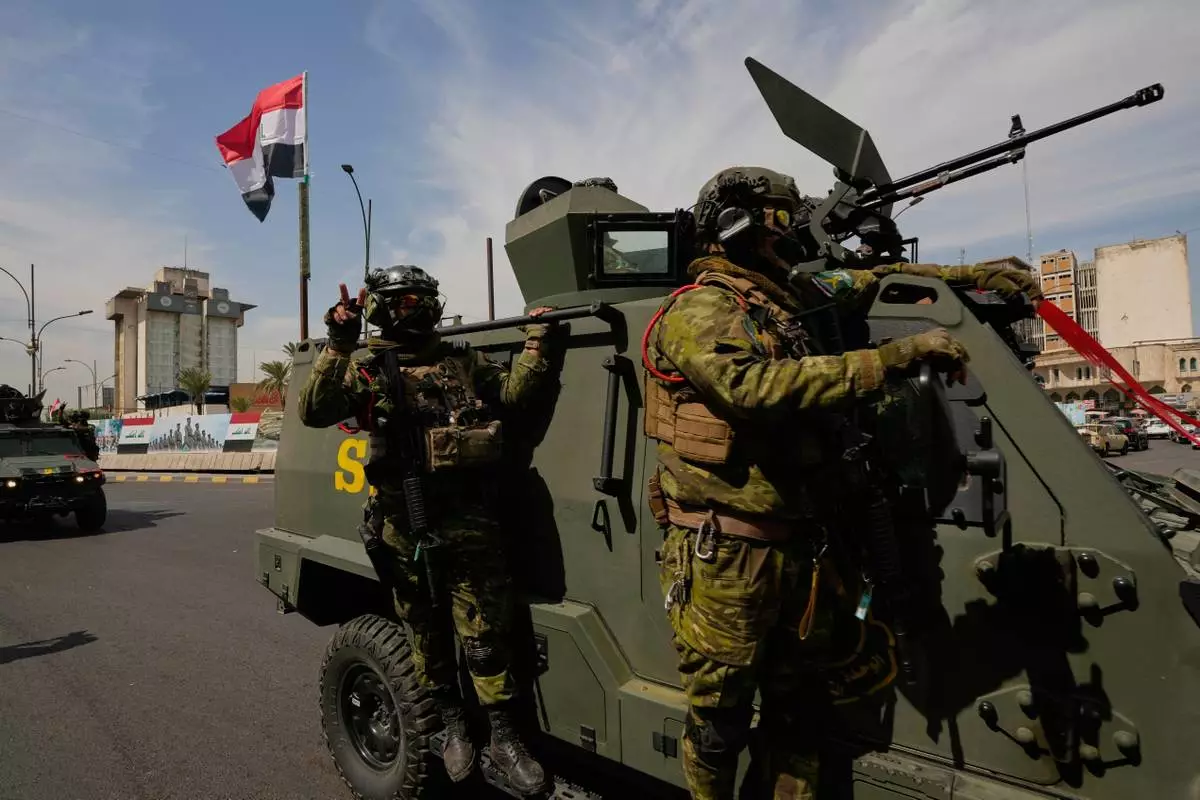
Iraqi police officers stand beside security vehicles decorated with national flags and ribbons during a convoy celebrating the complete withdrawal of U.S. troops from Iraq, in Baghdad, Iraq, Wednesday, Sept. 30, 2026. (AP Photo/Hadi Mizban)
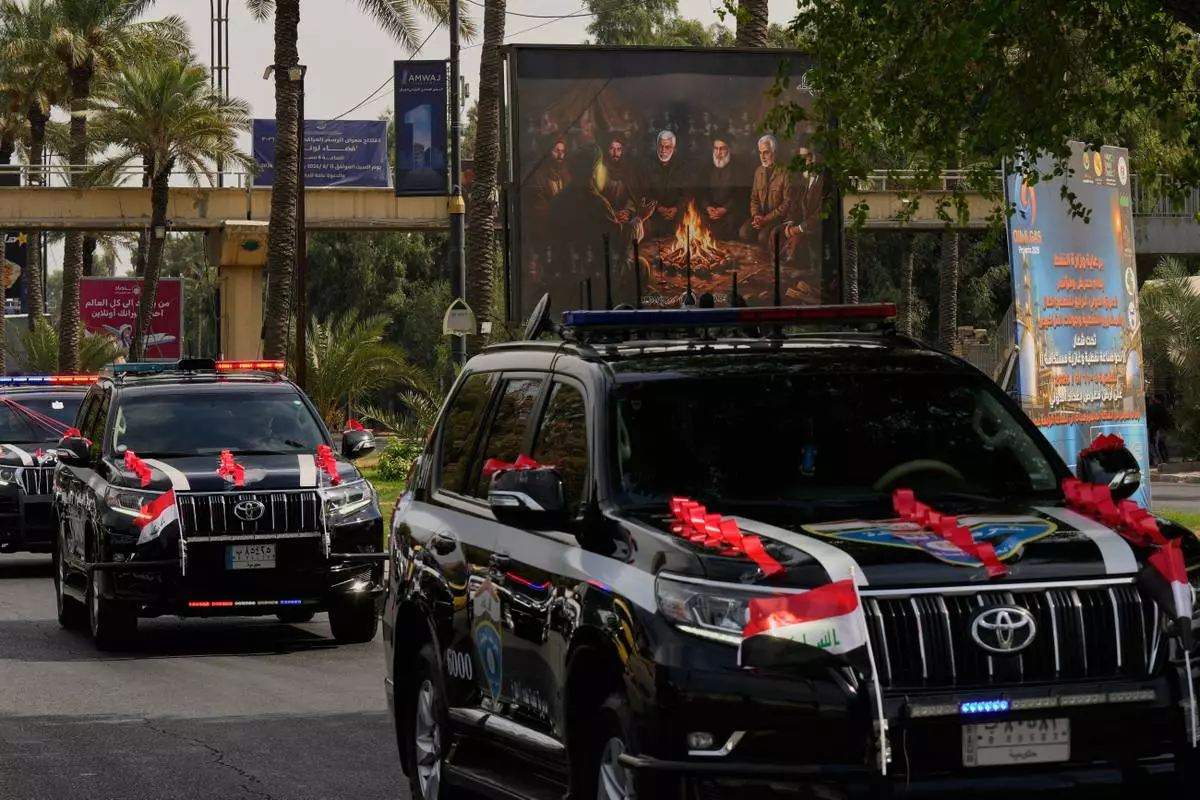
Iraqi security vehicles decorated with national flags and ribbons drive in a convoy past a billboard depicting slain Iranian commander Qassem Soleimani, slain Hezbollah leader Hassan Nasrallah and slain Iraqi militia commander Abu Mahdi al-Muhandis seated with religious figures around a fire, as they celebrate the complete withdrawal of U.S. troops from Iraq, in Baghdad, Iraq, Wednesday, Sept. 30, 2026. (AP Photo/Hadi Mizban)
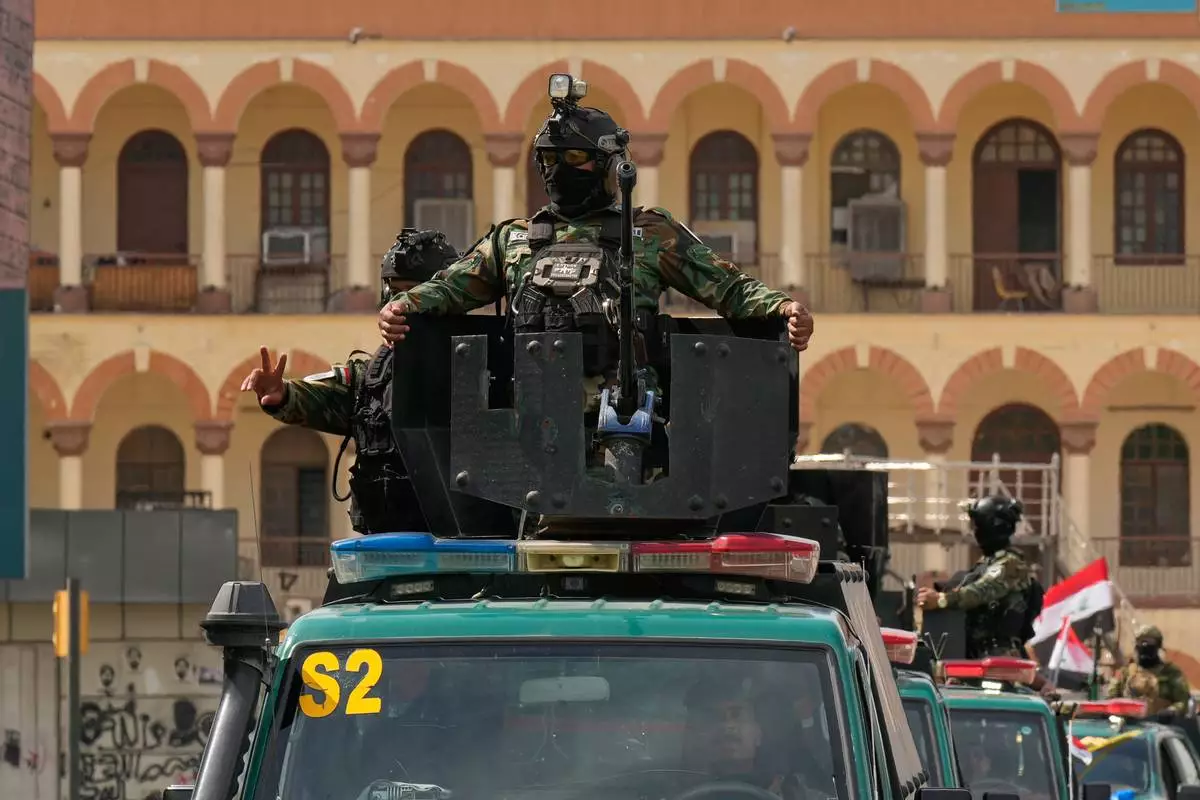
Iraqi security officers ride atop vehicles during a convoy celebrating the complete withdrawal of U.S. troops from Iraq, in Baghdad, Iraq, Wednesday, Sept. 30, 2026. (AP Photo/Hadi Mizban)
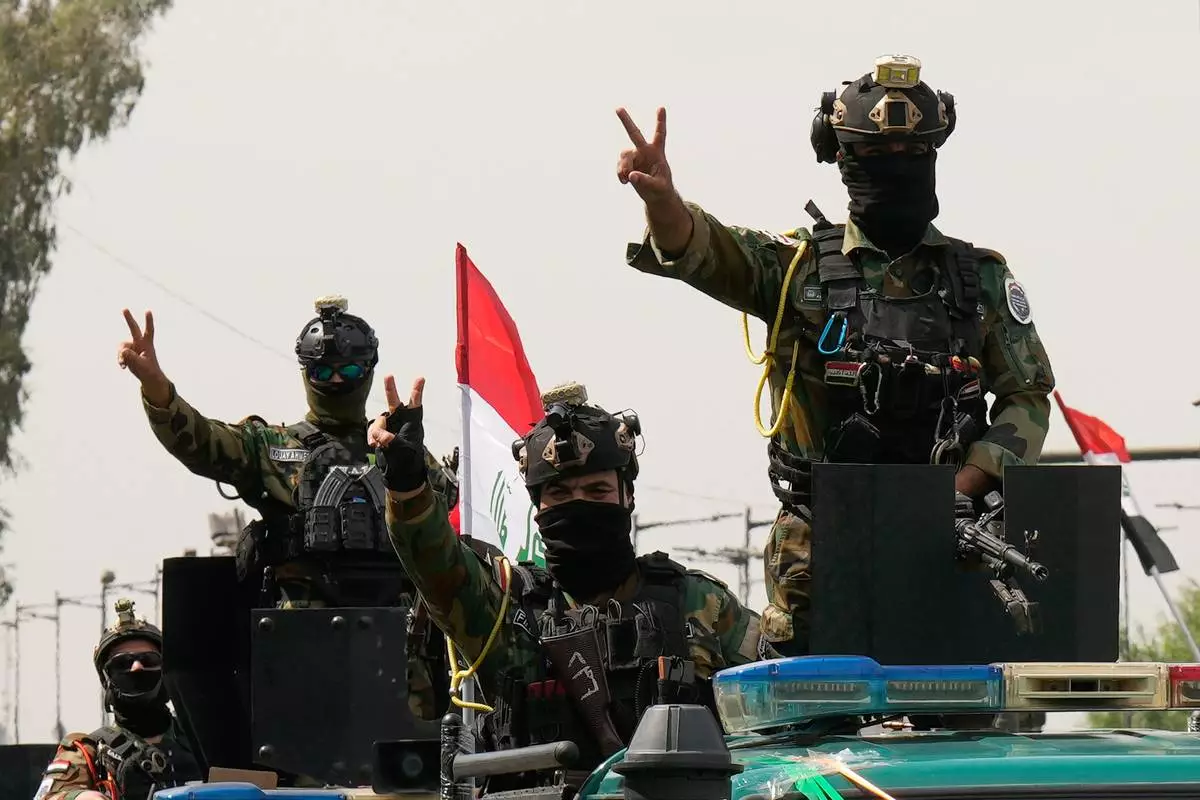
Iraqi security officers flash victory signs while riding in vehicles decorated with national flags during a convoy celebrating the complete withdrawal of U.S. troops from Iraq, in Baghdad, Iraq, Wednesday, Sept. 30, 2026. (AP Photo/Hadi Mizban)
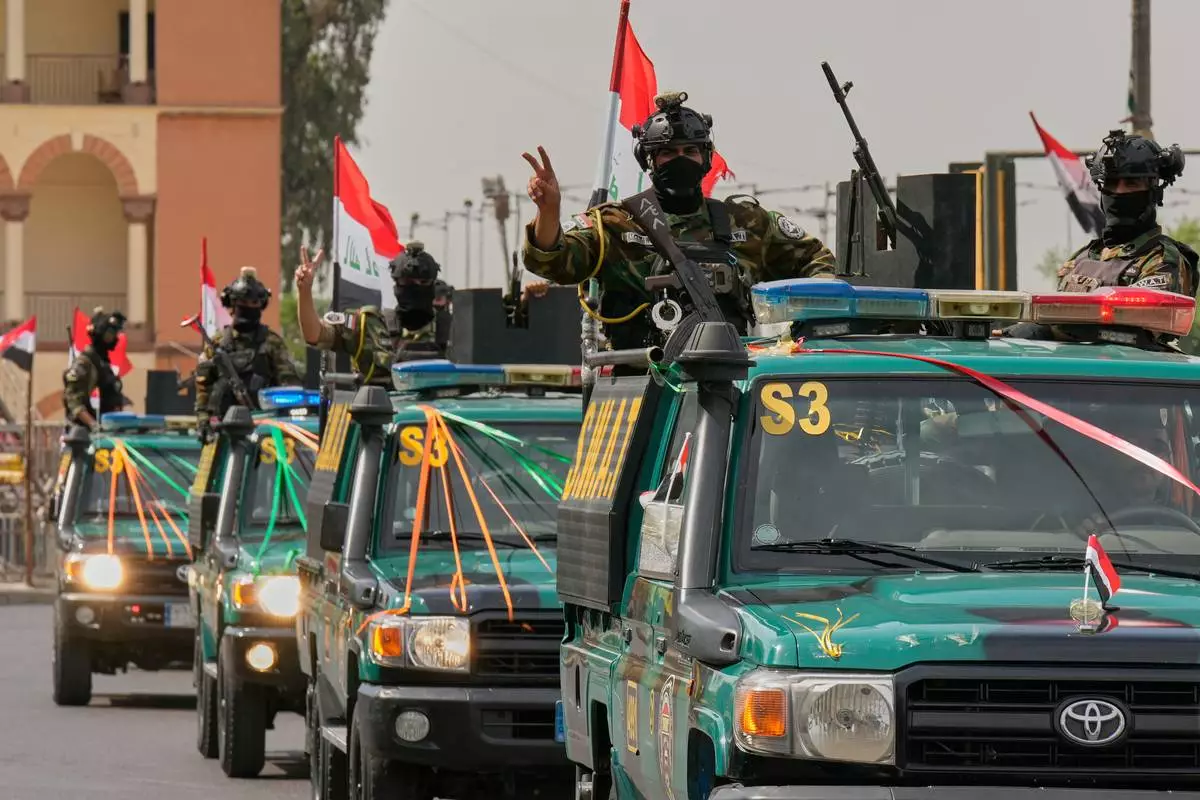
Iraqi security officers flash victory signs as they ride on vehicles decorated with national flags and ribbons during a convoy celebrating the complete withdrawal of U.S. troops from Iraq, in Baghdad, Iraq, Wednesday, Sept. 30, 2026. (AP Photo/Hadi Mizban)
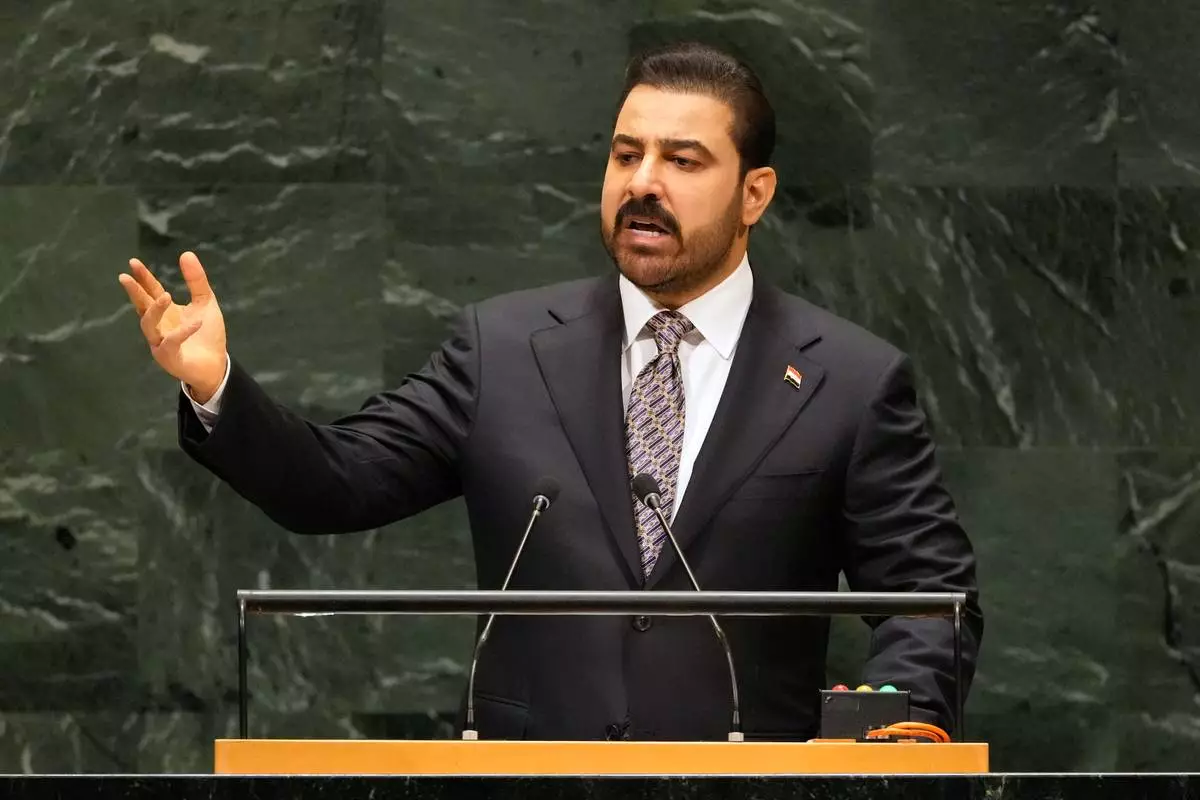
Iraq's Prime Minister Ali al-Zaidi speaks during the 81st session of the United Nations General Assembly at United Nations headquarters, Friday, Sept. 25, 2026. (AP Photo/Seth Wenig)
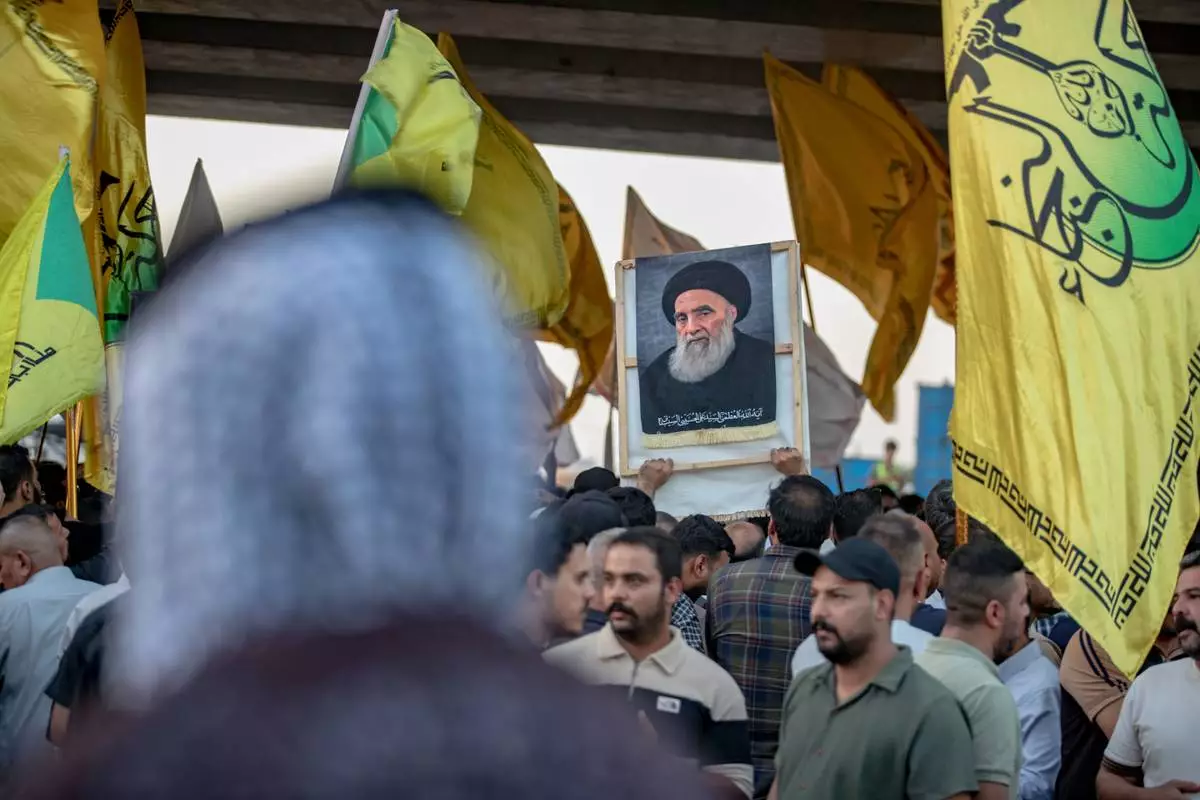
A demonstrator holds a portrait of Iraq's top Shiite cleric, Grand Ayatollah Ali al-Sistani, during a protest against the suspension of flights between Iraq and Iran outside Najaf International Airport in Najaf, Iraq, Monday, Sept. 28, 2026. (AP Photo/Anmar Khalil)