U.S. stocks ended mixed on Wednesday as cooler-than-expected inflation data was offset by persistent pressure from elevated U.S. Treasury yields and rising oil prices.
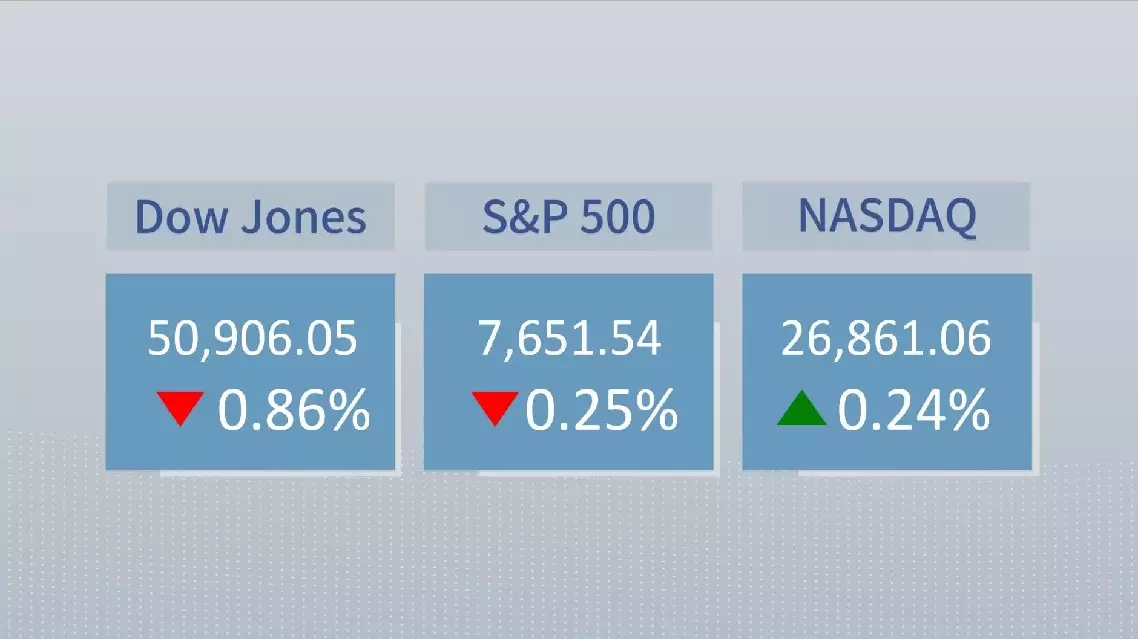
The Dow Jones Industrial Average fell 443.87 points, or 0.86 percent, to 50,906.05. The benchmark Standard and Poor's 500 dipped 19.3 points, or 0.25 percent, to 7,651.54, while the tech-heavy Nasdaq Composite Index gained 63.52 points, or 0.24 percent, to close at 26,861.06.
Nine of the 11 primary Standard and Poor's 500 sectors ended in the red, with consumer staples and health leading the decliners by dropping 1.68 percent and 1.39 percent, respectively. Technology and consumer discretionary advanced 0.61 percent and 0.13 percent, respectively.
On the macroeconomic front, the U.S. Commerce Department reported that the headline personal consumption expenditures (PCE) price index rose 3.4 percent year on year in August, coming in below consensus forecasts of 3.7 percent and easing from levels sustained throughout much of the summer. The core PCE price index, which excludes volatile food and energy costs, climbed 3 percent, lower than expectations of a 3.3 percent increase and marking a drop from 3.3 percent in July. On a monthly basis, core PCE rose 0.2 percent, edging down 0.1 percentage point from the previous month and coming in below a projected gain of 0.3 percent.
Complementing the inflation readout, payroll processor ADP reported that private sector employment grew by 90,000 jobs in September, rebounding notably from the 36,000 jobs added in August and pointing to resilience in domestic hiring.
The softening inflation figures, coupled with dovish commentary from New York Federal Reserve President John Williams noting "no need for urgency" to hike rates next month, prompted traders to sharply scale back tightening expectations. According to the CME FedWatch tool, the implied probability of an interest rate increase at the central bank's October meeting fell to 37 percent, down markedly from more than 70 percent priced in a week earlier. Despite the easing rate-hike expectations, equity markets remained constrained by elevated sovereign debt yields and firming energy prices. The yield on the benchmark 10-year U.S. Treasury note edged up over 4 basis points to 5.291 percent, hovering near multi-decade highs reached earlier in the week, while the 30-year bond yield rose over 6 basis points to 5.634 percent.
In commodity markets, crude oil benchmarks moved higher on Wednesday. West Texas Intermediate crude for November delivery added 1.04 U.S. dollars, or 1.16 percent, to settle at 90.42 dollars a barrel. Brent crude for November delivery rose 94 cents, or 0.92 percent, to finish at 103.53 dollars a barrel.
In other corporate news, Boeing ended 0.87 percent lower, erasing early gains after the plane maker was selected by the U.S. Navy for its next-generation fighter program. Robinhood Markets declined 3.2 percent after the company announced new active trading products. Micron's earnings after the bell will also offer investors insights into the state of the memory and AI markets.
U.S. stocks close mixed despite cooler inflation report
Iraqis are concerned about the country's security capabilities after the withdrawal of U.S. and coalition forces.
The United States and its allies have officially ended Operation Inherent Resolve against the Islamic State (IS) in Iraq, the Pentagon said on Wednesday.
The Iraqi Security Forces, including the Peshmerga and other security forces in the Iraqi Kurdistan region, will "lead the continuing effort to secure Iraq and keep IS remnants suppressed," according to a Pentagon statement.
The primary responsibility for addressing Iraq's remaining security challenges now rests with the Iraqi government, the statement said, adding that the United States will continue to provide "targeted training and intelligence support" to its Iraqi partners.
The Ministry of Peshmerga Affairs of Iraq's Kurdistan Region on Monday warned about security risks following the U.S. withdrawal.
In a statement, the ministry said the withdrawal comes at a sensitive time, amid continued security instability in Iraq and the Middle East. It stressed that the ongoing instability in the region requires vigilance and sound political decisions.
It added that the Kurdistan Region came under more than 1,000 drone and ballistic missile attacks during the war between the U.S. and Iran in recent months, expressing concern over the withdrawal of U.S. forces from the region amid complex regional security conditions, without the provision of a defensive system.
"Although Iraq has forces capable of sustained ground operations -- lasting months rather than days -- we still have significant shortcomings in areas such as air power and modern electronic technology," said Baghdad resident Anwar Musawi.
In addition to the external security environment, attention is also focused on how to further integrate Shia militias in Iraq under the unified state control following the foreign troops withdrawal.
The Iraqi government had previously set September 30 as a key deadline and worked to ensure that armed groups outside state institutions completed their disarmament. However, this process has now been extended.
Iraqi Prime Minister Ali al-Zaidi stated that Iraqi militias will cease armed activities and hand over their weapons in phases, and the government plans to complete the process by June 30, 2027.
"Only by keeping weapons in the hands of the state can we secure the future of the Iraqi people and ensure that we live in safety and stability," said another resident Majid Hasnavi.
The withdrawal of U.S. troops does not mean that U.S. influence in Iraq has come to an end. Iraq's fiscal revenue is heavily dependent on oil, and the U.S. dollar revenue from oil exports has long been managed through the Iraqi central bank's account at the Federal Reserve Bank of New York. In recent years, the United States has influenced Iraq's financial system by, for example, tightening scrutiny of U.S. dollar transactions and restricting certain Iraqi banks' use of the U.S. dollar.
"The Americans have many tricks, [and] we may ultimately have no choice but to cooperate with them again," said Anwar Musawi.
"I believe the U.S. will continue to exert influence. First, although U.S. troops have withdrawn from Iraq, they remain deployed in Jordan and Kuwait, which border Iraq. Should an emergency arise in Iraq, the United States would still be able to intervene. The United States will continue to keep a close eye on Iraq and will not allow it to fall into the hands of other powers so easily after its withdrawal," said Majid Hasnavi.
In 2014, the United States and its allies launched their campaign and deployed forces to fight the IS militants in Iraq and neighboring Syria.
In 2024, Washington and Baghdad agreed on a gradual pullout of U.S. troops from Iraq, seven years after the Iraqi government declared the country's full liberation from the IS militants at the end of 2017.

Iraqis concerned about security challenges after U.S. troop withdrawal