People from across China gathered at the Tian'anmen Square in the heart of Beijing in the early morning on Thursday, the country's National Day, to witness the national flag-raising ceremony.
The grand ceremony is seen as one of the defining moments of China's National Day, which falls on October 1 every year, with the ritual performed by honor guards of the Chinese People's Liberation Army.
With firm and steady steps, the national flag Guard of Honor marched toward the center of the Tian'anmen Square for the flag-raising ceremony. The Five-Starred Red Flag was raised as the national anthem played, marking the 77th anniversary of the founding of the People's Republic of China.
The flag-raising ceremony itself was brief, but for those who had traveled and stood in line through the night, the experience carried meaning beyond the few minutes that the ceremony lasted.
The 46 seconds of the national anthem, as one attendee put it, were not just a ceremonial moment, but a time to pay tribute to the path the country has traveled.
"We have waited more than 10 hours, all for those 46 seconds, to witness the national flag rising and to reflect on the arduous journey China has traversed over the past century," said a spectator.
Another spectator said the experience was deeply encouraging.
"We are deeply inspired as we continue to learn and forge ahead. We hope to work like our predecessors and make our own contributions in our respective roles," she said.
The national flag-raising ceremony at the Tian'anmen Square takes place every morning at sunrise. Watching the ceremony at the Tian'anmen Square on Oct 1 has been a tradition of celebrating the National Day for many Chinese.

Flag-raising kindles patriotic pride on National Day
Chinese researchers are pairing 6G with robot training and validation at a dedicated test facility in Beijing, aiming to make smart robots more reliable and affordable as they move from lab prototypes toward real-world deployment.
At a specialized test site in Hangzhou City, east China's Zhejiang Province, a four-legged robot flips, jumps and climbs its way through punishing obstacle courses. The goal is not just to show what it can do, but to see how well it performs under real-world conditions.
"We are testing its motion‑control stability across multiple scenarios and complex terrains, including slopes, rubble‑strewn surfaces and other rugged environments," said Zhang Tianyi, product manager of Zhejiang Humanoid Robot Pilot Test Platform.
The difficulty is that real-world environments are unpredictable. For AI to control robots reliably, it must adapt to physical surroundings - an approach known as physical AI. That is why a dedicated test facility at Beijing 6G Laboratory has been set up to pair 6G with robot training and validation.
"A complete closed loop of 'sensing‑decision‑execution' must be fully functional. Every link imposes extremely high requirements on latency and stability, a delay of just a fraction of a second can trigger critical errors," said Liu Guangyi, chief expert of China Mobile Group and also chief scientist of ZGC-XNET.
Existing networks, including 5G-A, hit hard limits. Slow signal response cannot sustain robots' long-hour, high-precision operations.
6G changes that by delivering near-instant latency, massive device connectivity and ultra-stable signals.
The test site at Beijing 6G Laboratory replicates real-life working conditions, helping robots move more smoothly from lab prototypes to field deployment.
"It enables the cloud‑based AI brain to govern physical robots within milliseconds," said Liu.
6G-powered cloud computing also frees robots from bulky on-board hardware, making them lighter, less costly and longer-lasting.
That shift is already showing results in the market.
"Our robot has secured orders for nearly 100 units so far, and mass delivery is expected by the end of this year," said Ling Lei, product manager of WUBA Intelligence Humanoid Robot.
Beyond individual robots, the facility offers end-to-end support for local companies, covering research, training and certification. The test site is projected to push local intelligent robot industry output above 10 billion yuan by 2027. "Even when hundreds of devices connect simultaneously, data transmission and command synchronization remain stable," said Liu.
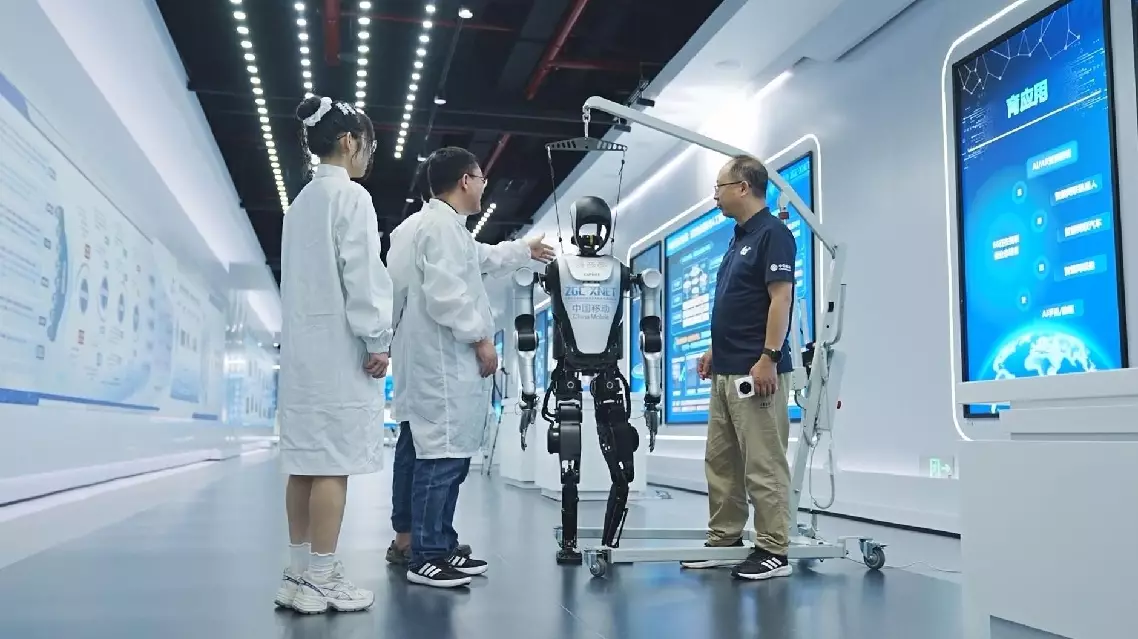
Chinese researchers use 6G to boost smart robots' real-world performance