SAN FRANCISCO & ANTWERP, Belgium--(BUSINESS WIRE)--Oct 1, 2026--
Apideck, the unified API provider for the finance and accounting industry, today announced the launch of its Embedded Finance Index, the first public, citable, quarterly benchmark of the companies and providers that make up the embedded finance market. The Embedded Finance Index outlines the relationships between embedded finance companies and vendors, showing who buys from whom. It covers 6,000+ fintech and embedded finance companies, 1,297 verified providers across 12 stack layers, 5,000+ pre-rendered company profiles, and roughly $252B in venture capital sitting behind the vendor base.
This press release features multimedia. View the full release here: https://www.businesswire.com/news/home/20261001997176/en/
Embedded payments represent a $185B B2B market opportunity, but the landscape has remained opaque until now. Existing market maps are built from the vendor side and reflect what providers want to sell. Apideck’s Embedded Finance Index i nverts the lens.
“Apideck has operated the Open Banking Tracker for eight years. It maps the global open banking ecosystem, tracking thousands of financial institutions and providers across dozens of jurisdictions, so you can see which companies sell what in the industry. What we didn't know was which companies buy from whom. The Embedded Finance Index answers that question,” said Apideck CEO and founder Gertjan de Wilde. “We published the gaps in our own data alongside the findings because a benchmark you cannot audit is not a benchmark. We’ve also ensured the Embedded Finance Report is agent-readable because that is how the next generation of fintech research will be consumed.”
Highlights from Apideck’s first quarterly Embedded Finance Index include:
Every entry in the Embedded Finance Index dataset is derived from public customer-side evidence: subprocessor lists, regulatory footers, trust pages, customer announcements, and 517 indexed articles from the Embedded Finance Review. Every vendor attribution links back to a source URL, every named provider is cross-referenced against the Open Banking Tracker directory, and evidence is graded across three tiers, with regulatory disclosures outranking press mentions, which outrank structural integration signals. Additionally, the entire Embedded Finance Index ships as plain-text Markdown, making it agent-readable and easy for LLMs to digest.
Access the Apideck Embedded Finance Index Press Kit here or visit Apideck.com to learn more.
About Apideck
Apideck is the unified API platform for B2B SaaS, with 200+ connectors across accounting ERP, CRM, HRIS, and commerce. The company serves customers including Airbnb, Zoom, BILL, and PTC. Apideck is a member of the OpenAPI Initiative, the first unified API company to join, and operates its own production MCP server. Apideck has operated Open Banking Tracker, the global directory of embedded finance, open banking, BaaS, and card-issuing providers since 2018, covering 54,000+ financial institutions across 30+ jurisdictions, and the Open Finance Map, which covers 80+ open finance and open banking regulatory frameworks worldwide.
Headquartered in Antwerp, with an additional office in San Francisco, Apideck is a privately held company backed by Airbridge Equity Partners and PMV. Follow Apideck on LinkedIn and X, or learn more at https://apideck.com.
APIDECK FREQUENTLY ASKED QUESTIONS
Who is Apideck, and what does the company do?
Apideck is a unified API platform for B2B SaaS, offering 200+ connectors across accounting, ERP, CRM, and HRIS so companies can ship integrations in weeks, not months. It also operates the Open Banking Tracker, the Open Finance Map, and now the Apideck Embedded Finance Index.
What is the Apideck Embedded Finance Index?
The Apideck Embedded Finance Index is the first public, citable, quarterly benchmark of the embedded finance market, covering 6,000+ companies and 1,297 verified providers across 12 stack layers. Unlike vendor-built market maps, it shows who buys from whom.
How big is the embedded finance market that Apideck’s Embedded Finance Index tracks?
Embedded payments represent a $185B B2B market opportunity, with roughly $252B in venture capital behind the vendor base.
What does the Index reveal about compliance transparency?
965 companies publicly name their sponsor bank, but only 345 name their KYC vendor and just 80 name their fraud-tooling vendor. Apideck notes this is the layer that has failed first in recent enforcement actions like Synapse and Evolve.
Which vendors lead each layer of the stack?
Stripe leads payment service providers with 595 disclosed buyers, Evolve Bank & Trust leads Banking-as-a-Service with 64, and Plaid leads financial data connectivity with 248, more than every other open banking aggregator combined.
Is the "global" Banking-as-a-Service market actually one market?
No, the top three BaaS providers in the US, UK, and EU show zero overlap, pointing to three separate regional oligopolies rather than one global market.
Is the Index built for AI agents to read?
Yes. Every entry in the Embedded Finance Index is sourced and graded across three evidence tiers, and the full Index ships as plain-text Markdown for LLM consumption. Apideck CEO and founder Gertjan de Wilde believes this will be central to how fintech research is consumed going forward.
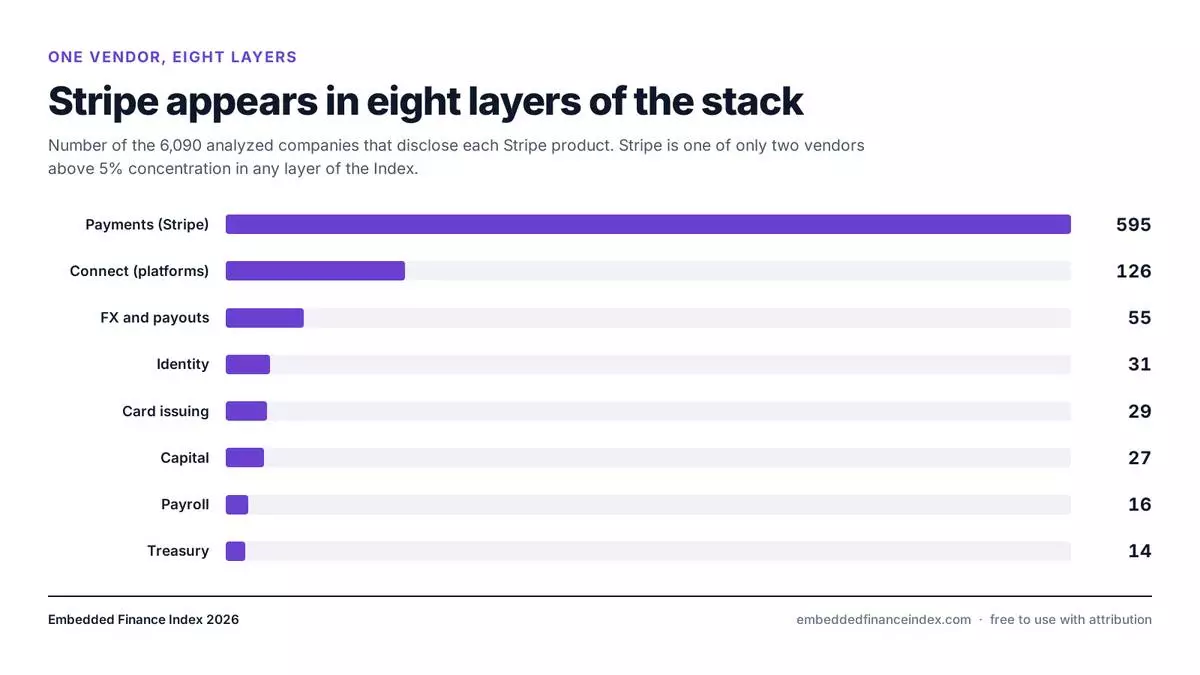
Apideck Embedded Finance Index: One Vendor, Eight Layers. Stripe appears in eight layers of the stack, including Payments (Stripe), Connect (platforms), FX and Payouts, Identity, Card Issuing, Capital, Payroll and Treasury. The chart shows how many of the 6,090 analyzed companies disclose each Stripe product. Stripe is one of only two vendors above 5% concentration in any layer of the Index.
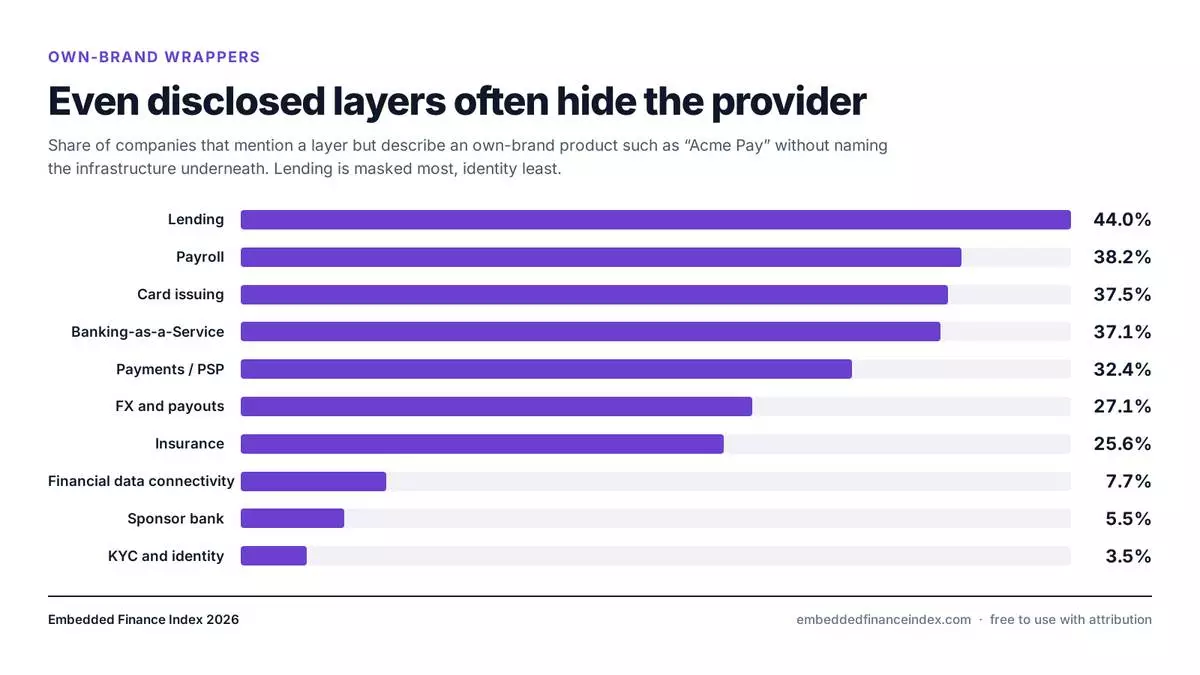
Apideck Embedded Finance Index: Disclosed layers include Lending, Payroll, Card Issuing, Banking-as-a-Service, Payments/PSP, FX and Payouts, Insurance, Financial Data Connectivity, Sponsor Bank, KYC and Identity. Even disclosed layers often hide the provider. The chart shows the share of companies that mention a layer but describe an own-brand product, such as "Acme Pay," without naming the underlying infrastructure. Lending is masked most, identity least.
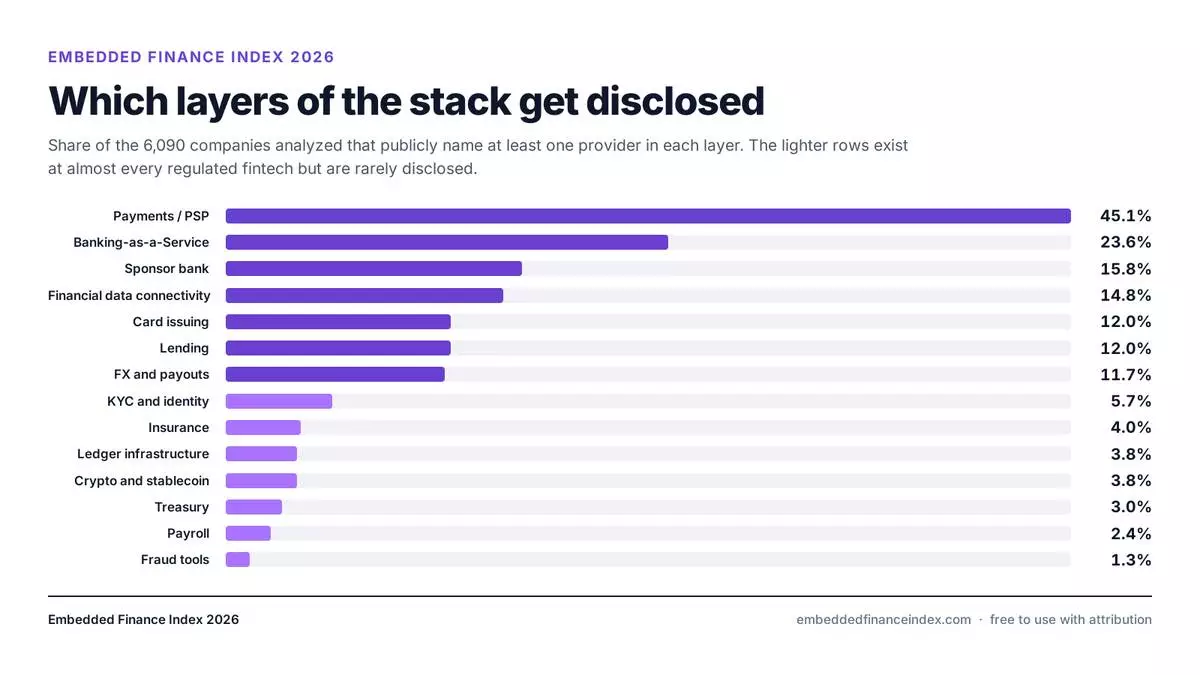
Apideck Embedded Finance Index: The layers of the stack that get disclosed, include Payments/PSP, Banking-as-a-Service, Sponsor Bank, Financial Data Connectivity, Card Issuing, Lending, FX and Payouts, KYC and Identity, Insurance, Ledger Infrastructure, Crypto and Stablecoin, Treasury, Payroll and Fraud Tools. The graph shows the share of the 6,090 companies analyzed that publicly name at least one provider in each layer. The lighter rows exist at almost every regulated fintech but are rarely disclosed.
A copilot stabbed his captain and attempted to crash a flight bound for Israel from the United Arab Emirates that was carrying 174 people. Passengers, most of them Israelis, feared for their lives as the FlyDubai aircraft lost half its altitude in about a minute.
The wounded pilot managed to open the cockpit door, and a passenger and a crew member rushed in to subdue the attacker, an Omani national. Other crew members gained control of the aircraft, which landed safely in Saudi Arabia on Wednesday.
It's still unclear what motivated the attack, which came just days before the anniversary of Hamas' Oct. 7, 2023, attack on Israel that triggered conflict across the Middle East. It has rekindled anxieties about airline security and focused attention on risks associated with flight crews.
Here’s what we know — and don’t know — about what happened on FlyDubai flight FZ1073:
The distress call came at 8:44 a.m. local time, about two and a half hours after the flight left Dubai, a futuristic hub of international business and tourism, heading to the Israeli city of Tel Aviv.
Officials later said that the copilot stabbed the pilot and tried to crash the aircraft.
The plane swiftly lost altitude — dropping from 33,000 feet to 17,000 feet (around 10,000 meters to 5,100 meters) in the span of about a minute. It then circled close to the Jordanian border before landing in Tabuk, Saudi Arabia, about an hour later.
A person who heard the flight’s communications with air traffic control said the plane was initially turned away by Saudi Arabia and Jordan before eventually landing in Tabuk, while passengers screamed in the background. The person who heard the communications spoke on condition of anonymity because they were not authorized to speak to the media.
Aviation experts said they were surprised that the plane did not crash after a descent so extreme that most of the rudder was ripped off the tail.
After landing at Tabuk's Prince Sultan bin Abdulaziz International Airport, Saudi authorities arrested the copilot. His motivations remain unknown.
A plane carrying passengers from the flight landed Wednesday evening in Israel.
The wounded pilot, Capt. Smit Machchhar, from the Indian city of Mumbai, has been praised for opening the cockpit door so that others could subdue the attacker and take control of the Boeing 737, pulling it out of a risky dive. Other crew members were able to fly the plane to a safe landing.
The cockpit door on all aircraft is locked during flight for security reasons — a measure that became the industry standard after the Sept. 11, 2001, attacks, in which hijackers broke into the cockpits of four domestic flights in the United States.
Israeli Prime Minister Benjamin Netanyahu said on X that the pilot's opening of the cockpit door had “enabled passengers and crew to overpower the attacker — preventing a catastrophic midair disaster.”
Indian Prime Minister Narendra Modi on Thursday called Machchhar a hero.
“In the face of the gravest danger and despite being seriously injured, he showed immense courage and an unwavering resolve to protect the lives of others,” Modi wrote on X.
Machchhar was taken to a hospital and was in stable condition, according to the Indian Embassy in Saudi Arabia.
One question is how anyone on the aircraft — especially a pilot — was able to get a knife onboard.
In an interview with the Fox News Channel’s Sean Hannity that aired Wednesday night, Netanyahu said the attacker might have hit the captain with an ax. Airlines are generally required to carry crash axes in the cockpit for use in an emergency to break open a window to escape or break open a panel to access a fire.
Pilots, like passengers, must pass through metal detectors at airports. It's also standard for airlines to check their pilots' background for criminal and employment history, and their physical and mental health, as well as having them undergo intelligence and security screening.
Israel has some of the most stringent airline security measures worldwide. Passengers on Israel-bound flights regularly are taken aside for questioning and baggage searches after passing through normal airport security. It's unclear whether the pilots of the FlyDubai flight had been screened as vigorously.
The UAE government said an investigation team had begun its work, adding that it has jurisdiction because the plane is registered there. It said UAE law applies to crimes committed on board, even outside its territory.
A regional official briefed on the investigation said the suspect, an Omani citizen, was under arrest. Netanyahu said the attacker had undergone radical Islamist indoctrination but did not provide further details. The suspect has not been publicly identified.
Israeli intelligence and security officials were in Saudi Arabia to help investigate the suspect, according to a regional official who spoke on condition of anonymity because they were not authorized to speak to the media. Israel has requested that the suspect be sent to Israel for the investigation, though it is unclear if that request will be granted, the official said.
Another regional official said the United States and Oman also were involved. The official did not describe the extent of Israeli involvement.
“All possible scenarios, from terrorism to mental disorders, are being looked into. Nothing is ruled out for now,” said the official, speaking on condition of anonymity to discuss the probe.
Associated Press writers David Rising in Bangkok, Thailand, Sheikh Saaliq in New Delhi, Melanie Lidman in Tel Aviv, Israel, and Samy Magdy in Cairo contributed to this report.

Israeli passengers who had been aboard a FlyDubai aircraft that made an emergency landing in Saudi Arabia are welcomed at the arrivals gate at Ben Gurion International Airport near Tel Aviv, Israel, Wednesday, Sept. 30, 2026. (AP Photo/Ohad Zwigenberg)

Passengers who experienced an emergency landing in Saudi Arabia, during a flight on FlyDubai plane, arrive at Ben Gurion International Airport, near Tel Aviv, Israel, Wednesday, Sept. 30, 2026. (AP Photo/Ariel Schalit)

Israeli passenger Yaniv Hayoun, with blood stains on his shirt, who was aboard a Flydubai aircraft that made an emergency landing in Saudi Arabia, is welcomed at the arrivals gate at Ben Gurion International Airport near Tel Aviv, Israel, Wednesday, Sept. 30, 2026. (AP Photo/Tomer Appelbaum)

Passengers embark on a FlyDubai aircraft at Ben Gurion International Airport, near Tel Aviv, Israel, Wednesday, Sept. 30, 2026. (AP Photo/Ariel Schalit)

Holding balloons people wait for the arrival of passengers at Ben Gurion International Airport, near Tel Aviv, Israel, Wednesday, Sept. 30, 2026. (AP Photo/Ariel Schalit)

A FlyDubai aircraft carrying Israelis who experienced an emergency landing in Saudi Arabia arrives at Ben Gurion International Airport, near Tel Aviv, Israel, Wednesday, Sept. 30, 2026. (AP Photo/Ariel Schalit)