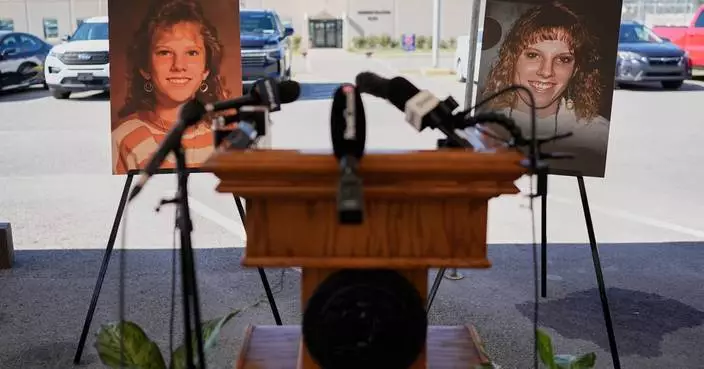
A woman who says she was gang-raped at a Cornell University fraternity told the school's investigators last year that she “felt like bait” as the attackers were “like lions around me,” according to records from the school’s disciplinary investigation.
The documents, reviewed Friday by The Associated Press, include excerpts of interviews Cornell's investigators did with the woman and the men she accused and shed more light on the university's handling of the case.
While heavily redacted, the records offer a fuller but sometimes conflicting timeline of events and a glimpse at how the men responded to the allegations. Some disputed the woman’s account and said they weren’t involved in any assault.
The woman, identified in court papers only as Jane Doe, sued Cornell and seven former students last month, alleging she was given ketamine and repeatedly assaulted at a fraternity house in October 2024.
She went to campus police three weeks after the encounter and gave a detailed account of what happened, but the local district attorney decided not to file criminal charges or push for more investigation after reviewing a police summary of her interview.
Only the school’s investigation, under the federal Title IX law, persisted, with a goal of deciding discipline for the students involved.
This week, a lawyer for one of the accused men filed documents from the school’s investigation in a lawsuit that seeks to overturn the university’s punishment and remove it from his academic record. They include a 99-page report on a campus hearing panel’s disciplinary findings and a summary of events submitted by the university's lawyers.
Though only a fraction of the thousands of pages amassed in the investigation, the records show the breadth of the university’s inquiry — including 50 interviews with 32 witnesses and 12 days of hearings.
Late Thursday, Gov. Kathy Hochul appointed Attorney General Letitia James as a special prosecutor to lead a renewed criminal investigation, saying she had lost faith in Tompkins County District Attorney Matthew Van Houten.
According to the Title IX documents filed in court, which are only a portion of the entire investigation, the woman and several of the men gave investigators similar accounts of drug use and sexual activity that took place at the Chi Phi fraternity house — but differed sharply in how much of it was consensual.
The woman had been invited there by a fraternity member for whom she had long held strong romantic feelings and sexual interest, according to the disciplinary panel’s findings. The panel found that she initially consented to sex with that man and one of his friends, though she later alleged in her lawsuit that she had been pressured into taking ketamine, marijuana and alcohol and was too intoxicated to consent.
Then other men began showing up in the room, some drawn by a message one of the fraternity brothers sent to a Snapchat group at 1:42 a.m. using a vulgar term to advertise that a woman's body was freely available. Later, another person in the chat asked if the “shop” was still open.
The woman told investigators that her intoxication had rendered her partly defenseless. She said she remembered smoking marijuana and said she knew she took ketamine, her first time doing so, but didn’t have an independent memory of it. The drug, she said, left her in a state of “vague consciousness."
“You look like an operating human being," she told school investigators at a hearing in May of 2025. "You don’t look dead or asleep necessarily. So, lights are on, but nobody’s home. Your brain is not functioning at its proper level.”
She said some of the men inhaled drugs off her unclothed body.
“I felt like bait. I felt like lions around me. It just was a totally debilitating place to be in," she told investigators.
One of the men the woman accused of snorting drugs off her body — but not participating in other elements of the assault — denied her account.
He told investigators he was in the room for no more than five minutes, and didn’t go there for sex.
“That was not our intentions at all. We were just checking out to see if everything” was OK, he said.
He insisted that he did not see the woman naked at any time — she was under bed coverings, he said — and did not partake in drug use. He said he sat on a couch and chatted for a few minutes, then left after the woman and another man there both indicated they were all right.
A Cornell disciplinary panel later cleared him of sexual assault or exploitation allegations, but found him responsible for attempted sexual exploitation because it didn't believe his claim to have gone to the room for altruistic reasons.
The fraternity member, who is challenging Cornell’s disciplinary process in court, also posted in the Snapchat conversation, saying what was happening in the room was not a joke, adding: “Firsthand pov not a bit.” The student later told investigators he did not remember sending the message, according to Cornell’s account.
In her lawsuit, Jane Doe accused two of the other men who entered the room of performing sex acts on her without her consent, while she was partially incapacitated. She accused another man of kissing her without her consent. According to the Title IX documents, Jane Doe told investigators two other men stood at the foot of the bed acting “more like voyeurs than anything."
The lawsuit seeks to hold all seven men liable for rape. She is asking for unspecified damages.
Cornell hasn’t detailed the results of its investigation, but said it resulted in some students being expelled.
The man who filed the lawsuit challenging his punishment was allowed to stay at Cornell, but he was ordered to stay away from the woman, take a class on sexual harassment and bystander intervention, and write a paper reflecting on the circumstances for which he was found responsible and include a proposal to train other students on preventing sexual harassment.
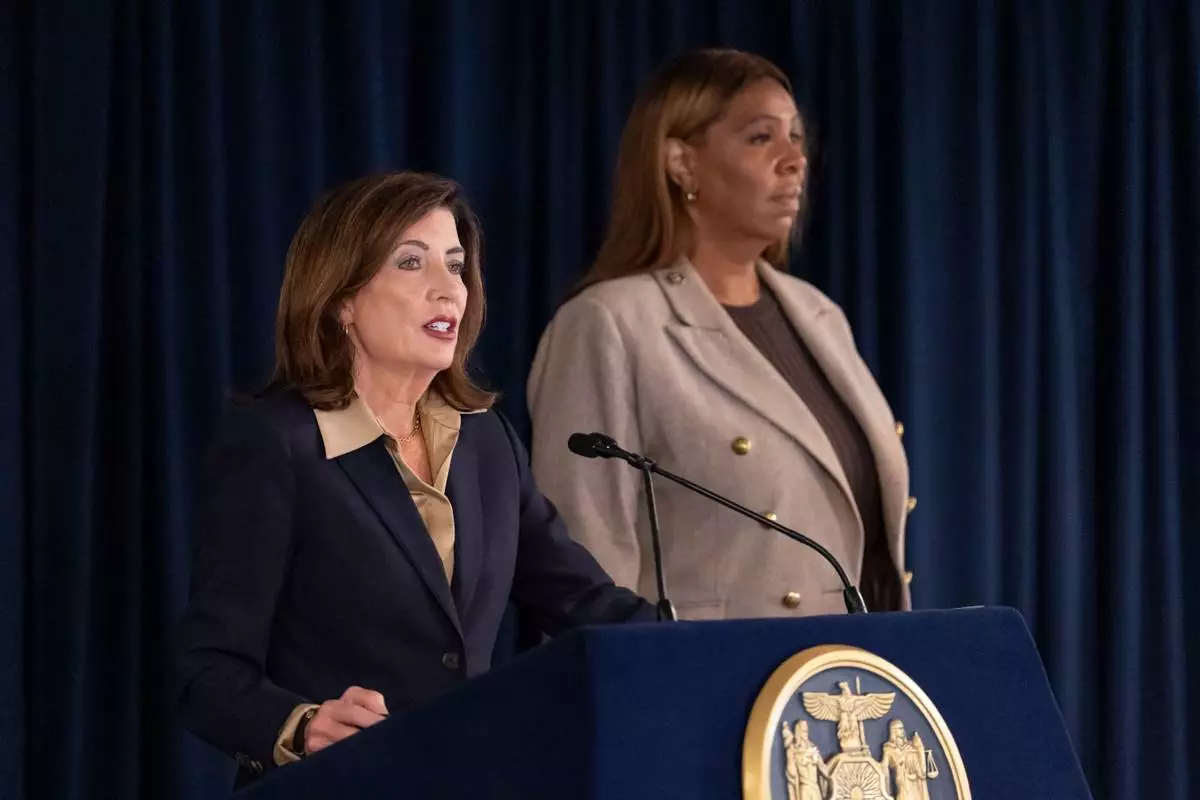
New York Governor Kathy Hochul speaks during a news conference with New York Attorney General Letitia James, Friday, Oct. 2, 2026, in New York. (AP Photo/Yuki Iwamura)

Shown is the the Chi Phi fraternity house at Cornell University in Ithaca, N.Y., Thursday, Oct. 1, 2026. (AP Photo/Matt Rourke)
The Indian airline captain who helped thwart an apparent attempt to crash a FlyDubai flight said in a live video call that he knew he had to get back on his feet to save passengers after being stabbed by his co-pilot.
Meanwhile, a Palestinian citizen of Israel who was running in Israel’s upcoming election is withdrawing his candidacy following comments about Hamas’ Oct. 7 attack on Israel.
Here is the latest news from the Middle East on Friday. Full coverage is available here.
The FlyDubai captain told Indian Prime Minister Narendra Modi that he knew he had to get back on his feet to save everyone on board, after he was stabbed by his co-pilot and the aircraft plunged into a steep descent.
“I had so many wounds. I had fallen down,” Capt. Smit Machchhar said from a hospital in Abu Dhabi. “I was fighting for my life. At one point I realized that if I didn’t get up … then passengers would lose their lives.”
Machchhar was seriously injured in Wednesday’s attack but managed to open the cockpit door, allowing passengers to enter and restrain the attacker as the Boeing 737 descended sharply, witnesses and Israeli authorities said.
The flight from Dubai to Tel Aviv, with 182 people on board, was diverted to Tabuk in northwestern Saudi Arabia for an emergency landing.
Israeli Prime Minister Benjamin Netanyahu said the attacker, an Omani national, was arrested in Saudi Arabia. His motive for the attack was not immediately clear.
The first repatriation flight left the UAE shortly before 11 p.m. and landed in Tel Aviv just after 1 a.m., according to the Ben Gurion International Airport website.
— More coverage on the attempt to crash the plane is available here.
In the Strait of Hormuz, a tanker was struck by an “unknown projectile” while transiting outbound through the waterway, the British military said Friday, adding that the attack caused a “small fire and blackout onboard.” There were no reported casualties, the United Kingdom Maritime Trade Operations Center (UKMTO) said. The fire was extinguished and the tanker continued its transit.
UKMTO did not identify the tanker and there was no immediate claim of responsibility for the attack. Four tankers have recently been hit by projectiles in the critical waterway, bringing the total to five with Friday’s incident, UKMTO said.
Overall ship traffic remains below prewar levels in the Strait of Hormuz, as do shipments of energy products, even though Iran has lost its near-complete chokehold over the crucial waterway thanks to the U.S. Navy's efforts to shepherd oil tankers through the strait. That, along with various pipelines, has allowed Gulf countries to restore oil exports to nearly prewar levels.
Three Israeli strikes in Gaza City and central Gaza killed three people and wounded at least one other on Friday, according to health officials at Gaza’s hospitals.
Two strikes in Gaza City killed one person each, while another strike in central Gaza killed a third, officials said.
Israel’s military acknowledged carrying out the strikes, saying that it was hitting militants in those areas, without elaborating.
In Yemen, intense fighting engulfed a residential area in Taiz City as clashes between the Iran-backed Houthis and Saudi-backed government forces raised concerns over a worsening humanitarian situation.
The World Food Program warned that renewed fighting in Yemen is worsening an already dire humanitarian situation in a country suffering from severe hunger.
WFP director Matthew Hollingworth said that almost three out of four households are unable to meet their basic food needs.
Shelling Friday by the Houthis on the residential neighborhood of Wadi al-Qadi in Taiz City injured several people, according to an Associated Press reporter in the city.
Separately, Saudi Arabia said Friday that it intercepted three ballistic missiles, launched by the Houthis, over the city of Khamis Mushait. The statement, by Saudi spokesman Gen. Turki al-Maliki, did not specify when the attacks occurred or report any immediate damage. A fourth projectile, also blamed on Houthi rebels, fell on a school in the city of Najran, causing material damage, Saudi Civil Defense said. No injuries have been reported.
In Israel, the chairman of the left-wing Balad party said he would withdraw from Israel’s upcoming election after the country’s Supreme Court president said a majority of justices were prepared to uphold his disqualification.
Sami Abou Shehadeh’s candidacy was challenged over an editorial he wrote in the newspaper Al-Araby al-Jadeed the day after Hamas’ Oct. 7 attack on Israel. The article did not condemn Hamas and argued that it was surprising violence hadn’t erupted earlier given conditions in Gaza.
In a subsequent article, Abou Shehadeh, a former member of Israel’s Knesset, called Hamas’ attack both unacceptable and a crime. He said he hadn’t known the scale of the violence when he wrote the first article.
The court weighed whether his remarks violated an Israeli law barring candidates who reject Israel’s existence, incite racism or support armed struggle against Israel. His lawyers said that barring him would reinterpret the law and create a new threshold.
About 20% of Israel's citizens are of Palestinian descent.
Israeli soldiers have barred Palestinian farmers and activists from harvesting olives in the northern West Bank, according to video footage obtained by The Associated Press.
The footage showed soldiers firing shots in the air and tear gas toward the Palestinian farmers and activists, while settlers were also seen in the area.
Israel's military said troops were deployed following reports of a confrontation, which was dispersed. It added that a security official at the scene fired shots into the air earlier, without elaborating. The military said no one was injured.
The olive harvest season in the West Bank is usually marred by tensions between Palestinian farmers and settlers. Israel has imposed new rules this year, prohibiting Palestinians from harvesting in what’s known as Area C, which is under Israeli security control and encompasses the majority of the territory’s agricultural lands.
An earlier version of this story mistakenly said that a fourth projectile reported by Saudi Arabia Friday was not attributed to anyone in particular; it was blamed on Houthi rebels.
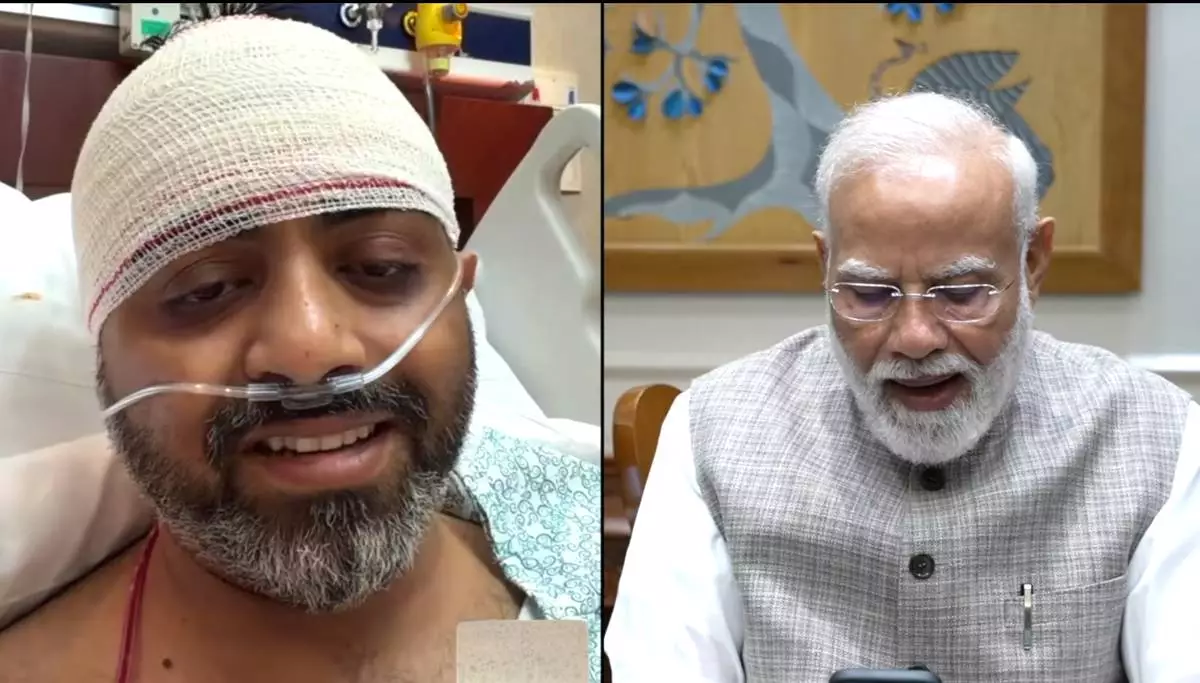
This screengrab from Narendra Modi YouTube Channel shows Indian Prime Minister Narendra Modi speaking with FlyDubai pilot Capt. Smit Machchhar on Friday, Oct. 2, 2026. (Narendra Modi YouTube Channel via AP )