China's largest desert oil field has produced more than 26 million tonnes of oil and gas from reservoirs more than 6,000 meters underground, according to China National Petroleum Corporation (CNPC) on Monday.
The output was recorded at the Hade-Fuman oil field, located on the northern edge of the Taklimakan Desert in northwest China's Xinjiang Uygur Autonomous Region.
Recently, oil workers successfully retrieved core samples from a depth of 8,080 meters from the Zhentan-1 well at the field. The rocks had remained underground for about 500 million years.
This marks the first time China has retrieved a core from more than 8,000 meters in the northwestern Tarim Basin, providing valuable geological data for exploring ultra-deep oil and gas resources.
"With these valuable rocks, we can analyze and evaluate the generative capacity of oil and gas below 8,000 meters, the thickness of the oil and gas reservoirs, and the maturity level of the oil and gas," said Xu Yanan, director of the project department of CNPC Tarim Oilfield Branch.
Over the years, the Tarim Oilfield has sped up the development of ultra-deep oil and gas resources beneath the Taklimakan Desert.
A total of 485 ultra-deep wells have been drilled at the Hade-Fuman oil field. Among them, 133 oil wells have each produced more than 100,000 tonnes of oil and gas, while 464 have each produced more than 10,000 tonnes.
The development has made the Hade-Fuman oil field China's largest desert oil field and a major base for ultra-deep oil and gas production.
"We have extracted 20.36 million tonnes of crude oil and 8.15 billion cubic meters of natural gas from the ultra-deep strata in the Taklamakan Desert. The oil and gas equivalent exceeds 26.86 million tonnes. The 17,000-square-kilometer expanse of sand has been transformed into a hot spot for oil and gas exploration and development," said Lu Zhongyuan, engineer of CNPC Tarim Oilfield Branch.
The Tarim Basin is a major potential source of growth in China's oil and gas reserves and production. Proven oil and gas reserves in the basin exceed 5 billion tonnes, with more than half found in ultra-deep formations.
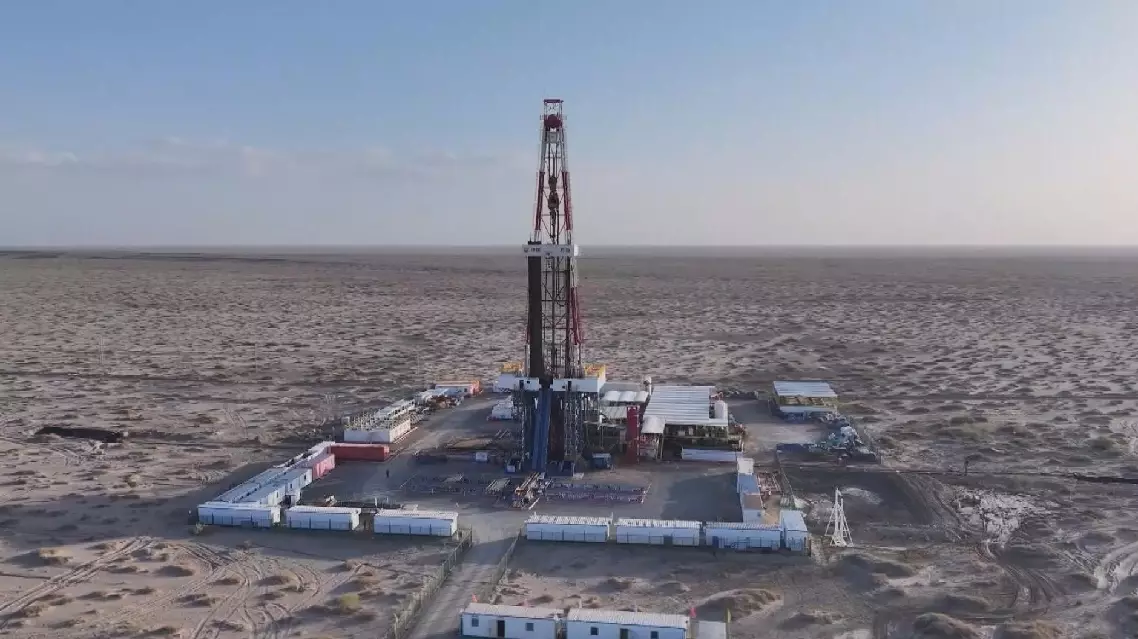
China's desert oil field produces over 26 mln tonnes of oil, gas
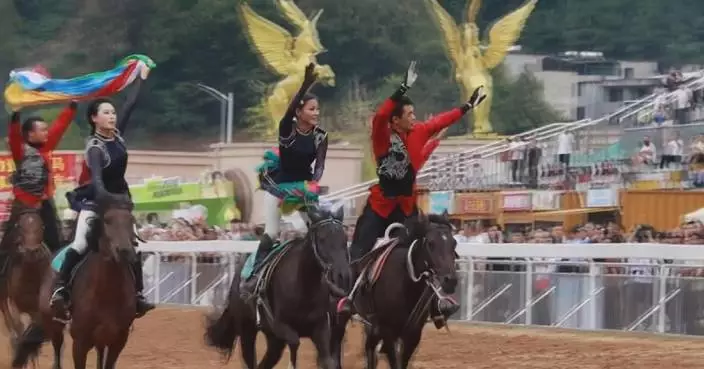
The first national traditional horseback archery competition has drawn riders from across China and abroad to Inner Mongolia in the north during the National Day holiday from Oct 1-7, as the sport is now listed for the 2030 Doha Asian Games.
The event, which kicked off last Thursday in the border city of Erenhot and ran through the week-long National Day holiday. The competition comprises three major tournaments: the inaugural National Mongolian Horse Super League, the National Mounted Archery Tour, and the Erenhot International Masters Tournament.
Together, they drew more than 150 domestic riders from 22 provincial-level regions, alongside 139 competitors from 23 countries and regions, competing across five major disciplines: horseback archery, endurance racing, horse racing relay, horse racing, and trick riding.
The mounted archery event requires competitors to nock arrows and draw bows while their horses gallop at top speed, hitting targets within seconds amid intense motion.
"This is my first time participating in such a large-scale international competition. I feel it quite rewarding to be able to perform near my usual level under such intense competitive pressure," said Sun Fu'an, a Chinese rider.
International players also shared their impressions of the grassland.
"It's very exotic. I've never been to China before. And here, Inner Mongolia is really beautiful with an exceptionally vast expanse of land. It's not at all what I'm used to at home. I'm very happy to be here," said Manon Depas, a Belgian competitor.
Having secured a spot as a competition event at the 2030 Doha Asian Games, mounted archery is emerging as a growing segment in equestrian sports.
At present, China has over 100 mounted archery clubs and 22 standardized training bases. The country's archery competition system is also improving.
"The traditional and cultural traditions from China are really appreciated there. So we in IHAA, we promote and develop this traditional sport to bring up to ... our goal is to make it Olympic," said Alan Le Gall, president of the International Horseback Archery Alliance.
The tournaments also serve a practical purpose for livestock development, organizers said.
"We need suitable competitions, tailored specifically for domestic horses and Mongolian horses, to showcase their significance and value," said Wu Gangfang, president of the horse culture sports committee under the China Ethnic Sports Association.
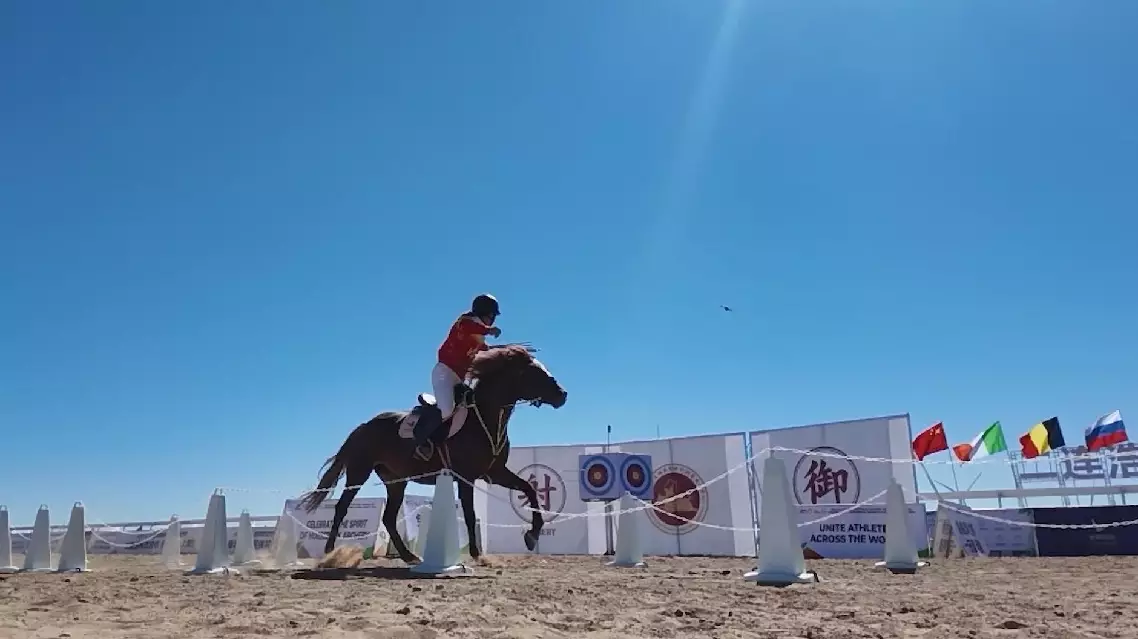
China's first traditional horseback archery competition draws global riders to Inner Mongolia