Factories in Ningbo, one of China's leading manufacturing hubs, are installing rooftop photovoltaic panels to cope with surging power demand under China's "Six Networks" initiative, a move that has driven an infrastructure upgrade to the local grid system.
China is mulling multi-trillion-yuan investment through the "Six Networks" initiative, as the country works to expand domestic demand and stabilize economic growth amid external uncertainties and lingering domestic supply-demand imbalances.
The "Six Networks" refer to water networks, new-type power grids, computing power networks, next-generation communication networks, urban underground pipeline networks and logistics networks.
At a manufacturing base in Ningbo, smart production lines are running at full capacity, with part of the electricity supplied by the base's rooftop photovoltaic panels. To date, Ningbo's rooftop photovoltaic panels would cover an area equivalent to 5,000 standard football fields if put together, with an installed capacity exceeding 10 million kilowatts.
Rooftop photovoltaic panels not only help address the base's power demand, it also brings extra income to the base, its business head said.
"The company can save over 10 million yuan (around 1.49 million U.S. dollars) in energy costs every year. The surplus electricity can be supplied to the grid to generate revenue. It's like building another production line for the company on the rooftop," said Ma Ji, business head of Ningbo FOTILE Kitchen Ware Co., Ltd.
But when massive numbers of photovoltaic panels are connected to the grid, how should it respond to this "stress test"? The Ningbo Power Supply Command Center faced this challenge.
"In the past, electricity was sent from our power plants to every household. It was a 'single lane'. But now, with so many photovoltaic panels on rooftops, each like a small power plant, feeding electricity into the grid, it needs to become a 'double lane'. Our lines simply cannot handle it," said Lu Zhiming, director of the Power Supply Service Command Center, State Grid Ningbo Power Supply Company.
Ningbo's challenge is also a challenge for the construction of new-type power grids across the country. Currently, new energy installed capacity is growing by about 200 million kilowatts annually on average, urgently requiring a stronger new-type power grid that allows clean electricity to be generated, transmitted and used reliably.
Recently, State Grid technicians have been installing a set of devices on poles and towers in the streets and alleys, turning invisible information such as photovoltaic output, power flow and line load into an intuitive map of tidal energy. Researchers have loaded massive meteorological data into the power dispatch system, using future sunlight and temperature forecasts to calculate in advance the changes in photovoltaic power generation.
"Through using this model, we have improved our forecast accuracy to over 96 percent. It has transformed our grid dispatch mode from passive response to proactive prediction and control, giving us much more confidence," said Cai Zhenhua, a level-4 expert at the Power Dispatch Center, State Grid Ningbo Power Supply Company.
This exploration makes large-scale newly connected new energy more predictable, dispatchable and controllable.
China's 15th Five-Year Plan, covering the period from 2026 to 2030, addresses the upgrading of traditional forms of infrastructure and the development of new ones. These infrastructure networks are coordinated, mutually reinforcing, and essential for daily life, guaranteeing stable power, faster connectivity, water security, safe and clean cities, and efficient deliveries.
The country's cutting-edge infrastructure coordination mechanisms are already delivering results. Along the Pinglu Canal and at Ningbo-Zhoushan Port, water transport, logistics, and digital networks are being advanced together to expand capacity, improve flood control, and raise efficiency. And China's computing hubs, power grids and computing networks are continuously sharing data to better match supply with demand.
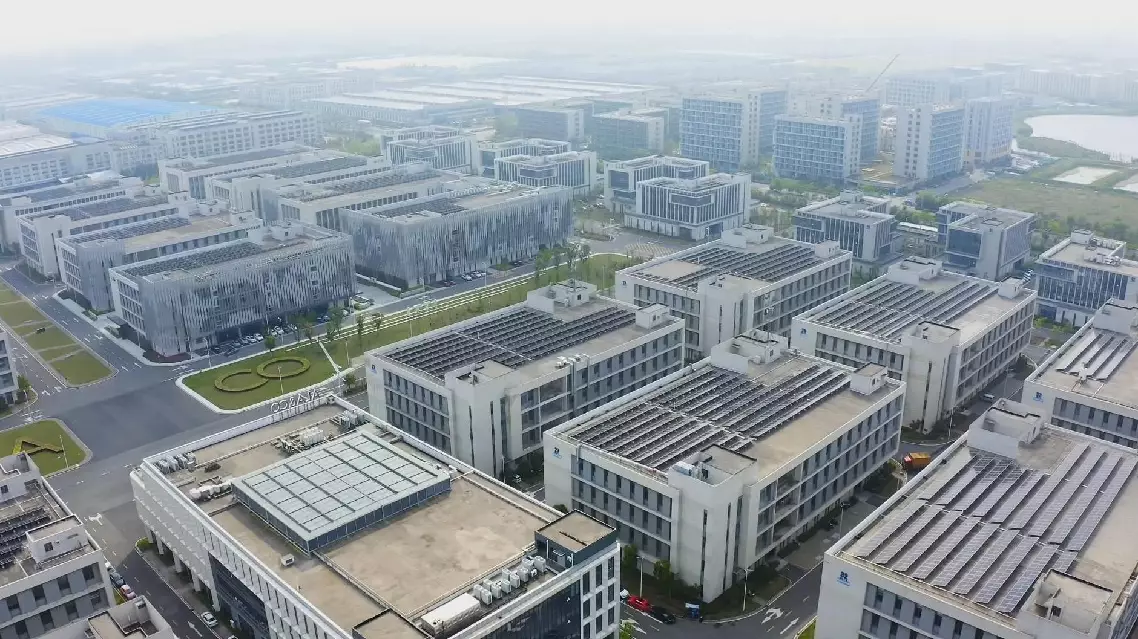
Ningbo's "rooftop solar boom" drives State Grid's infrastructure upgrade