China and the United States cannot resolve all their differences at once, but they can first manage the most urgent risks and on that basis gradually solidify consensus, according to a commentary piece published on Thursday by Yuyuantantian, a media arm of the China Media Group (CMG).
An edited translation of the commentary is as follows:
There are many channels for dialogue between China and the U.S. around AI governance this year, including the United Nations, G20, APEC and the Track II Dialogue which brings together Chinese and American technical experts and policy researchers. Consensus formed at the professional level can be shaped through dialogue and ultimately confirmed at the decision-making level in each country.
During Chinese President Xi Jinping's state visit to the United States in late September, China and the United States agreed to establish a communication channel for AI-related incidents.
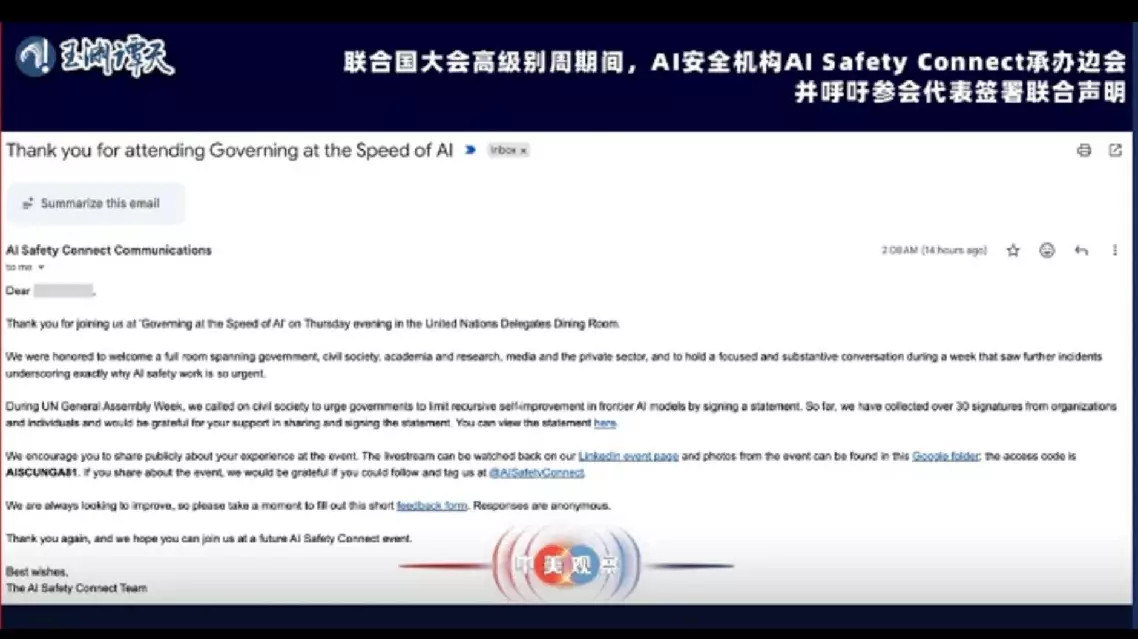
Cyrus Hodes and Nicolas Miailhe, two co-founders of AI Safety Connect, an AI safety institution with close ties to the United Nations, told Yuyuantantian that they had worked for a long time to establish this communication channel.
They said seeing it reach the global stage is "a positive step," but only the first step, and they are now discussing with Chinese and U.S. counterparts how to build an incident reporting mechanism, so that AI laboratories in both countries can communicate with each other, while also coordinating with their governments.
More issues are now moving toward tangible results. One is preventing the most dangerous capabilities of AI from being misused, including ensuring that the technology is not used by terrorist organizations.
Xiao Qian, Deputy Director of the Center for International Security and Strategy (CISS) at Tsinghua University and a core figure in the China-U.S. Senior-Level Track Two Dialogue, said that establishing a communication channel for AI incidents and AI misuse prevention serves China's interests. Several policy researchers at U.S. AI safety institutions have also called for greater communication around these two issues.
Despite the development of communications around AI between China and the U.S., some basic issues present real challenges.
Zhu Yan, a Chinese researcher, said one such issue is terminology. In English, "safety" and "security" are different concepts, while in Chinese both concepts are expressed with one word.
Differences in AI risk classification methods also see both sides treating "major risks" differently. U.S. AI researchers are mainly concerned about whether AI could bring about the destruction of human society, while researchers in China are more concerned about specific risks arising from AI in practical use.
Katarina Slama, a former engineer at U.S. tech firm OpenAI, said that in early AI training, humans gave feedback on AI responses to guide AI toward understanding human intent. Later, she said, this process was replaced by having AI give feedback to AI. As a result, aligning AI's thinking with human goals has become much harder, she concluded.
The U.S. side also wants to know whether Chinese enterprises, experts, and ordinary people are concerned that one day AI might go out of control or even turn around and control humans. They asked many such questions during the China-U.S. Senior-Level Track Two Dialogue, but different positions were seen from the two sides.
There are practical reasons behind this cognitive gap.
Even though Chinese large language models have a place in the world, Chinese participation in the European and American AI safety communities is insufficient. But the problem is that, even when no Chinese personnel or Chinese enterprises are present, discussions on AI governance cannot avoid China-related issues.
This points to a more fundamental question about rule making around AI. China and the U.S. are two leading AI powers and should have corresponding powers in rules and standard setting.
The possibility of China-U.S. cooperation is now more advanced than it was months ago. The policy window has opened, and both sides have the will, but the key is how to make it happen.
Therefore, the two sides first need to reach common understandings before taking specific actions.
The two sides need to discuss AI risk classification and grading standards. They should first clarify the definition of major AI risks and model behaviors that constitute serious loss of control.
Second, the two sides need to finalize the scope, process, and requirements for reporting AI risk incidents.
Once incidents such as model loss of control or escape occur, both sides need to grasp the situation immediately and judge the risk level, understand the patterns of risk evolution, and manage AI.
In addition, both sides should place AI governance within a broader framework of China-U.S. exchange.
AI discussions should fully involve China and allow more countries' voices to be heard. Models may affect public safety, and deepfakes may impact social trust. These consequences will ultimately be borne by society as a whole.
California State Senator Jerry McNerney told Yuyuantantian that advancing cooperation at the U.S. federal level may be slower, but California can pilot first, build mutual trust and an institutional framework, and then gradually expand outward.
After all, the competition between China and the U.S. around AI may continue, but ensuring that AI is used for good and benefits all humanity is the greatest common interest among the countries in the field of AI.
On AI cooperation, China, US should manage most urgent risks first: commentary